 Add to Chrome
 Add to Firefox
 Add to Edge
Memory by Design: Probabilistic Sequence Layers
May 29, 2026
We introduce the design-model framework: a way to derive efficient recurrent sequence maps from explicit assumptions about memory. A design model writes evidence into memory by exact Bayesian filtering; a query-dependent readout produces a predictive distribution whose mean is the layer output. In our linear-Gaussian instantiation, the \emph{Bayesian Layer} propagates both a mean and a covariance: the covariance tracks uncertainty over stored associations, steering writes toward uncertain directions, attenuating gains as evidence accumulates, and preserving confident memories. The same framework unifies several sub-quadratic recurrences. Linear attention, GLA, and Mamba-2/SSD are exact filters under one design model, whereas DeltaNet and related Delta-rule models arise as covariance-reset reductions under another. Restoring the covariance yields closed-form predictions for retrieval dynamics, verified empirically, and improves robustness beyond the training regime across controlled collision studies, learned associative recall, and the Zoology MQAR benchmark; distilling Bayesian Layers into a pretrained 340M Gated DeltaNet improves RULER long-context retrieval at matched compute.

Meta-Dynamical State Space Models for Integrative Neural Data Analysis
Oct 07, 2024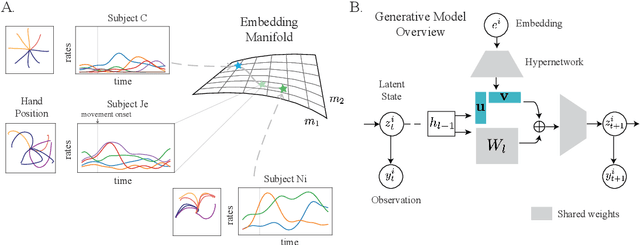

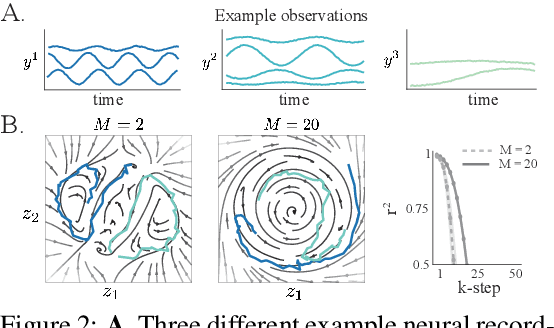

Learning shared structure across environments facilitates rapid learning and adaptive behavior in neural systems. This has been widely demonstrated and applied in machine learning to train models that are capable of generalizing to novel settings. However, there has been limited work exploiting the shared structure in neural activity during similar tasks for learning latent dynamics from neural recordings. Existing approaches are designed to infer dynamics from a single dataset and cannot be readily adapted to account for statistical heterogeneities across recordings. In this work, we hypothesize that similar tasks admit a corresponding family of related solutions and propose a novel approach for meta-learning this solution space from task-related neural activity of trained animals. Specifically, we capture the variabilities across recordings on a low-dimensional manifold which concisely parametrizes this family of dynamics, thereby facilitating rapid learning of latent dynamics given new recordings. We demonstrate the efficacy of our approach on few-shot reconstruction and forecasting of synthetic dynamical systems, and neural recordings from the motor cortex during different arm reaching tasks.