 Add to Chrome
 Add to Firefox
 Add to Edge
ArtBoost: Synthetic Articulatory Data Augmentation for Acoustic-to-Articulatory Inversion
Jun 15, 2026
Recent acoustic-to-articulatory inversion (AAI) models rely on electromagnetic articulography (EMA) data, which are costly and limited in scale. To address this limitation, we propose \textit{ArtBoost}, a novel data augmentation strategy that leverages large-scale speech--mesh datasets originally developed for speech-driven 3D facial animation to improve AAI under limited EMA supervision. \textit{ArtBoost} extracts pseudo articulatory trajectories from visible facial anchors and uses them for pre-training before fine-tuning on real EMA data. Experiments show consistent improvements in PCC and RMSE. Trajectory analyses confirm that the pseudo articulatory signals reflect physically meaningful visible articulatory dynamics. Additional evaluations across different AAI architectures demonstrate stable performance gains, indicating that \textit{ArtBoost} can be integrated into diverse AAI models. These results suggest that speech--mesh data provide an effective and scalable source of articulatory supervision for AAI. Project page: https://cau-irislab.github.io/Interspeech26-ArtBoost/

MemoryTalker: Personalized Speech-Driven 3D Facial Animation via Audio-Guided Stylization
Jul 28, 2025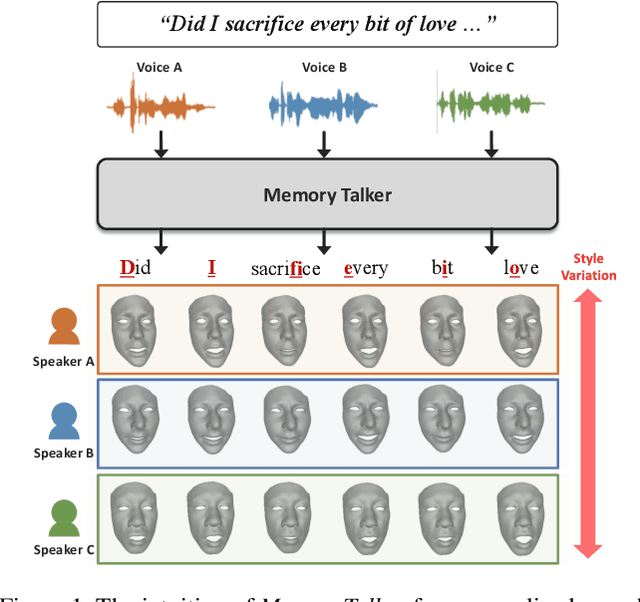
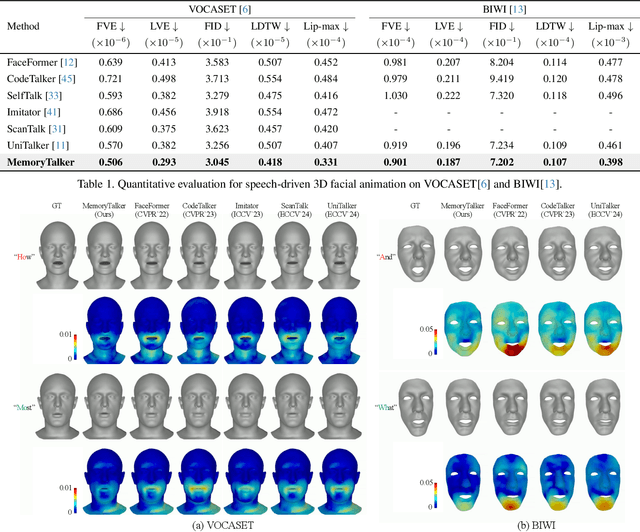
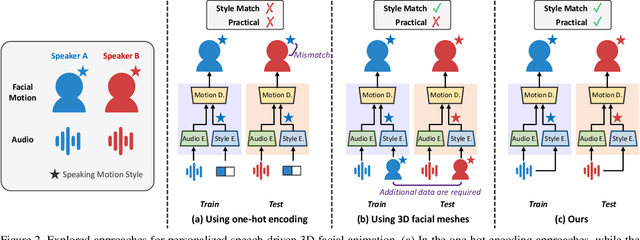
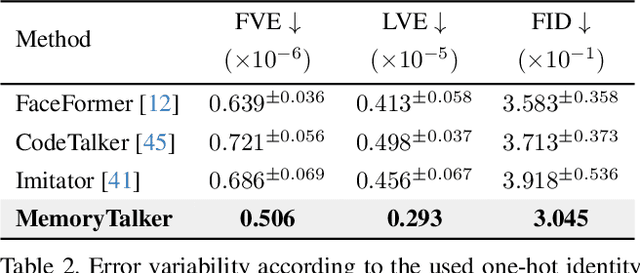
Speech-driven 3D facial animation aims to synthesize realistic facial motion sequences from given audio, matching the speaker's speaking style. However, previous works often require priors such as class labels of a speaker or additional 3D facial meshes at inference, which makes them fail to reflect the speaking style and limits their practical use. To address these issues, we propose MemoryTalker which enables realistic and accurate 3D facial motion synthesis by reflecting speaking style only with audio input to maximize usability in applications. Our framework consists of two training stages: 1-stage is storing and retrieving general motion (i.e., Memorizing), and 2-stage is to perform the personalized facial motion synthesis (i.e., Animating) with the motion memory stylized by the audio-driven speaking style feature. In this second stage, our model learns about which facial motion types should be emphasized for a particular piece of audio. As a result, our MemoryTalker can generate a reliable personalized facial animation without additional prior information. With quantitative and qualitative evaluations, as well as user study, we show the effectiveness of our model and its performance enhancement for personalized facial animation over state-of-the-art methods.
Learning Phonetic Context-Dependent Viseme for Enhancing Speech-Driven 3D Facial Animation
Jul 28, 2025Speech-driven 3D facial animation aims to generate realistic facial movements synchronized with audio. Traditional methods primarily minimize reconstruction loss by aligning each frame with ground-truth. However, this frame-wise approach often fails to capture the continuity of facial motion, leading to jittery and unnatural outputs due to coarticulation. To address this, we propose a novel phonetic context-aware loss, which explicitly models the influence of phonetic context on viseme transitions. By incorporating a viseme coarticulation weight, we assign adaptive importance to facial movements based on their dynamic changes over time, ensuring smoother and perceptually consistent animations. Extensive experiments demonstrate that replacing the conventional reconstruction loss with ours improves both quantitative metrics and visual quality. It highlights the importance of explicitly modeling phonetic context-dependent visemes in synthesizing natural speech-driven 3D facial animation. Project page: https://cau-irislab.github.io/interspeech25/