 Add to Chrome
 Add to Firefox
 Add to Edge
Enhancing Continual Learning of Vision-Language Models via Dynamic Prefix Weighting
Apr 20, 2026
We investigate recently introduced domain-class incremental learning scenarios for vision-language models (VLMs). Recent works address this challenge using parameter-efficient methods, such as prefix-tuning or adapters, which facilitate model adaptation to downstream tasks by incorporating task-specific information into input tokens through additive vectors. However, previous approaches often normalize the weights of these vectors, disregarding the fact that different input tokens require different degrees of adjustment. To overcome this issue, we propose Dynamic Prefix Weighting (DPW), a framework that dynamically assigns weights to prefixes, complemented by adapters. DPW consists of 1) a gating module that adjusts the weights of each prefix based on the importance of the corresponding input token, and 2) a weighting mechanism that derives adapter output weights as a residual of prefix-tuning weights, ensuring that adapters are utilized only when necessary. Experimental results demonstrate that our method achieves state-of-the-art performance in domain-class incremental learning scenarios for VLMs. The code is available at: https://github.com/YonseiML/dpw.

Rethinking Open-World Semi-Supervised Learning: Distribution Mismatch and Inductive Inference
May 31, 2024
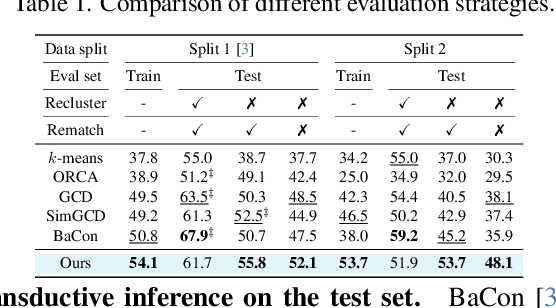
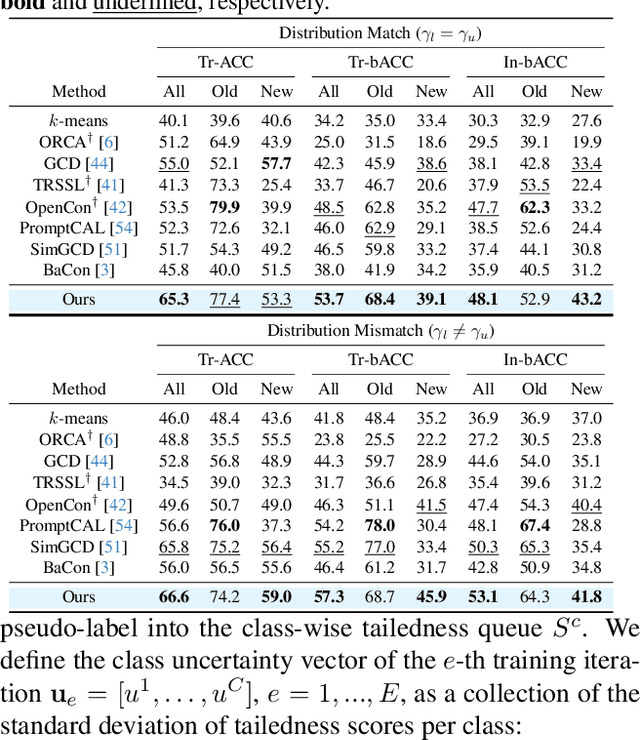
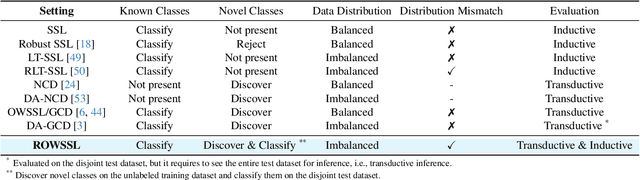
Open-world semi-supervised learning (OWSSL) extends conventional semi-supervised learning to open-world scenarios by taking account of novel categories in unlabeled datasets. Despite the recent advancements in OWSSL, the success often relies on the assumptions that 1) labeled and unlabeled datasets share the same balanced class prior distribution, which does not generally hold in real-world applications, and 2) unlabeled training datasets are utilized for evaluation, where such transductive inference might not adequately address challenges in the wild. In this paper, we aim to generalize OWSSL by addressing them. Our work suggests that practical OWSSL may require different training settings, evaluation methods, and learning strategies compared to those prevalent in the existing literature.