 Add to Chrome
 Add to Firefox
 Add to Edge
SynSym: A Synthetic Data Generation Framework for Psychiatric Symptom Identification
Mar 23, 2026
Psychiatric symptom identification on social media aims to infer fine-grained mental health symptoms from user-generated posts, allowing a detailed understanding of users' mental states. However, the construction of large-scale symptom-level datasets remains challenging due to the resource-intensive nature of expert labeling and the lack of standardized annotation guidelines, which in turn limits the generalizability of models to identify diverse symptom expressions from user-generated text. To address these issues, we propose SynSym, a synthetic data generation framework for constructing generalizable datasets for symptom identification. Leveraging large language models (LLMs), SynSym constructs high-quality training samples by (1) expanding each symptom into sub-concepts to enhance the diversity of generated expressions, (2) producing synthetic expressions that reflect psychiatric symptoms in diverse linguistic styles, and (3) composing realistic multi-symptom expressions, informed by clinical co-occurrence patterns. We validate SynSym on three benchmark datasets covering different styles of depressive symptom expression. Experimental results demonstrate that models trained solely on the synthetic data generated by SynSym perform comparably to those trained on real data, and benefit further from additional fine-tuning with real data. These findings underscore the potential of synthetic data as an alternative resource to real-world annotations in psychiatric symptom modeling, and SynSym serves as a practical framework for generating clinically relevant and realistic symptom expressions.

A Dual-Prompting for Interpretable Mental Health Language Models
Feb 20, 2024Despite the increasing demand for AI-based mental health monitoring tools, their practical utility for clinicians is limited by the lack of interpretability.The CLPsych 2024 Shared Task (Chim et al., 2024) aims to enhance the interpretability of Large Language Models (LLMs), particularly in mental health analysis, by providing evidence of suicidality through linguistic content. We propose a dual-prompting approach: (i) Knowledge-aware evidence extraction by leveraging the expert identity and a suicide dictionary with a mental health-specific LLM; and (ii) Evidence summarization by employing an LLM-based consistency evaluator. Comprehensive experiments demonstrate the effectiveness of combining domain-specific information, revealing performance improvements and the approach's potential to aid clinicians in assessing mental state progression.
Learning Co-Speech Gesture for Multimodal Aphasia Type Detection
Oct 20, 2023Aphasia, a language disorder resulting from brain damage, requires accurate identification of specific aphasia types, such as Broca's and Wernicke's aphasia, for effective treatment. However, little attention has been paid to developing methods to detect different types of aphasia. Recognizing the importance of analyzing co-speech gestures for distinguish aphasia types, we propose a multimodal graph neural network for aphasia type detection using speech and corresponding gesture patterns. By learning the correlation between the speech and gesture modalities for each aphasia type, our model can generate textual representations sensitive to gesture information, leading to accurate aphasia type detection. Extensive experiments demonstrate the superiority of our approach over existing methods, achieving state-of-the-art results (F1 84.2\%). We also show that gesture features outperform acoustic features, highlighting the significance of gesture expression in detecting aphasia types. We provide the codes for reproducibility purposes.
Towards Suicide Prevention from Bipolar Disorder with Temporal Symptom-Aware Multitask Learning
Jul 03, 2023
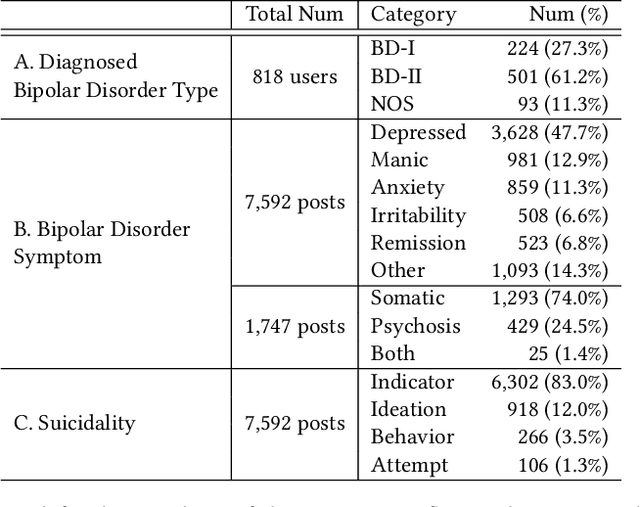


Bipolar disorder (BD) is closely associated with an increased risk of suicide. However, while the prior work has revealed valuable insight into understanding the behavior of BD patients on social media, little attention has been paid to developing a model that can predict the future suicidality of a BD patient. Therefore, this study proposes a multi-task learning model for predicting the future suicidality of BD patients by jointly learning current symptoms. We build a novel BD dataset clinically validated by psychiatrists, including 14 years of posts on bipolar-related subreddits written by 818 BD patients, along with the annotations of future suicidality and BD symptoms. We also suggest a temporal symptom-aware attention mechanism to determine which symptoms are the most influential for predicting future suicidality over time through a sequence of BD posts. Our experiments demonstrate that the proposed model outperforms the state-of-the-art models in both BD symptom identification and future suicidality prediction tasks. In addition, the proposed temporal symptom-aware attention provides interpretable attention weights, helping clinicians to apprehend BD patients more comprehensively and to provide timely intervention by tracking mental state progression.
* KDD 2023 accepted