 Add to Chrome
 Add to Firefox
 Add to Edge
Humans vs Vision-Language Models: A Unified Measure of Narrative Coherence
Mar 26, 2026
We study narrative coherence in visually grounded stories by comparing human-written narratives with those generated by vision-language models (VLMs) on the Visual Writing Prompts corpus. Using a set of metrics that capture different aspects of narrative coherence, including coreference, discourse relation types, topic continuity, character persistence, and multimodal character grounding, we compute a narrative coherence score. We find that VLMs show broadly similar coherence profiles that differ systematically from those of humans. In addition, differences for individual measures are often subtle, but they become clearer when considered jointly. Overall, our results indicate that, despite human-like surface fluency, model narratives exhibit systematic differences from those of humans in how they organise discourse across a visually grounded story. Our code is available at https://github.com/GU-CLASP/coherence-driven-humans.

Predicting Sentence Acceptability Judgments in Multimodal Contexts
Feb 24, 2026Previous work has examined the capacity of deep neural networks (DNNs), particularly transformers, to predict human sentence acceptability judgments, both independently of context, and in document contexts. We consider the effect of prior exposure to visual images (i.e., visual context) on these judgments for humans and large language models (LLMs). Our results suggest that, in contrast to textual context, visual images appear to have little if any impact on human acceptability ratings. However, LLMs display the compression effect seen in previous work on human judgments in document contexts. Different sorts of LLMs are able to predict human acceptability judgments to a high degree of accuracy, but in general, their performance is slightly better when visual contexts are removed. Moreover, the distribution of LLM judgments varies among models, with Qwen resembling human patterns, and others diverging from them. LLM-generated predictions on sentence acceptability are highly correlated with their normalised log probabilities in general. However, the correlations decrease when visual contexts are present, suggesting that a higher gap exists between the internal representations of LLMs and their generated predictions in the presence of visual contexts. Our experimental work suggests interesting points of similarity and of difference between human and LLM processing of sentences in multimodal contexts.
Generalizable Sarcasm Detection Is Just Around The Corner, Of Course!
Apr 10, 2024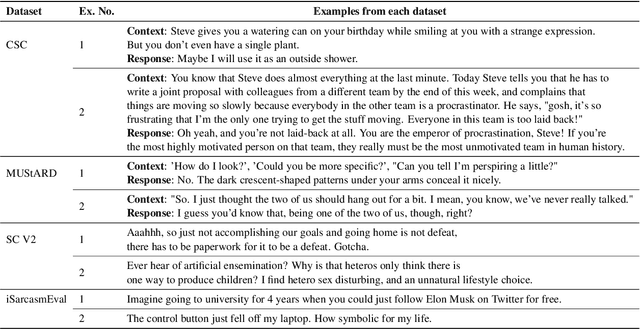
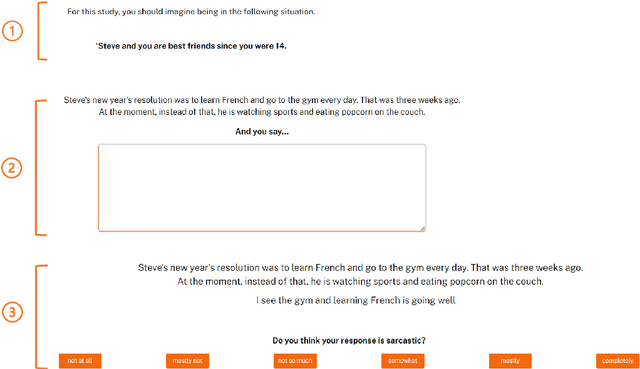
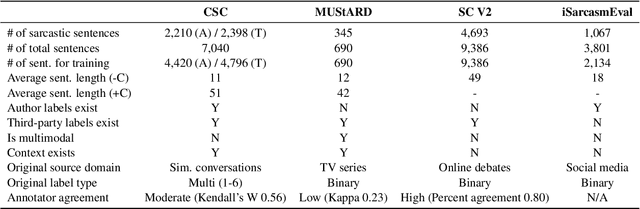
We tested the robustness of sarcasm detection models by examining their behavior when fine-tuned on four sarcasm datasets containing varying characteristics of sarcasm: label source (authors vs. third-party), domain (social media/online vs. offline conversations/dialogues), style (aggressive vs. humorous mocking). We tested their prediction performance on the same dataset (intra-dataset) and across different datasets (cross-dataset). For intra-dataset predictions, models consistently performed better when fine-tuned with third-party labels rather than with author labels. For cross-dataset predictions, most models failed to generalize well to the other datasets, implying that one type of dataset cannot represent all sorts of sarcasm with different styles and domains. Compared to the existing datasets, models fine-tuned on the new dataset we release in this work showed the highest generalizability to other datasets. With a manual inspection of the datasets and post-hoc analysis, we attributed the difficulty in generalization to the fact that sarcasm actually comes in different domains and styles. We argue that future sarcasm research should take the broad scope of sarcasm into account.