 Add to Chrome
 Add to Firefox
 Add to Edge
BiPO: Bidirectional Partial Occlusion Network for Text-to-Motion Synthesis
Nov 28, 2024
Generating natural and expressive human motions from textual descriptions is challenging due to the complexity of coordinating full-body dynamics and capturing nuanced motion patterns over extended sequences that accurately reflect the given text. To address this, we introduce BiPO, Bidirectional Partial Occlusion Network for Text-to-Motion Synthesis, a novel model that enhances text-to-motion synthesis by integrating part-based generation with a bidirectional autoregressive architecture. This integration allows BiPO to consider both past and future contexts during generation while enhancing detailed control over individual body parts without requiring ground-truth motion length. To relax the interdependency among body parts caused by the integration, we devise the Partial Occlusion technique, which probabilistically occludes the certain motion part information during training. In our comprehensive experiments, BiPO achieves state-of-the-art performance on the HumanML3D dataset, outperforming recent methods such as ParCo, MoMask, and BAMM in terms of FID scores and overall motion quality. Notably, BiPO excels not only in the text-to-motion generation task but also in motion editing tasks that synthesize motion based on partially generated motion sequences and textual descriptions. These results reveal the BiPO's effectiveness in advancing text-to-motion synthesis and its potential for practical applications.

Holo-VQVAE: VQ-VAE for phase-only holograms
Mar 29, 2024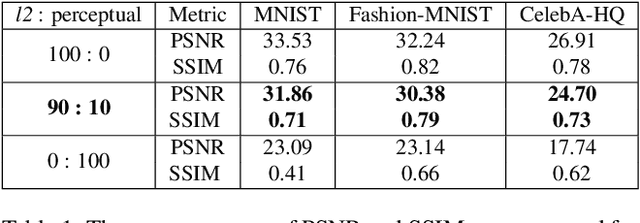

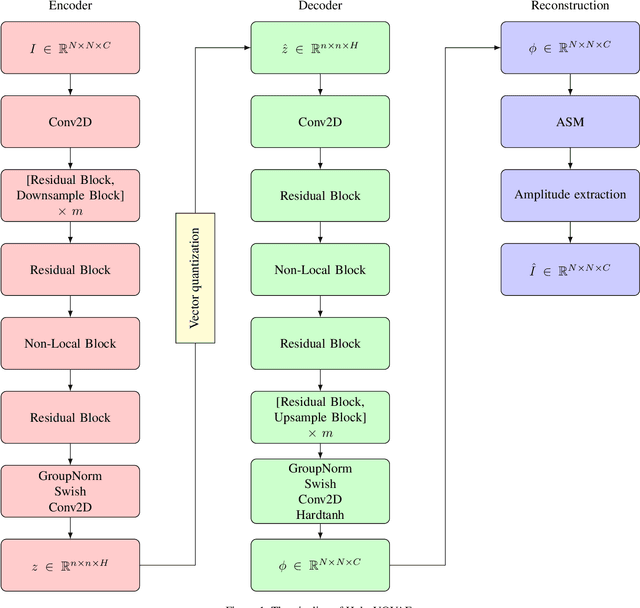
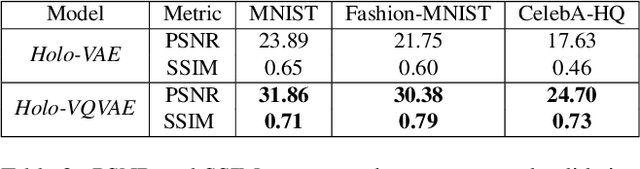
Holography stands at the forefront of visual technology innovation, offering immersive, three-dimensional visualizations through the manipulation of light wave amplitude and phase. Contemporary research in hologram generation has predominantly focused on image-to-hologram conversion, producing holograms from existing images. These approaches, while effective, inherently limit the scope of innovation and creativity in hologram generation. In response to this limitation, we present Holo-VQVAE, a novel generative framework tailored for phase-only holograms (POHs). Holo-VQVAE leverages the architecture of Vector Quantized Variational AutoEncoders, enabling it to learn the complex distributions of POHs. Furthermore, it integrates the Angular Spectrum Method into the training process, facilitating learning in the image domain. This framework allows for the generation of unseen, diverse holographic content directly from its intricately learned latent space without requiring pre-existing images. This pioneering work paves the way for groundbreaking applications and methodologies in holographic content creation, opening a new era in the exploration of holographic content.