 Add to Chrome
 Add to Firefox
 Add to Edge
Heterogeneous Vision-Language Ensemble with Disagreement-Aware Reranking for Text-Based Person Anomaly Retrieval
Aug 13, 2026
Text-based person anomaly retrieval aims to retrieve pedestrians exhibiting anomalous behaviors from a large image gallery using natural language descriptions. Compared with conventional text-based person retrieval, this task requires fine-grained reasoning over pedestrian appearance, behaviors, object interactions, and scene context, making robust cross-modal matching significantly more challenging. This paper presents the GENAI4E team's solution to AI City Challenge 2026 Track 4. Our framework builds upon a strong retrieval backbone and progressively integrates heterogeneous vision-language embedding models through score alignment and iterative ensemble fusion, followed by disagreement-aware VLM reranking for ambiguous queries. On the official Pedestrian Anomaly Behavior (PAB) benchmark, our approach achieves 90.92% mAP, 85.13% Recall@1, 97.72% Recall@5, and 98.68% Recall@10, demonstrating the effectiveness of combining complementary vision-language representations with selective multimodal reasoning for large-scale text-based person anomaly retrieval.

MADTempo: An Interactive System for Multi-Event Temporal Video Retrieval with Query Augmentation
Dec 15, 2025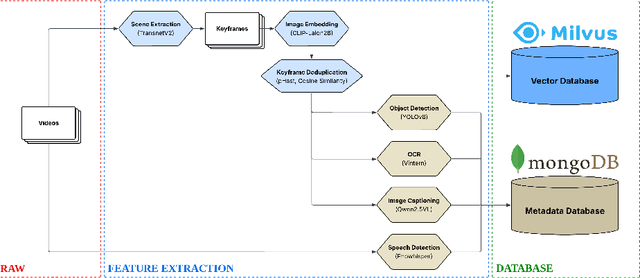
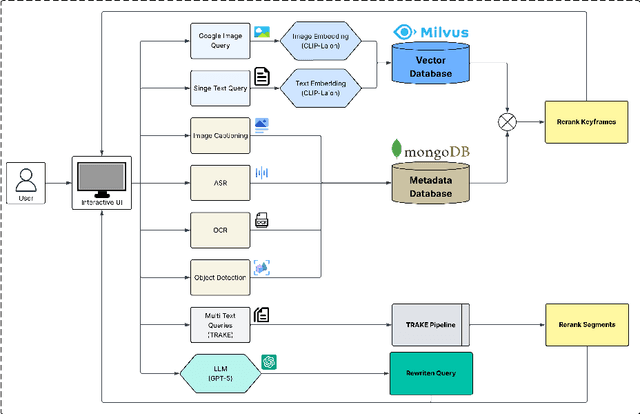
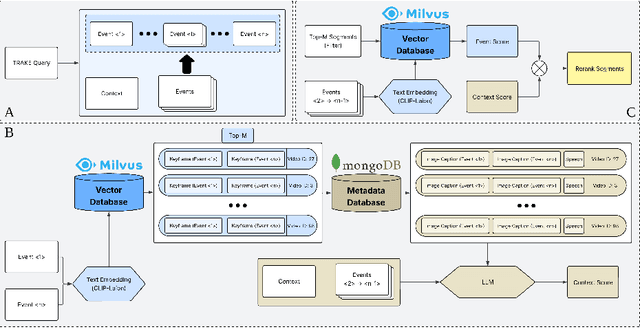
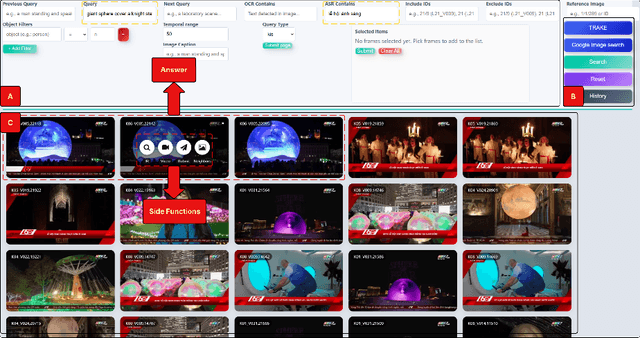
The rapid expansion of video content across online platforms has accelerated the need for retrieval systems capable of understanding not only isolated visual moments but also the temporal structure of complex events. Existing approaches often fall short in modeling temporal dependencies across multiple events and in handling queries that reference unseen or rare visual concepts. To address these challenges, we introduce MADTempo, a video retrieval framework developed by our team, AIO_Trinh, that unifies temporal search with web-scale visual grounding. Our temporal search mechanism captures event-level continuity by aggregating similarity scores across sequential video segments, enabling coherent retrieval of multi-event queries. Complementarily, a Google Image Search-based fallback module expands query representations with external web imagery, effectively bridging gaps in pretrained visual embeddings and improving robustness against out-of-distribution (OOD) queries. Together, these components advance the temporal reasoning and generalization capabilities of modern video retrieval systems, paving the way for more semantically aware and adaptive retrieval across large-scale video corpora.