 Add to Chrome
 Add to Firefox
 Add to Edge
Multi-Dimensional Behavioral Evaluation of Agentic Stock Prediction Systems Using LLM Judges with Closed-Loop Reinforcement Learning Feedback
May 07, 2026
Agentic stock prediction systems make sequences of interdependent decisions (regime detection, pathway routing, reinforcement learning control) whose individual quality is hidden by aggregate metrics such as mean absolute percentage error (MAPE) or directional accuracy. We present a behavioral evaluation framework that addresses this gap. Behavioral traces logged at every autonomous decision point are grouped into five-day episodes and scored along six domain-specific dimensions (regime detection, routing, adaptation, risk calibration, strategy coherence, error recovery) by an ensemble of three large language model (LLM) judges (GPT 5.4, Claude 4.6 Opus, Gemini 3.1 Pro). Perturbation-based validation on 420 episodes yields targeted score drops of $-1.6$ to $-2.4$ on intended dimensions versus an average of $-0.32$ on the remaining five, with cross-model agreement up to Krippendorff's $α= 0.85$. The composite behavioral score, used here only for cross-episode reporting, correlates at $ρ= 0.72$ with realized 20-day Sharpe ratio from offline backtesting. Closing the loop, the framework converts deficient per-dimension scores into a credit-assigned penalty term added to the Soft Actor-Critic (SAC) reward. Three short fine-tuning cycles, all confined to the validation period, produce on the held-out 2017-2025 test period a one-day MAPE reduction from 0.61% to 0.54% (an 11.5% relative reduction; $p<0.001$, Cohen's $d=0.31$), a directional accuracy increase from 71% to 74%, and an 18% Sharpe ratio improvement (95% bootstrap CI [8.2%, 27.4%]), with gains concentrated in high-volatility episodes where the original system was most behaviorally deficient. Results are from offline backtesting and do not address effects specific to live deployment.

Adaptive Regime-Aware Stock Price Prediction Using Autoencoder-Gated Dual Node Transformers with Reinforcement Learning Control
Mar 19, 2026Stock markets exhibit regime-dependent behavior where prediction models optimized for stable conditions often fail during volatile periods. Existing approaches typically treat all market states uniformly or require manual regime labeling, which is expensive and quickly becomes stale as market dynamics evolve. This paper introduces an adaptive prediction framework that adaptively identifies deviations from normal market conditions and routes data through specialized prediction pathways. The architecture consists of three components: (1) an autoencoder trained on normal market conditions that identifies anomalous regimes through reconstruction error, (2) dual node transformer networks specialized for stable and event-driven market conditions respectively, and (3) a Soft Actor-Critic reinforcement learning controller that adaptively tunes the regime detection threshold and pathway blending weights based on prediction performance feedback. The reinforcement learning component enables the system to learn adaptive regime boundaries, defining anomalies as market states where standard prediction approaches fail. Experiments on 20 S&P 500 stocks spanning 1982 to 2025 demonstrate that the proposed framework achieves 0.68% MAPE for one-day predictions without the reinforcement controller and 0.59% MAPE with the full adaptive system, compared to 0.80% for the baseline integrated node transformer. Directional accuracy reaches 72% with the complete framework. The system maintains robust performance during high-volatility periods, with MAPE below 0.85% when baseline models exceed 1.5%. Ablation studies confirm that each component contributes meaningfully: autoencoder routing accounts for 36% relative MAPE degradation upon removal, followed by the SAC controller at 15% and the dual-path architecture at 7%.
Manifold-Matching Autoencoders
Mar 17, 2026We study a simple unsupervised regularization scheme for autoencoders called Manifold-Matching (MMAE): we align the pairwise distances in the latent space to those of the input data space by minimizing mean squared error. Because alignment occurs on pairwise distances rather than coordinates, it can also be extended to a lower-dimensional representation of the data, adding flexibility to the method. We find that this regularization outperforms similar methods on metrics based on preservation of nearest-neighbor distances and persistent homology-based measures. We also observe that MMAE provides a scalable approximation of Multi-Dimensional Scaling (MDS).
Socially Aware Synthetic Data Generation for Suicidal Ideation Detection Using Large Language Models
Jan 25, 2024Suicidal ideation detection is a vital research area that holds great potential for improving mental health support systems. However, the sensitivity surrounding suicide-related data poses challenges in accessing large-scale, annotated datasets necessary for training effective machine learning models. To address this limitation, we introduce an innovative strategy that leverages the capabilities of generative AI models, such as ChatGPT, Flan-T5, and Llama, to create synthetic data for suicidal ideation detection. Our data generation approach is grounded in social factors extracted from psychology literature and aims to ensure coverage of essential information related to suicidal ideation. In our study, we benchmarked against state-of-the-art NLP classification models, specifically, those centered around the BERT family structures. When trained on the real-world dataset, UMD, these conventional models tend to yield F1-scores ranging from 0.75 to 0.87. Our synthetic data-driven method, informed by social factors, offers consistent F1-scores of 0.82 for both models, suggesting that the richness of topics in synthetic data can bridge the performance gap across different model complexities. Most impressively, when we combined a mere 30% of the UMD dataset with our synthetic data, we witnessed a substantial increase in performance, achieving an F1-score of 0.88 on the UMD test set. Such results underscore the cost-effectiveness and potential of our approach in confronting major challenges in the field, such as data scarcity and the quest for diversity in data representation.
ChatGPT for Suicide Risk Assessment on Social Media: Quantitative Evaluation of Model Performance, Potentials and Limitations
Jun 15, 2023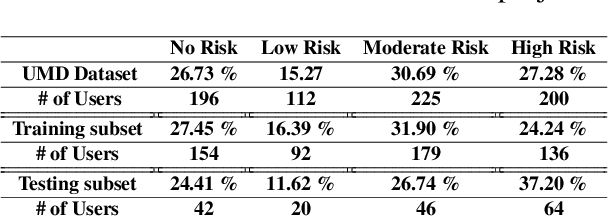
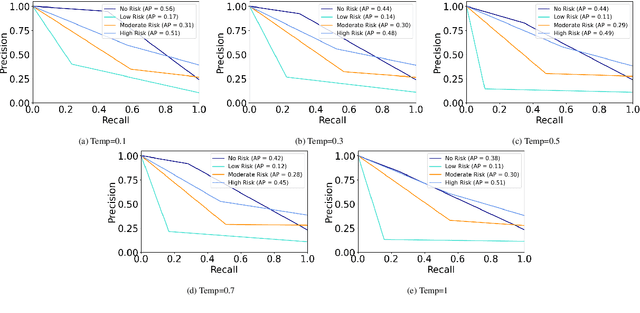
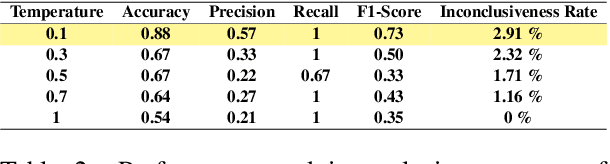
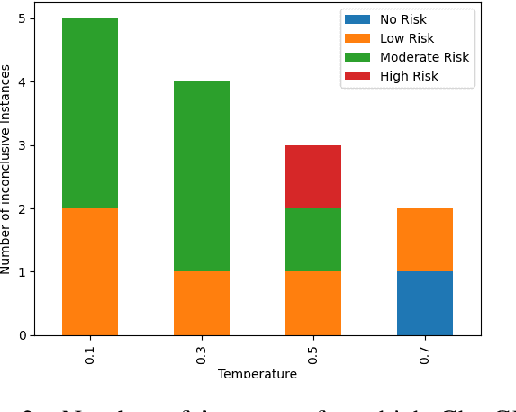
This paper presents a novel framework for quantitatively evaluating the interactive ChatGPT model in the context of suicidality assessment from social media posts, utilizing the University of Maryland Reddit suicidality dataset. We conduct a technical evaluation of ChatGPT's performance on this task using Zero-Shot and Few-Shot experiments and compare its results with those of two fine-tuned transformer-based models. Additionally, we investigate the impact of different temperature parameters on ChatGPT's response generation and discuss the optimal temperature based on the inconclusiveness rate of ChatGPT. Our results indicate that while ChatGPT attains considerable accuracy in this task, transformer-based models fine-tuned on human-annotated datasets exhibit superior performance. Moreover, our analysis sheds light on how adjusting the ChatGPT's hyperparameters can improve its ability to assist mental health professionals in this critical task.