 Add to Chrome
 Add to Firefox
 Add to Edge
Thinking Deeper, Not Longer: Depth-Recurrent Transformers for Compositional Generalization
Mar 23, 2026
Standard Transformers have a fixed computational depth, fundamentally limiting their ability to generalize to tasks requiring variable-depth reasoning, such as multi-hop graph traversal or nested logic. We propose a depth-recurrent Transformer that decouples computational depth from parameter count by iteratively applying a shared-weight Transformer block in latent space -- enabling the model to trade recurrence steps for deeper reasoning at inference time. Our architecture incorporates three mechanisms to make deep recurrence (20+ steps) stable: (1) a silent thinking objective that supervises only the final output, forcing genuine multi-step reasoning rather than intermediate heuristic shortcuts; (2) LayerScale initialization to protect fragile reasoning states from untrained layer noise; and (3) an identity-biased recurrence that creates a gradient highway across many steps. We evaluate on three compositional reasoning domains with decreasing inductive biases: graph reachability (strict adjacency masking), nested boolean logic (relative positioning), and unstructured relational text (where sequence position provides no structural hints). Across all tasks, we observe a clear \emph{computational frontier} -- a boundary where performance transitions from chance to near-perfect as thinking steps scale with task complexity. Moreover, these tasks reveal qualitatively different generalization behaviors: precise but brittle (graph), approximate but robust (logic), and autonomous latent routing without structural hints (text). This progression illuminates how the interplay between a task-invariant recurrent reasoning core and task-specific perceptual interfaces shapes out-of-distribution (OOD) generalization, offering a mechanistic perspective on vertical chain-of-thought that complements the prevailing horizontal token-generation paradigm.

Structure-Preserving Graph Contrastive Learning for Mathematical Information Retrieval
Mar 09, 2026This paper introduces Variable Substitution as a domain-specific graph augmentation technique for graph contrastive learning (GCL) in the context of searching for mathematical formulas. Standard GCL augmentation techniques often distort the semantic meaning of mathematical formulas, particularly for small and highly structured graphs. Variable Substitution, on the other hand, preserves the core algebraic relationships and formula structure. To demonstrate the effectiveness of our technique, we apply it to a classic GCL-based retrieval model. Experiments show that this straightforward approach significantly improves retrieval performance compared to generic augmentation strategies. We release the code on GitHub.\footnote{https://github.com/lazywulf/formula_ret_aug}.
NoRA: Breaking the Linear Ceiling of Low-Rank Adaptation via Manifold Expansion
Feb 26, 2026Low-Rank Adaptation (LoRA) dominates parameter-efficient fine-tuning (PEFT). However, it faces a critical ``linear ceiling'' in complex reasoning tasks: simply increasing the rank yields diminishing returns due to intrinsic linear constraints. We introduce NoRA (Non-linear Rank Adaptation), a weight-level parallel adapter that injects SiLU gating and structural dropout to induce manifold expansion. On the SlimOrca benchmark, NoRA breaks this linear barrier: NoRA remarkably at rank 64 (PPL 3.89) outperforms LoRA at rank 512 (PPL 3.90), demonstrating superior spectral efficiency. This advantage generalizes to mathematical reasoning, where NoRA achieves a perplexity of 1.97 on MathInstruct, significantly surpassing LoRA's saturation point of 2.07. Mechanism analysis via Singular Value Decomposition (SVD) confirms that NoRA activates the dormant tail of the singular value spectrum, effectively preventing the rank collapse observed in linear methods.
From Volumes to Slices: Computationally Efficient Contrastive Learning for Sequential Abdominal CT Analysis
Jan 21, 2026The requirement for expert annotations limits the effectiveness of deep learning for medical image analysis. Although 3D self-supervised methods like volume contrast learning (VoCo) are powerful and partially address the labeling scarcity issue, their high computational cost and memory consumption are barriers. We propose 2D-VoCo, an efficient adaptation of the VoCo framework for slice-level self-supervised pre-training that learns spatial-semantic features from unlabeled 2D CT slices via contrastive learning. The pre-trained CNN backbone is then integrated into a CNN-LSTM architecture to classify multi-organ injuries. In the RSNA 2023 Abdominal Trauma dataset, 2D-VoCo pre-training significantly improves mAP, precision, recall, and RSNA score over training from scratch. Our framework provides a practical method to reduce the dependency on labeled data and enhance model performance in clinical CT analysis. We release the code for reproducibility. https://github.com/tkz05/2D-VoCo-CT-Classifier
GraphFusionSBR: Denoising Multi-Channel Graphs for Session-Based Recommendation
Jan 13, 2026Session-based recommendation systems must capture implicit user intents from sessions. However, existing models suffer from issues such as item interaction dominance and noisy sessions. We propose a multi-channel recommendation model, including a knowledge graph channel, a session hypergraph channel, and a session line graph channel, to capture information from multiple sources. Our model adaptively removes redundant edges in the knowledge graph channel to reduce noise. Knowledge graph representations cooperate with hypergraph representations for prediction to alleviate item dominance. We also generate in-session attention for denoising. Finally, we maximize mutual information between the hypergraph and line graph channels as an auxiliary task. Experiments demonstrate that our method enhances the accuracy of various recommendations, including e-commerce and multimedia recommendations. We release the code on GitHub for reproducibility.\footnote{https://github.com/hohehohe0509/DSR-HK}
From Structured Prompts to Open Narratives: Measuring Gender Bias in LLMs Through Open-Ended Storytelling
Mar 20, 2025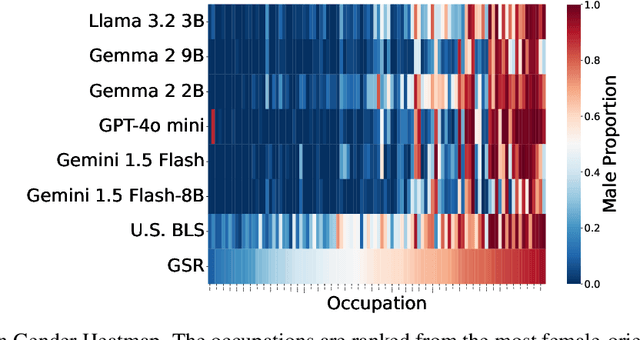
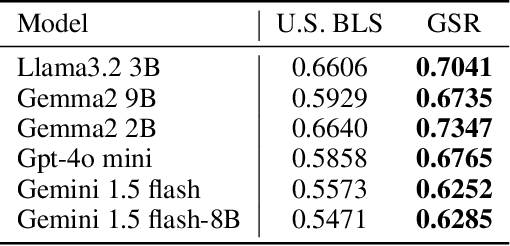
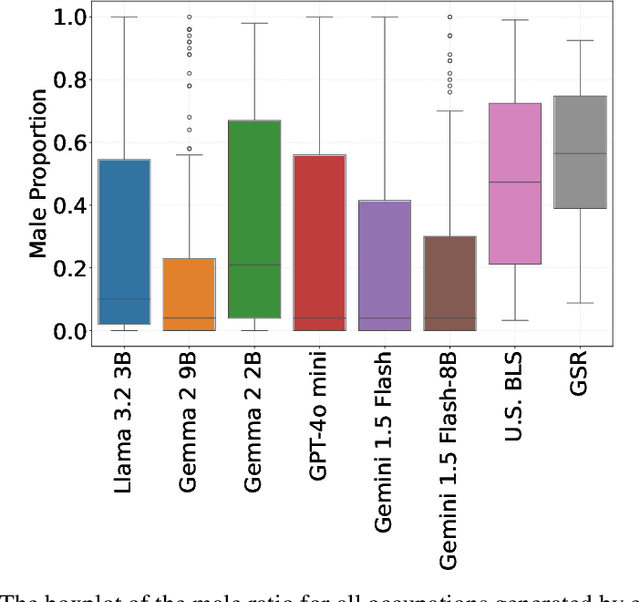
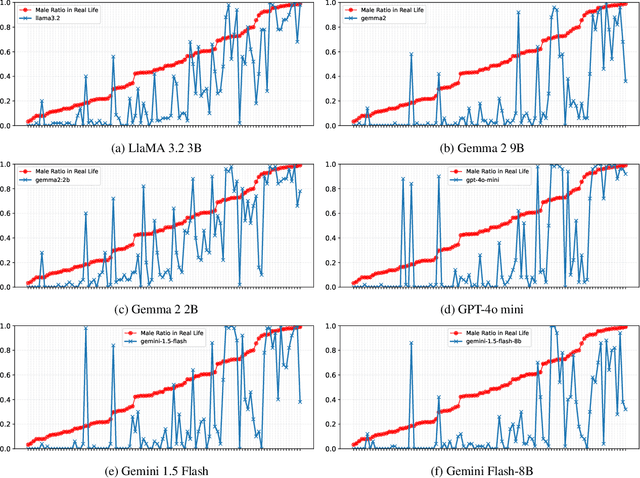
Large Language Models (LLMs) have revolutionized natural language processing, yet concerns persist regarding their tendency to reflect or amplify social biases present in their training data. This study introduces a novel evaluation framework to uncover gender biases in LLMs, focusing on their occupational narratives. Unlike previous methods relying on structured scenarios or carefully crafted prompts, our approach leverages free-form storytelling to reveal biases embedded in the models. Systematic analyses show an overrepresentation of female characters across occupations in six widely used LLMs. Additionally, our findings reveal that LLM-generated occupational gender rankings align more closely with human stereotypes than actual labor statistics. These insights underscore the need for balanced mitigation strategies to ensure fairness while avoiding the reinforcement of new stereotypes.
Dynamic DropConnect: Enhancing Neural Network Robustness through Adaptive Edge Dropping Strategies
Feb 27, 2025Dropout and DropConnect are well-known techniques that apply a consistent drop rate to randomly deactivate neurons or edges in a neural network layer during training. This paper introduces a novel methodology that assigns dynamic drop rates to each edge within a layer, uniquely tailoring the dropping process without incorporating additional learning parameters. We perform experiments on synthetic and openly available datasets to validate the effectiveness of our approach. The results demonstrate that our method outperforms Dropout, DropConnect, and Standout, a classic mechanism known for its adaptive dropout capabilities. Furthermore, our approach improves the robustness and generalization of neural network training without increasing computational complexity. The complete implementation of our methodology is publicly accessible for research and replication purposes at https://github.com/ericabd888/Adjusting-the-drop-probability-in-DropConnect-based-on-the-magnitude-of-the-gradient/.
Flexible Bivariate Beta Mixture Model: A Probabilistic Approach for Clustering Complex Data Structures
Feb 27, 2025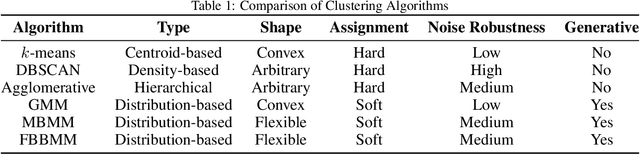
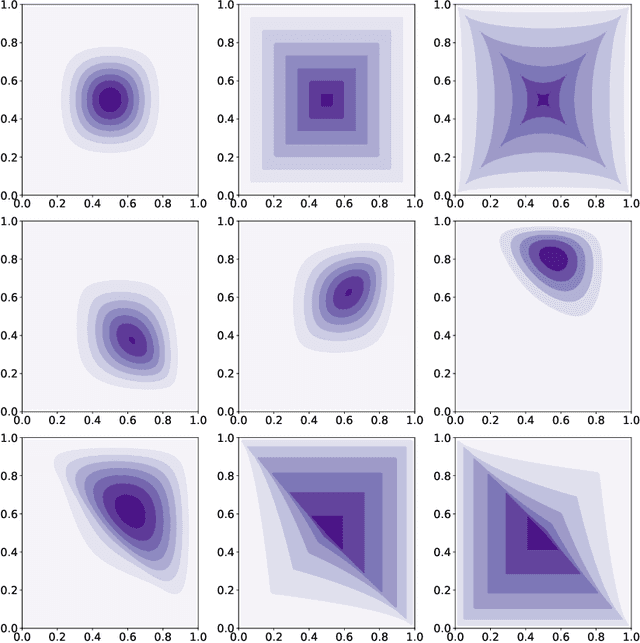
Clustering is essential in data analysis and machine learning, but traditional algorithms like $k$-means and Gaussian Mixture Models (GMM) often fail with nonconvex clusters. To address the challenge, we introduce the Flexible Bivariate Beta Mixture Model (FBBMM), which utilizes the flexibility of the bivariate beta distribution to handle diverse and irregular cluster shapes. Using the Expectation Maximization (EM) algorithm and Sequential Least Squares Programming (SLSQP) optimizer for parameter estimation, we validate FBBMM on synthetic and real-world datasets, demonstrating its superior performance in clustering complex data structures, offering a robust solution for big data analytics across various domains. We release the experimental code at https://github.com/yung-peng/MBMM-and-FBBMM.
Understanding Gradient Boosting Classifier: Training, Prediction, and the Role of $γ_j$
Oct 08, 2024The Gradient Boosting Classifier (GBC) is a widely used machine learning algorithm for binary classification, which builds decision trees iteratively to minimize prediction errors. This document explains the GBC's training and prediction processes, focusing on the computation of terminal node values $\gamma_j$, which are crucial to optimizing the logistic loss function. We derive $\gamma_j$ through a Taylor series approximation and provide a step-by-step pseudocode for the algorithm's implementation. The guide explains the theory of GBC and its practical application, demonstrating its effectiveness in binary classification tasks. We provide a step-by-step example in the appendix to help readers understand.
The Effectiveness of Graph Contrastive Learning on Mathematical Information Retrieval
Feb 21, 2024This paper details an empirical investigation into using Graph Contrastive Learning (GCL) to generate mathematical equation representations, a critical aspect of Mathematical Information Retrieval (MIR). Our findings reveal that this simple approach consistently exceeds the performance of the current leading formula retrieval model, TangentCFT. To support ongoing research and development in this field, we have made our source code accessible to the public at https://github.com/WangPeiSyuan/GCL-Formula-Retrieval/.