 Add to Chrome
 Add to Firefox
 Add to Edge
Fast and Accurate Quotation Attribution in Literary Texts
Aug 03, 2026
Attributing quotations to their speakers in literary texts remains an open challenge. Standard methods, which independently predict a speaker mention for each quotation, are efficient but still limited in accuracy. In contrast, large language model (LLM) approaches achieve strong performance, but their computational cost limits their use in large-scale literary analysis. We propose an encoder-based efficient formulation that resolves multiple quotation attributions within a shared, large context window. Using our new formulation, \textit{joint scoring}, we report state-of-the-art (SOTA) performance on the Project Dialogism Novel Corpus (PDNC), comprising more than 35,000 manually annotated quotations from 22 English novels. Our best model reaches 94.5\% overall attribution accuracy while processing novels $20\times$ faster than comparable standard methods and more than $1000\times$ faster than LLM-based approaches on an A100 GPU. An analysis of models' representations suggests that joint scoring improves on challenging attribution examples by preserving long-range anaphora resolution signal, an information that we found already present in pretrained encoders. To facilitate adoption, we release ModernBookNLP, a modified fork of BookNLP that replaces its quotation attribution model with our best system available at https://github.com/gasmichel/ModernBookNLP_QA/.

Ramanujan Graph Rewiring with Non Negative Resistance Curvature
Jun 24, 2026Graph Neural Networks (GNNs) have emerged as a powerful paradigm for learning on graph-structured data by iteratively propagating and aggregating information across edges. However, conventional message passing schemes often suffer from over-squashing, whereby exponentially large neighborhoods are compressed into fixed-dimensional embeddings, impeding effective long-range dependency learning. In this work, we introduce Ramanujan Propagation, a graph rewiring strategy that leverages Ramanujan graphs to alleviate topological bottlenecks in GNNs. We first establish that suitably chosen Ramanujan graphs guarantee non-negative resistance curvature, which mitigates over-squashing and facilitates efficient information flow. We then propose an algorithmic framework to construct a Ramanujan rewired graph that preserves the local connectivity of the original graph. Our experiments demonstrate that our method outperforms nine state-of-the-art rewiring techniques. These results establish Ramanujan graphs as a rigorous structural prior for scalable, topology-aware message passing in GNNs.
Dynamic Triangulation-Based Graph Rewiring for Graph Neural Networks
Aug 28, 2025Graph Neural Networks (GNNs) have emerged as the leading paradigm for learning over graph-structured data. However, their performance is limited by issues inherent to graph topology, most notably oversquashing and oversmoothing. Recent advances in graph rewiring aim to mitigate these limitations by modifying the graph topology to promote more effective information propagation. In this work, we introduce TRIGON, a novel framework that constructs enriched, non-planar triangulations by learning to select relevant triangles from multiple graph views. By jointly optimizing triangle selection and downstream classification performance, our method produces a rewired graph with markedly improved structural properties such as reduced diameter, increased spectral gap, and lower effective resistance compared to existing rewiring methods. Empirical results demonstrate that TRIGON outperforms state-of-the-art approaches on node classification tasks across a range of homophilic and heterophilic benchmarks.
Rewiring Techniques to Mitigate Oversquashing and Oversmoothing in GNNs: A Survey
Nov 26, 2024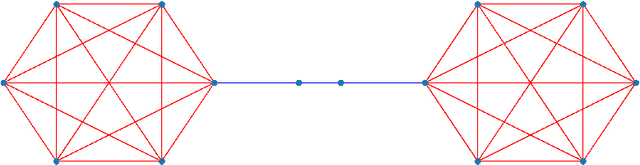
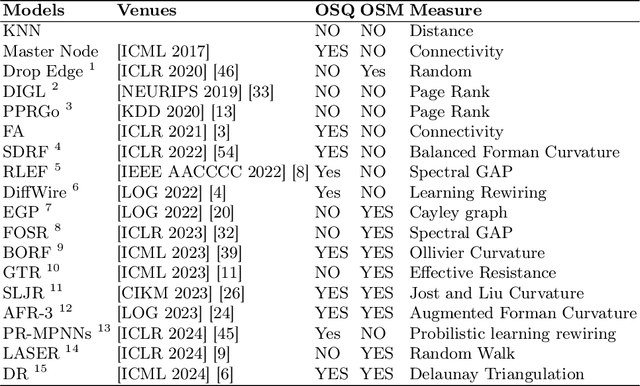
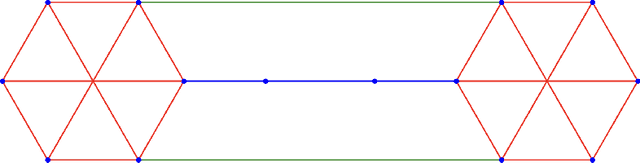
Graph Neural Networks (GNNs) are powerful tools for learning from graph-structured data, but their effectiveness is often constrained by two critical challenges: oversquashing, where the excessive compression of information from distant nodes results in significant information loss, and oversmoothing, where repeated message-passing iterations homogenize node representations, obscuring meaningful distinctions. These issues, intrinsically linked to the underlying graph structure, hinder information flow and constrain the expressiveness of GNNs. In this survey, we examine graph rewiring techniques, a class of methods designed to address these structural bottlenecks by modifying graph topology to enhance information diffusion. We provide a comprehensive review of state-of-the-art rewiring approaches, delving into their theoretical underpinnings, practical implementations, and performance trade-offs.