 Add to Chrome
 Add to Firefox
 Add to Edge
Forage V2: Knowledge Evolution and Transfer in Autonomous Agent Organizations
Apr 21, 2026
Autonomous agents operating in open-world tasks -- where the completion boundary is not given in advance -- face denominator blindness: they systematically underestimate the scope of the target space. Forage V1 addressed this through co-evolving evaluation (an independent Evaluator discovers what "complete" means) and method isolation (Evaluator and Planner cannot see each other's code). V2 extends the architecture from a single expedition to a learning organization: experience accumulates across runs, transfers across model capabilities, and institutional safeguards prevent knowledge degradation. We demonstrate two claims across three task types (web scraping, API queries, mathematical reasoning). Knowledge accumulation: over six runs, knowledge entries grow from 0 to 54, and denominator estimates stabilize as domain understanding deepens. Knowledge transfer: a weaker agent (Sonnet) seeded with a stronger agent's (Opus) knowledge narrows a 6.6pp coverage gap to 1.1pp, halves cost (9.40 to 5.13 USD), converges in half the rounds (mean 4.5 vs. 7.0), and three independent seeded runs arrive at exactly the same denominator estimate (266), suggesting organizational knowledge calibrates evaluation itself. V2's contribution is architectural: it designs institutions -- audit separation, contract protocols, organizational memory -- that make any agent more reliable upon entry. The accumulated experience is organizational, model-agnostic, and transferable, stored as readable documents that any future agent inherits regardless of provider or capability level.

Large Language Models at Work in China's Labor Market
Aug 17, 2023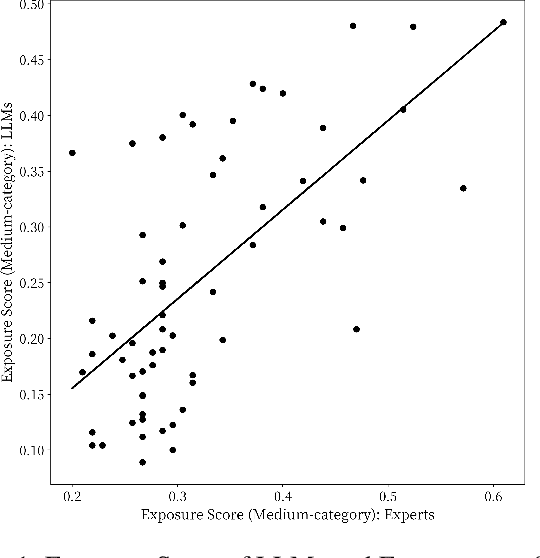


This paper explores the potential impacts of large language models (LLMs) on the Chinese labor market. We analyze occupational exposure to LLM capabilities by incorporating human expertise and LLM classifications, following Eloundou et al. (2023)'s methodology. We then aggregate occupation exposure to the industry level to obtain industry exposure scores. The results indicate a positive correlation between occupation exposure and wage levels/experience premiums, suggesting higher-paying and experience-intensive jobs may face greater displacement risks from LLM-powered software. The industry exposure scores align with expert assessments and economic intuitions. We also develop an economic growth model incorporating industry exposure to quantify the productivity-employment trade-off from AI adoption. Overall, this study provides an analytical basis for understanding the labor market impacts of increasingly capable AI systems in China. Key innovations include the occupation-level exposure analysis, industry aggregation approach, and economic modeling incorporating AI adoption and labor market effects. The findings will inform policymakers and businesses on strategies for maximizing the benefits of AI while mitigating adverse disruption risks.