 Add to Chrome
 Add to Firefox
 Add to Edge
Closed-Loop Sim-to-Real Reinforcement Learning for Deformable Microfiber Shape Control
May 20, 2026
Autonomous contact-based micromanipulation is challenging because surface and interfacial interactions at the microscale are difficult to model accurately, limiting the use of conventional model-based control and sim-to-real learning. We present a closed-loop sim-to-real reinforcement learning (RL) approach for microfiber shape control on a surface. The central idea is to train geometric shape regulation in a simplified frictionless simulator and rely on real-time visual feedback during deployment to iteratively correct the observed effects of unmodeled surface interactions. An RL policy trained entirely in simulation is transferred directly to a physical dual-gripper micromanipulation system operating at 40 Hz, without retraining or domain adaptation. Using silk microfibers as a testbed, the policy achieves a mean point-wise shape error of 270 $\pm$ 80 $μ$m across twenty-four diverse initial configurations. Across nine specimens covering all combinations of three fiber diameters (50, 80, and 120 $μ$m) and three manipulated lengths (10 mm, 15mm, and 20 mm), the same policy achieves sub-millimeter final shape error without any retraining or retuning. These results show that a policy learned in a simplified simulator can achieve repeatable real-world microfiber shape regulation under surface contact, provided that the task-relevant effects of the sim-to-real mismatch remain observable and correctable within the closed feedback loop.

FilMBot: A High-Speed Soft Parallel Robotic Micromanipulator
Oct 30, 2024
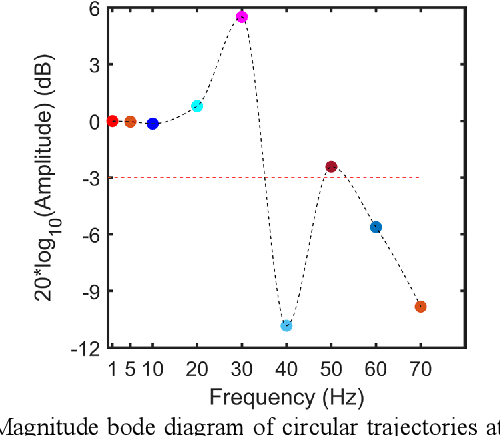


Soft robotic manipulators are generally slow despite their great adaptability, resilience, and compliance. This limitation also extends to current soft robotic micromanipulators. Here, we introduce FilMBot, a 3-DOF film-based, electromagnetically actuated, soft kinematic robotic micromanipulator achieving speeds up to 2117 $\deg$/s and 2456 $\deg$/s in $\alpha$ and $\beta$ angular motions, with corresponding linear velocities of 1.61 m/s and 1.92 m/s using a 4-cm needle end-effector, and 1.57 m/s along the Z axis. The robot can reach ~1.50 m/s in path-following tasks, operates at frequencies up to 30 Hz, and remains functional up to 50 Hz. It demonstrates high precision (~6.3 $\mu$m, or ~0.05% of its workspace) in small path-following tasks. The novel combination of the low-stiffness soft kinematic film structure and strong electromagnetic actuation in FilMBot opens new avenues for soft robotics. Furthermore, its simple construction and inexpensive, readily accessible components could broaden the application of micromanipulators beyond current academic and professional users.
Depth Estimation Analysis of Orthogonally Divergent Fisheye Cameras with Distortion Removal
Jul 07, 2023Stereo vision systems have become popular in computer vision applications, such as 3D reconstruction, object tracking, and autonomous navigation. However, traditional stereo vision systems that use rectilinear lenses may not be suitable for certain scenarios due to their limited field of view. This has led to the popularity of vision systems based on one or multiple fisheye cameras in different orientations, which can provide a field of view of 180x180 degrees or more. However, fisheye cameras introduce significant distortion at the edges that affects the accuracy of stereo matching and depth estimation. To overcome these limitations, this paper proposes a method for distortion-removal and depth estimation analysis for stereovision system using orthogonally divergent fisheye cameras (ODFC). The proposed method uses two virtual pinhole cameras (VPC), each VPC captures a small portion of the original view and presents it without any lens distortions, emulating the behavior of a pinhole camera. By carefully selecting the captured regions, it is possible to create a stereo pair using two VPCs. The performance of the proposed method is evaluated in both simulation using virtual environment and experiments using real cameras and their results compared to stereo cameras with parallel optical axes. The results demonstrate the effectiveness of the proposed method in terms of distortion removal and depth estimation accuracy.