 Add to Chrome
 Add to Firefox
 Add to Edge
Bridging the Sim-to-Real Gap under Real-Time Constraints in Autonomous Racing
Jul 20, 2026
Autonomous racing exposes the sim-to-real gap under extreme operating conditions characterized by high speed, tight stability margins, and stringent real-time constraints. Although simulation is indispensable for development, controllers that perform well in simulation often degrade abruptly on physical platforms due to interacting effects of dynamics mismatch, estimation delay, and execution-layer latency. This paper frames sim-to-real transfer in autonomous racing as a full-stack, real-time systems problem. We introduce a structured three-layer perspective (Physical/Cyber/Execution) to analyze how mismatches propagate and amplify through closed-loop feedback. We present diagnostic metrics beyond nominal lap time, including performance flip, stability-oriented measures, sensitivity to delay and noise, and latency distribution characterization. Mitigation strategies are synthesized from a deployment-oriented viewpoint, emphasizing execution-aware and delay-aware design. Finally, we outline benchmarking guidelines that enable reproducible and fair sim-to-real evaluation under compute and timing constraints. The resulting framework clarifies cross-layer failure mechanisms and provides practical design principles for deployable autonomous racing systems operating near dynamic limits.

ConvoyNext: A Scalable Testbed Platform for Cooperative Autonomous Vehicle Systems
May 22, 2025The advancement of cooperative autonomous vehicle systems depends heavily on effective coordination between multiple agents, aiming to enhance traffic efficiency, fuel economy, and road safety. Despite these potential benefits, real-world testing of such systems remains a major challenge and is essential for validating control strategies, trajectory modeling methods, and communication robustness across diverse environments. To address this need, we introduce ConvoyNext, a scalable, modular, and extensible platform tailored for the real-world evaluation of cooperative driving behaviors. We demonstrate the capabilities of ConvoyNext through a series of experiments involving convoys of autonomous vehicles navigating complex trajectories. These tests highlight the platform's robustness across heterogeneous vehicle configurations and its effectiveness in assessing convoy behavior under varying communication conditions, including intentional packet loss. Our results validate ConvoyNext as a comprehensive, open-access testbed for advancing research in cooperative autonomous vehicle systems.
OpenConvoy: Universal Platform for Real-World Testing of Cooperative Driving Systems
May 28, 2024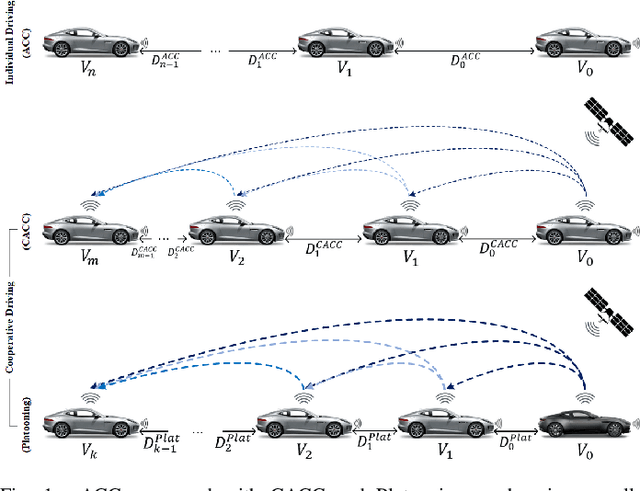
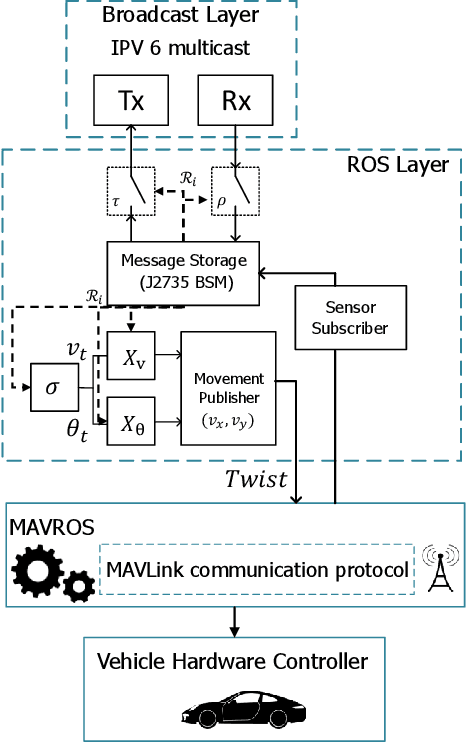
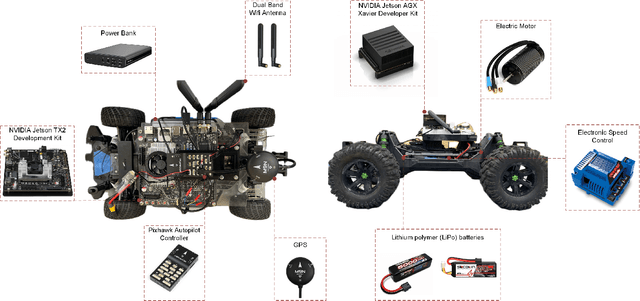
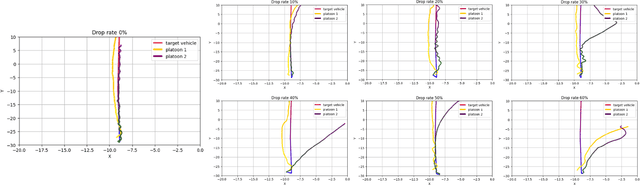
Cooperative driving, enabled by communication between automated vehicle systems, promises significant benefits to fuel efficiency, road capacity, and safety over single-vehicle driver assistance systems such as adaptive cruise control (ACC). However, the responsible development and implementation of these algorithms poses substantial challenges due to the need for extensive real-world testing. We address this issue and introduce OpenConvoy, an open and extensible framework designed for the implementation and assessment of cooperative driving policies on physical connected and autonomous vehicles (CAVs). We demonstrate the capabilities of OpenConvoy through a series of experiments on a convoy of multi-scale vehicles controlled by Platooning to show the stability of our system across vehicle configurations and its ability to effectively measure convoy cohesion across driving scenarios including varying degrees of communication loss.