 Add to Chrome
 Add to Firefox
 Add to Edge
A Comprehensive Survey on Deep Neural Image Deblurring
Oct 07, 2023
Image deblurring tries to eliminate degradation elements of an image causing blurriness and improve the quality of an image for better texture and object visualization. Traditionally, prior-based optimization approaches predominated in image deblurring, but deep neural networks recently brought a major breakthrough in the field. In this paper, we comprehensively review the recent progress of the deep neural architectures in both blind and non-blind image deblurring. We outline the most popular deep neural network structures used in deblurring applications, describe their strengths and novelties, summarize performance metrics, and introduce broadly used datasets. In addition, we discuss the current challenges and research gaps in this domain and suggest potential research directions for future works.

A Subspace-based Approach for Dimensionality Reduction and Important Variable Selection
Jun 03, 2021


An analysis of high dimensional data can offer a detailed description of a system but is often challenged by the curse of dimensionality. General dimensionality reduction techniques can alleviate such difficulty by extracting a few important features, but they are limited due to the lack of interpretability and connectivity to actual decision making associated with each physical variable. Important variable selection techniques, as an alternative, can maintain the interpretability, but they often involve a greedy search that is susceptible to failure in capturing important interactions. This research proposes a new method that produces subspaces, reduced-dimensional physical spaces, based on a randomized search and forms an ensemble of models for critical subspaces. When applied to high-dimensional data collected from a composite metal development process, the proposed method shows its superiority in prediction and important variable selection.
Blind Image Deblurring based on Kernel Mixture
Jan 15, 2021
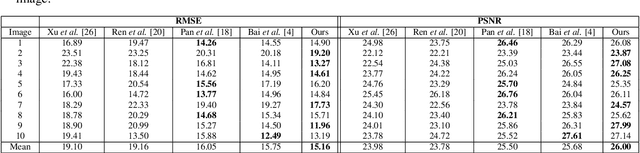
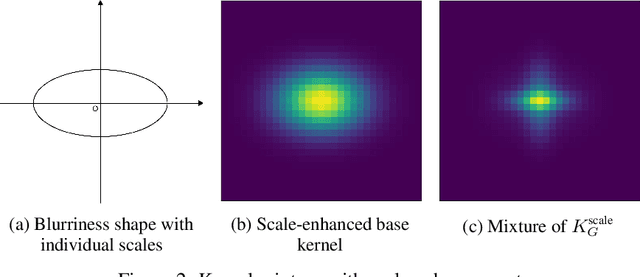
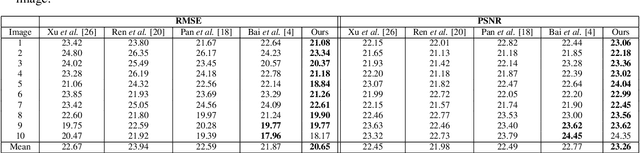
Blind Image deblurring tries to estimate blurriness and a latent image out of a blurred image. This estimation, as being an ill-posed problem, requires imposing restrictions on the latent image or a blur kernel that represents blurriness. Different from recent studies that impose some priors on the latent image, this paper regulates the structure of the blur kernel. We propose a kernel mixture structure while using the Gaussian kernel as a base kernel. By combining multiple Gaussian kernels structurally enhanced in terms of scales and centers, the kernel mixture becomes capable of modeling nearly non-parametric shape of blurriness. A data-driven decision for the number of base kernels to combine makes the structure even more flexible. We apply this approach to a remote sensing problem to recover images from blurry images of satellite. This case study shows the superiority of the proposed method regulating the blur kernel in comparison with state-of-the-art methods that regulates the latent image.