 Add to Chrome
 Add to Firefox
 Add to Edge
LogicIR: Logic Gate Networks for Image Restoration
Jun 25, 2026
Image restoration aims to reconstruct high-quality images from degraded low-quality inputs. As the computational demands of image restoration models continue to rise, there is growing interest in lightweight architectures optimized for fast and efficient inference. Logic gate networks (LGNs), which operate using fundamental logic operations such as NAND and XOR, have recently emerged as a promising direction for achieving highly efficient computation. However, their potential remains largely untapped in the domain of image restoration. In this work, we introduce LogicIR, the first LGN specifically designed for image restoration tasks. LogicIR incorporates a UNet-inspired architecture composed entirely of logic gates. In addition, we propose a differentiable bit decoding layer and an index shuffling mechanism that improves information propagation across logic gates. Experimental results across multiple image restoration benchmarks demonstrate that LogicIR achieves strong performance with significantly reduced computational cost, establishing LogicIR as a viable and efficient alternative for image restoration. The source code is available at https://github.com/jimmy9704/LogicIR

TaskTok: Delving into Task Tokens for Task-driven Image Restoration
Jun 25, 2026While traditional image restoration focuses on perceptual quality, Task-Driven Image Restoration (TDIR) aims to maximize the performance of downstream high-level vision tasks. Recent approaches leveraging generative priors have shown promise for TDIR; however, they typically suffer from computational inefficiency and potential semantic alteration by indiscriminately updating all latent tokens. In this paper, we posit that not all visual information is equally important for machine perception. Through an analysis of the latent token space, we observe that task-relevant cues are unevenly distributed across the token sequence, exhibiting index-wise specialization. This suggests that selectively refining a subset of tokens can be sufficient for task-driven objectives. Leveraging this insight, we propose TaskTok, a novel framework that selectively restores only task-relevant tokens via a learnable token switch and a lightweight token refinement module. Extensive experiments across image classification, semantic segmentation, and object detection demonstrate that TaskTok significantly enhances task performance with high computational efficiency. The source code is available at https://github.com/jimmy9704/TaskTok
RefQSR: Reference-based Quantization for Image Super-Resolution Networks
Apr 02, 2024Single image super-resolution (SISR) aims to reconstruct a high-resolution image from its low-resolution observation. Recent deep learning-based SISR models show high performance at the expense of increased computational costs, limiting their use in resource-constrained environments. As a promising solution for computationally efficient network design, network quantization has been extensively studied. However, existing quantization methods developed for SISR have yet to effectively exploit image self-similarity, which is a new direction for exploration in this study. We introduce a novel method called reference-based quantization for image super-resolution (RefQSR) that applies high-bit quantization to several representative patches and uses them as references for low-bit quantization of the rest of the patches in an image. To this end, we design dedicated patch clustering and reference-based quantization modules and integrate them into existing SISR network quantization methods. The experimental results demonstrate the effectiveness of RefQSR on various SISR networks and quantization methods.
Hierarchical Spatiotemporal Transformers for Video Object Segmentation
Jul 17, 2023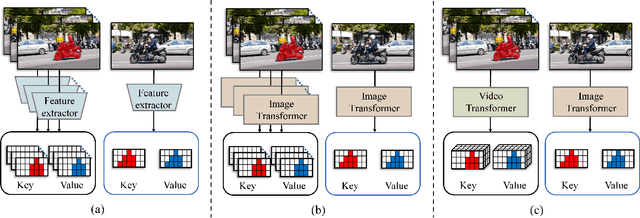
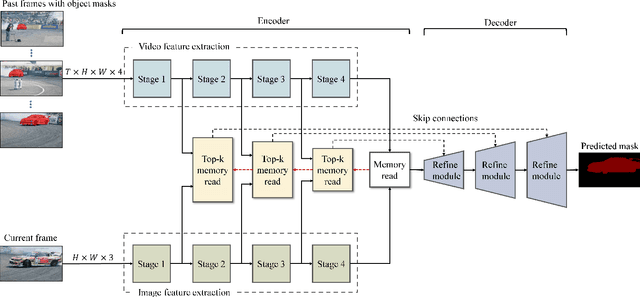
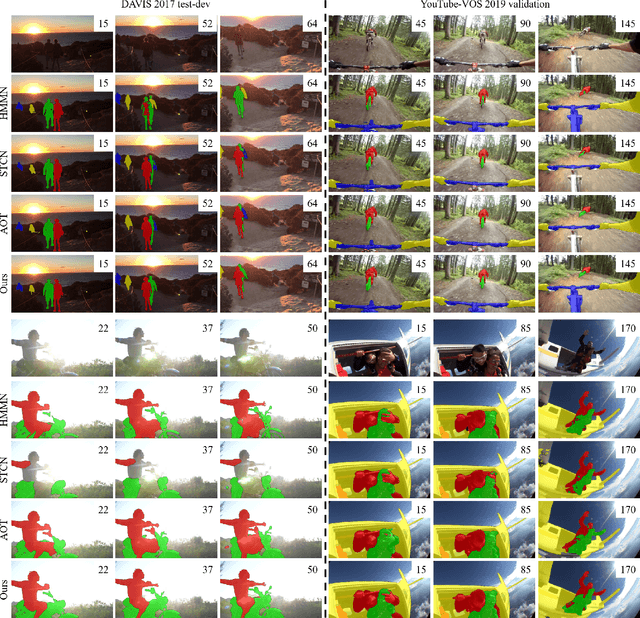
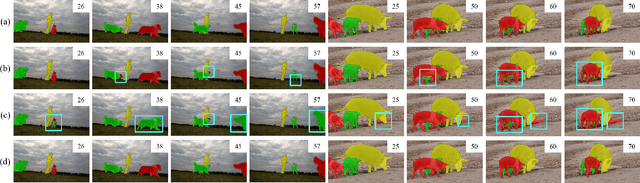
This paper presents a novel framework called HST for semi-supervised video object segmentation (VOS). HST extracts image and video features using the latest Swin Transformer and Video Swin Transformer to inherit their inductive bias for the spatiotemporal locality, which is essential for temporally coherent VOS. To take full advantage of the image and video features, HST casts image and video features as a query and memory, respectively. By applying efficient memory read operations at multiple scales, HST produces hierarchical features for the precise reconstruction of object masks. HST shows effectiveness and robustness in handling challenging scenarios with occluded and fast-moving objects under cluttered backgrounds. In particular, HST-B outperforms the state-of-the-art competitors on multiple popular benchmarks, i.e., YouTube-VOS (85.0%), DAVIS 2017 (85.9%), and DAVIS 2016 (94.0%).
GPS-GLASS: Learning Nighttime Semantic Segmentation Using Daytime Video and GPS data
Jul 27, 2022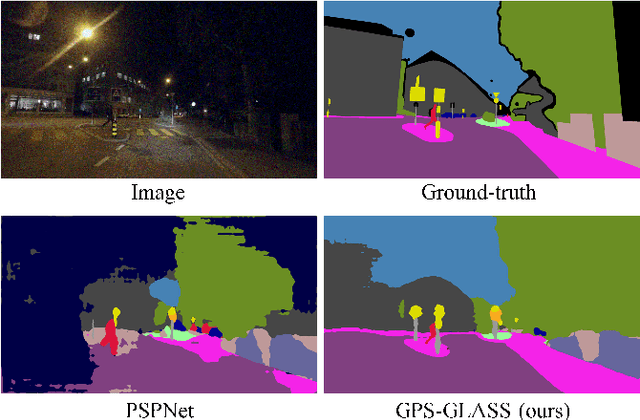
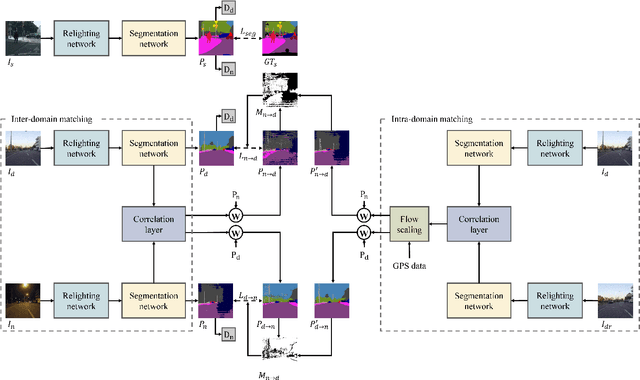
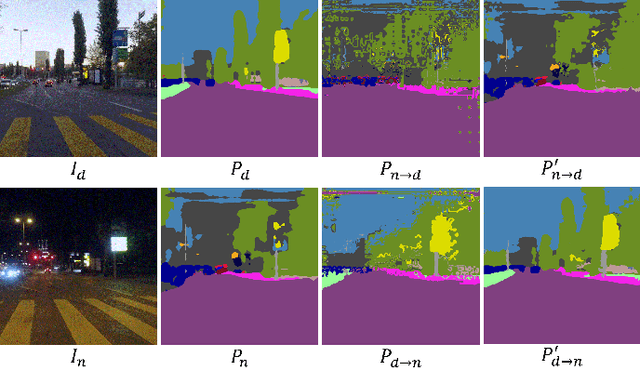
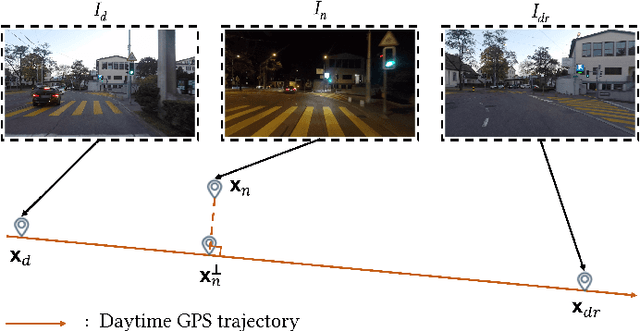
Semantic segmentation for autonomous driving should be robust against various in-the-wild environments. Nighttime semantic segmentation is especially challenging due to a lack of annotated nighttime images and a large domain gap from daytime images with sufficient annotation. In this paper, we propose a novel GPS-based training framework for nighttime semantic segmentation. Given GPS-aligned pairs of daytime and nighttime images, we perform cross-domain correspondence matching to obtain pixel-level pseudo supervision. Moreover, we conduct flow estimation between daytime video frames and apply GPS-based scaling to acquire another pixel-level pseudo supervision. Using these pseudo supervisions with a confidence map, we train a nighttime semantic segmentation network without any annotation from nighttime images. Experimental results demonstrate the effectiveness of the proposed method on several nighttime semantic segmentation datasets. Our source code is available at https://github.com/jimmy9704/GPS-GLASS.