 Add to Chrome
 Add to Firefox
 Add to Edge
Multi-Camera Self-Calibration in Sports Motion Capture: Leveraging Human and Stick Poses
Apr 19, 2026
Multi-camera systems are widely employed in sports to capture the 3D motion of athletes and equipment, yet calibrating their extrinsic parameters remains costly and labor-intensive. We introduce an efficient, tool-free method for multi-camera extrinsic calibration tailored to sports involving stick-like implements (e.g., golf clubs, bats, hockey sticks). Our approach jointly exploits two complementary cues from synchronized multi-camera videos: (i) human body keypoints with unknown metric scale and (ii) a rigid stick-like implement of known length. We formulate a three-stage optimization pipeline that refines camera extrinsics, reconstructs human and stick trajectories, and resolves global scale via the stick-length constraint. Our method achieves accurate extrinsic calibration without dedicated calibration tools. To benchmark this task, we present the first dataset for multi-camera self-calibration in stick-based sports, consisting of synthetic sequences across four sports categories with 3 to 10 cameras. Comprehensive experiments demonstrate that our method delivers SOTA performance, achieving low rotation and translation errors. Our project page: https://fandulu.github.io/sport_stick_multi_cam_calib/.

Ambiguity Detection and Elimination in Automated Executable Process Modeling
Apr 13, 2026Automated generation of executable Business Process Model and Notation (BPMN) models from natural-language specifications is increasingly enabled by large language models. However, ambiguous or underspecified text can yield structurally valid models with different simulated behavior. Our goal is not to prove that one generated BPMN model is semantically correct, but to detect when a natural-language specification fails to support a stable executable interpretation under repeated generation and simulation. We present a diagnosis-driven framework that detects behavioral inconsistency from the empirical distribution of key performance indicators (KPIs), localizes divergence to gateway logic using model-based diagnosis, maps that logic back to verbatim narrative segments, and repairs the source text through evidence-based refinement. Experiments on diabetic nephropathy health-guidance policies show that the method reduces variability in regenerated model behavior. The result is a closed-loop approach for validating and repairing executable process specifications in the absence of ground-truth BPMN models.
Automatic Generation of Executable BPMN Models from Medical Guidelines
Apr 09, 2026We present an end-to-end pipeline that converts healthcare policy documents into executable, data-aware Business Process Model and Notation (BPMN) models using large language models (LLMs) for simulation-based policy evaluation. We address the main challenges of automated policy digitization with four contributions: data-grounded BPMN generation with syntax auto-correction, executable augmentation, KPI instrumentation, and entropy-based uncertainty detection. We evaluate the pipeline on diabetic nephropathy prevention guidelines from three Japanese municipalities, generating 100 models per backend across three LLMs and executing each against 1,000 synthetic patients. On well-structured policies, the pipeline achieves a 100% ground-truth match with perfect per-patient decision agreement. Across all conditions, raw per-patient decision agreement exceeds 92%, and entropy scores increase monotonically with document complexity, confirming that the detector reliably separates unambiguous policies from those requiring targeted human clarification.
Harnessing Rich Multi-Modal Data for Spatial-Temporal Homophily-Embedded Graph Learning Across Domains and Localities
Dec 11, 2025Modern cities are increasingly reliant on data-driven insights to support decision making in areas such as transportation, public safety and environmental impact. However, city-level data often exists in heterogeneous formats, collected independently by local agencies with diverse objectives and standards. Despite their numerous, wide-ranging, and uniformly consumable nature, national-level datasets exhibit significant heterogeneity and multi-modality. This research proposes a heterogeneous data pipeline that performs cross-domain data fusion over time-varying, spatial-varying and spatial-varying time-series datasets. We aim to address complex urban problems across multiple domains and localities by harnessing the rich information over 50 data sources. Specifically, our data-learning module integrates homophily from spatial-varying dataset into graph-learning, embedding information of various localities into models. We demonstrate the generalizability and flexibility of the framework through five real-world observations using a variety of publicly accessible datasets (e.g., ride-share, traffic crash, and crime reports) collected from multiple cities. The results show that our proposed framework demonstrates strong predictive performance while requiring minimal reconfiguration when transferred to new localities or domains. This research advances the goal of building data-informed urban systems in a scalable way, addressing one of the most pressing challenges in smart city analytics.
SWR-Viz: AI-assisted Interactive Visual Analytics Framework for Ship Weather Routing
Nov 19, 2025Efficient and sustainable maritime transport increasingly depends on reliable forecasting and adaptive routing, yet operational adoption remains difficult due to forecast latencies and the need for human judgment in rapid decision-making under changing ocean conditions. We introduce SWR-Viz, an AI-assisted visual analytics framework that combines a physics-informed Fourier Neural Operator wave forecast model with SIMROUTE-based routing and interactive emissions analytics. The framework generates near-term forecasts directly from current conditions, supports data assimilation with sparse observations, and enables rapid exploration of what-if routing scenarios. We evaluate the forecast models and SWR-Viz framework along key shipping corridors in the Japan Coast and Gulf of Mexico, showing both improved forecast stability and realistic routing outcomes comparable to ground-truth reanalysis wave products. Expert feedback highlights the usability of SWR-Viz, its ability to isolate voyage segments with high emission reduction potential, and its value as a practical decision-support system. More broadly, this work illustrates how lightweight AI forecasting can be integrated with interactive visual analytics to support human-centered decision-making in complex geospatial and environmental domains.
Personalized Real-time Jargon Support for Online Meetings
Aug 13, 2025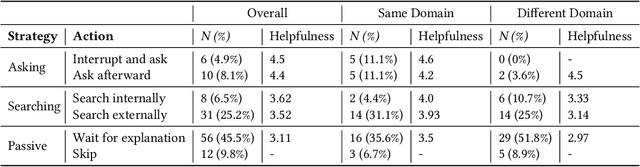

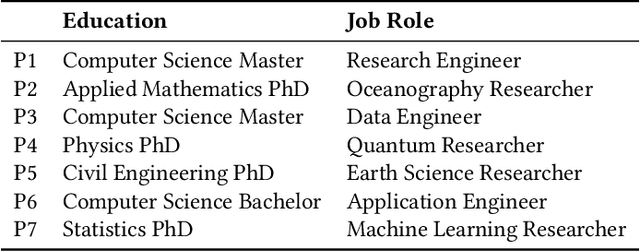
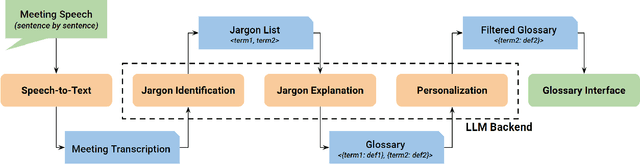
Effective interdisciplinary communication is frequently hindered by domain-specific jargon. To explore the jargon barriers in-depth, we conducted a formative diary study with 16 professionals, revealing critical limitations in current jargon-management strategies during workplace meetings. Based on these insights, we designed ParseJargon, an interactive LLM-powered system providing real-time personalized jargon identification and explanations tailored to users' individual backgrounds. A controlled experiment comparing ParseJargon against baseline (no support) and general-purpose (non-personalized) conditions demonstrated that personalized jargon support significantly enhanced participants' comprehension, engagement, and appreciation of colleagues' work, whereas general-purpose support negatively affected engagement. A follow-up field study validated ParseJargon's usability and practical value in real-time meetings, highlighting both opportunities and limitations for real-world deployment. Our findings contribute insights into designing personalized jargon support tools, with implications for broader interdisciplinary and educational applications.