 Add to Chrome
 Add to Firefox
 Add to Edge
SCORE: Specificity, Context Utilization, Robustness, and Relevance for Reference-Free LLM Evaluation
Feb 10, 2026
Large language models (LLMs) are increasingly used to support question answering and decision-making in high-stakes, domain-specific settings such as natural hazard response and infrastructure planning, where effective answers must convey fine-grained, decision-critical details. However, existing evaluation frameworks for retrieval-augmented generation (RAG) and open-ended question answering primarily rely on surface-level similarity, factual consistency, or semantic relevance, and often fail to assess whether responses provide the specific information required for domain-sensitive decisions. To address this gap, we propose a multi-dimensional, reference-free evaluation framework that assesses LLM outputs along four complementary dimensions: specificity, robustness to paraphrasing and semantic perturbations, answer relevance, and context utilization. We introduce a curated dataset of 1,412 domain-specific question-answer pairs spanning 40 professional roles and seven natural hazard types to support systematic evaluation. We further conduct human evaluation to assess inter-annotator agreement and alignment between model outputs and human judgments, which highlights the inherent subjectivity of open-ended, domain-specific evaluation. Our results show that no single metric sufficiently captures answer quality in isolation and demonstrate the need for structured, multi-metric evaluation frameworks when deploying LLMs in high-stakes applications.

Empowering Older Adults in Digital Technology Use with Foundation Models
Jan 15, 2026While high-quality technology support can assist older adults in using digital applications, many struggle to articulate their issues due to unfamiliarity with technical terminology and age-related cognitive changes. This study examines these communication challenges and explores AI-based approaches to mitigate them. We conducted a diary study with English-speaking, community-dwelling older adults to collect asynchronous, technology-related queries and used reflexive thematic analysis to identify communication barriers. To address these barriers, we evaluated how foundation models can paraphrase older adults' queries to improve solution accuracy. Two controlled experiments followed: one with younger adults evaluating AI-rephrased queries and another with older adults evaluating AI-generated solutions. We also developed a pipeline using large language models to generate the first synthetic dataset of how older adults request tech support (OATS). We identified four key communication challenges: verbosity, incompleteness, over-specification, and under-specification. Our prompt-chaining approach using the large language model, GPT-4o, elicited contextual details, paraphrased the original query, and generated a solution. AI-rephrased queries significantly improved solution accuracy (69% vs. 46%) and Google search results (69% vs. 35%). Younger adults better understood AI-rephrased queries (93.7% vs. 65.8%) and reported greater confidence and ease. Older adults reported high perceived ability to answer contextual questions (89.8%) and follow solutions (94.7%), with high confidence and ease. OATS demonstrated strong fidelity and face validity. This work shows how foundation models can enhance technology support for older adults by addressing age-related communication barriers. The OATS dataset offers a scalable resource for developing equitable AI systems that better serve aging populations.
PATENTWRITER: A Benchmarking Study for Patent Drafting with LLMs
Jul 30, 2025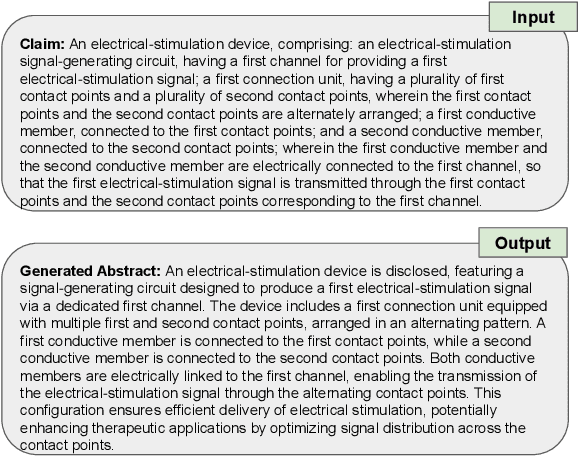
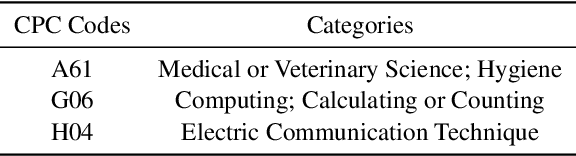
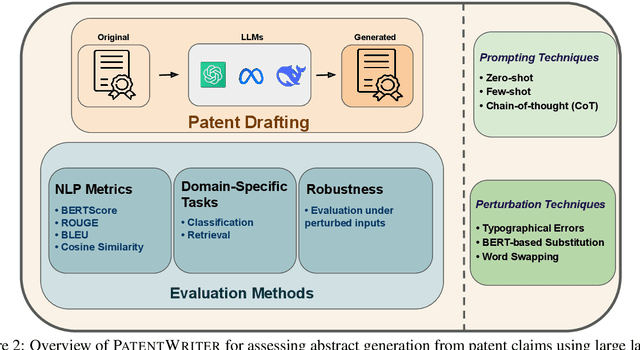
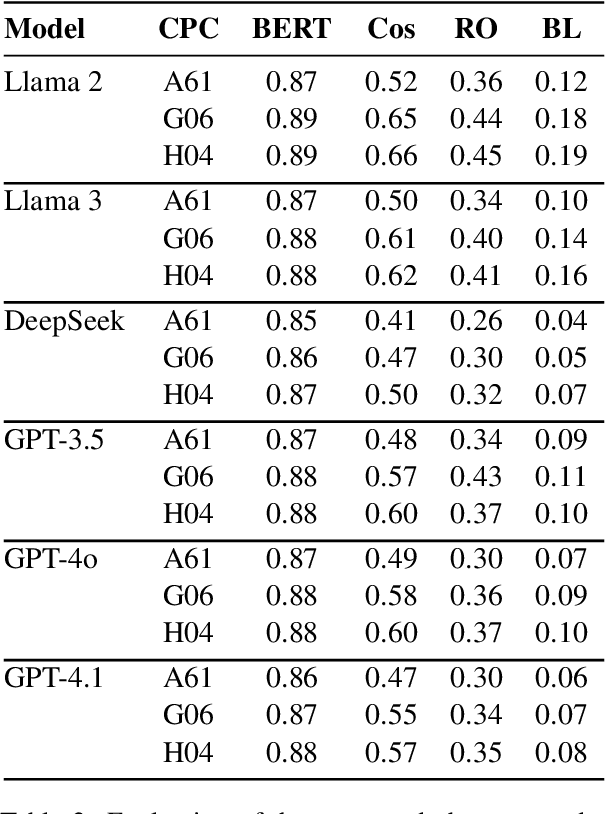
Large language models (LLMs) have emerged as transformative approaches in several important fields. This paper aims for a paradigm shift for patent writing by leveraging LLMs to overcome the tedious patent-filing process. In this work, we present PATENTWRITER, the first unified benchmarking framework for evaluating LLMs in patent abstract generation. Given the first claim of a patent, we evaluate six leading LLMs -- including GPT-4 and LLaMA-3 -- under a consistent setup spanning zero-shot, few-shot, and chain-of-thought prompting strategies to generate the abstract of the patent. Our benchmark PATENTWRITER goes beyond surface-level evaluation: we systematically assess the output quality using a comprehensive suite of metrics -- standard NLP measures (e.g., BLEU, ROUGE, BERTScore), robustness under three types of input perturbations, and applicability in two downstream patent classification and retrieval tasks. We also conduct stylistic analysis to assess length, readability, and tone. Experimental results show that modern LLMs can generate high-fidelity and stylistically appropriate patent abstracts, often surpassing domain-specific baselines. Our code and dataset are open-sourced to support reproducibility and future research.
A Comprehensive Survey on AI-based Methods for Patents
Apr 02, 2024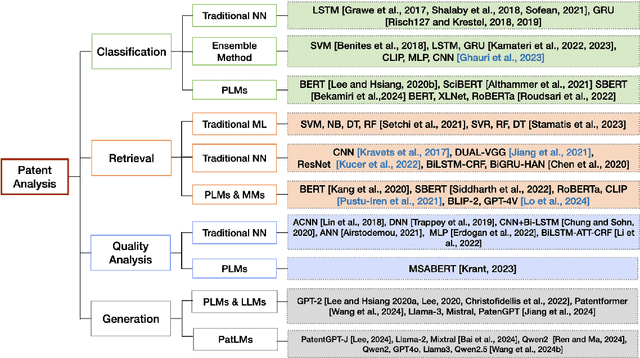
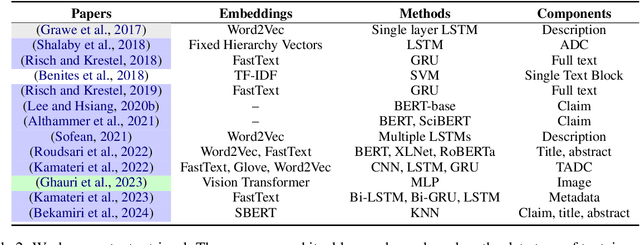
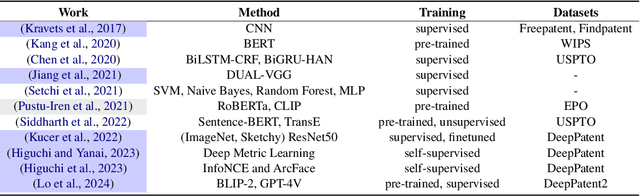
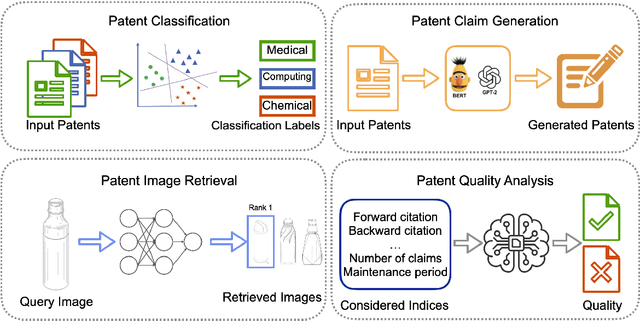
Recent advancements in Artificial Intelligence (AI) and machine learning have demonstrated transformative capabilities across diverse domains. This progress extends to the field of patent analysis and innovation, where AI-based tools present opportunities to streamline and enhance important tasks in the patent cycle such as classification, retrieval, and valuation prediction. This not only accelerates the efficiency of patent researchers and applicants but also opens new avenues for technological innovation and discovery. Our survey provides a comprehensive summary of recent AI tools in patent analysis from more than 40 papers from 26 venues between 2017 and 2023. Unlike existing surveys, we include methods that work for patent image and text data. Furthermore, we introduce a novel taxonomy for the categorization based on the tasks in the patent life cycle as well as the specifics of the AI methods. This survey aims to serve as a resource for researchers, practitioners, and patent offices in the domain of AI-powered patent analysis.