 Add to Chrome
 Add to Firefox
 Add to Edge
Reset-Free Reinforcement Learning for Real-World Agile Driving: An Empirical Study
Apr 09, 2026
This paper presents an empirical study of reset-free reinforcement learning (RL) for real-world agile driving, in which a physical 1/10-scale vehicle learns continuously on a slippery indoor track without manual resets. High-speed driving near the limits of tire friction is particularly challenging for learning-based methods because complex vehicle dynamics, actuation delays, and other unmodeled effects hinder both accurate simulation and direct sim-to-real transfer of learned policies. To enable autonomous training on a physical platform, we employ Model Predictive Path Integral control (MPPI) as both the reset policy and the base policy for residual learning, and systematically compare three representative RL algorithms, i.e., PPO, SAC, and TD-MPC2, with and without residual learning in simulation and real-world experiments. Our results reveal a clear gap between simulation and real-world: SAC with residual learning achieves the highest returns in simulation, yet only TD-MPC2 consistently outperforms the MPPI baseline on the physical platform. Moreover, residual learning, while clearly beneficial in simulation, fails to transfer its advantage to the real world and can even degrade performance. These findings reveal that reset-free RL in the real world poses unique challenges absent from simulation, calling for further algorithmic development tailored to training in the wild.

Stein Variational Guided Model Predictive Path Integral Control: Proposal and Experiments with Fast Maneuvering Vehicles
Sep 20, 2023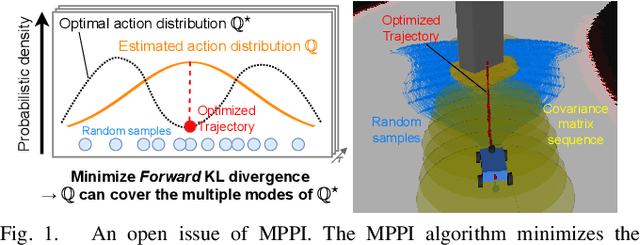
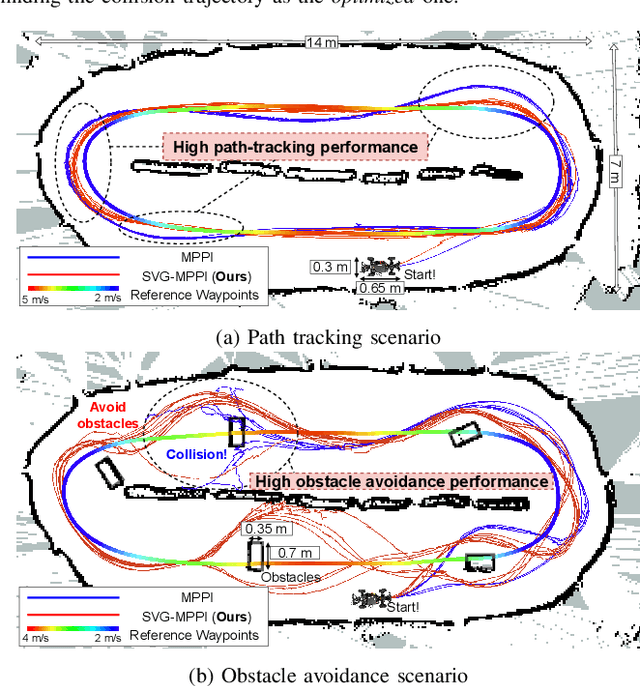
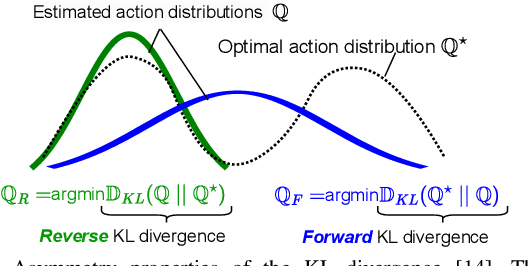

This paper presents a novel Stochastic Optimal Control (SOC) method based on Model Predictive Path Integral control (MPPI), named Stein Variational Guided MPPI (SVG-MPPI), designed to handle rapidly shifting multimodal optimal action distributions. While MPPI can find a Gaussian-approximated optimal action distribution in closed form, i.e., without iterative solution updates, it struggles with multimodality of the optimal distributions, such as those involving non-convex constraints for obstacle avoidance. This is due to the less representative nature of the Gaussian. To overcome this limitation, our method aims to identify a target mode of the optimal distribution and guide the solution to converge to fit it. In the proposed method, the target mode is roughly estimated using a modified Stein Variational Gradient Descent (SVGD) method and embedded into the MPPI algorithm to find a closed-form "mode-seeking" solution that covers only the target mode, thus preserving the fast convergence property of MPPI. Our simulation and real-world experimental results demonstrate that SVG-MPPI outperforms both the original MPPI and other state-of-the-art sampling-based SOC algorithms in terms of path-tracking and obstacle-avoidance capabilities. Source code: https://github.com/kohonda/proj-svg_mppi