 Add to Chrome
 Add to Firefox
 Add to Edge
Learning from imperfect quantum data via unsupervised domain adaptation with classical shadows
Mar 30, 2026
Learning from quantum data using classical machine learning models has emerged as a promising paradigm toward realizing quantum advantages. Despite extensive analyses on their performance, clean and fully labeled quantum data from the target domain are often unavailable in practical scenarios, forcing models to be trained on data collected under conditions that differ from those encountered at deployment. This mismatch highlights the need for new approaches beyond the common assumptions of prior work. In this work, we address this issue by employing an unsupervised domain adaptation framework for learning from imperfect quantum data. Specifically, by leveraging classical representations of quantum states obtained via classical shadows, we perform unsupervised domain adaptation entirely within a classical computational pipeline once measurements on the quantum states are executed. We numerically evaluate the framework on quantum phases of matter and entanglement classification tasks under realistic domain shifts. Across both tasks, our method outperforms source-only non-adaptive baselines and target-only unsupervised learning approaches, demonstrating the practical applicability of domain adaptation to realistic quantum data learning.

Statistical inference for quantum singular models
Nov 25, 2024Deep learning has seen substantial achievements, with numerical and theoretical evidence suggesting that singularities of statistical models are considered a contributing factor to its performance. From this remarkable success of classical statistical models, it is naturally expected that quantum singular models will play a vital role in many quantum statistical tasks. However, while the theory of quantum statistical models in regular cases has been established, theoretical understanding of quantum singular models is still limited. To investigate the statistical properties of quantum singular models, we focus on two prominent tasks in quantum statistical inference: quantum state estimation and model selection. In particular, we base our study on classical singular learning theory and seek to extend it within the framework of Bayesian quantum state estimation. To this end, we define quantum generalization and training loss functions and give their asymptotic expansions through algebraic geometrical methods. The key idea of the proof is the introduction of a quantum analog of the likelihood function using classical shadows. Consequently, we construct an asymptotically unbiased estimator of the quantum generalization loss, the quantum widely applicable information criterion (QWAIC), as a computable model selection metric from given measurement outcomes.
Trainable Discrete Feature Embeddings for Variational Quantum Classifier
Jun 17, 2021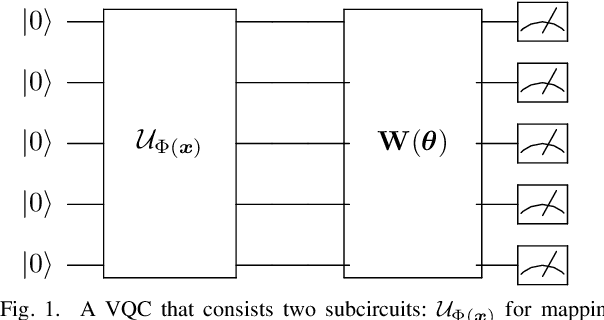
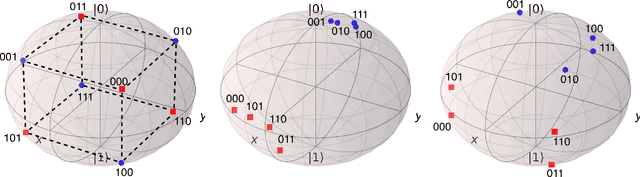
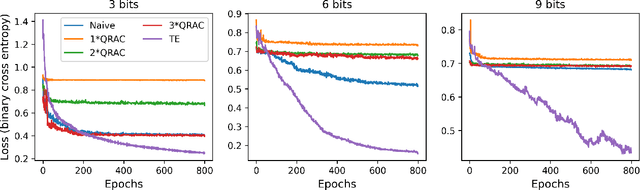
Quantum classifiers provide sophisticated embeddings of input data in Hilbert space promising quantum advantage. The advantage stems from quantum feature maps encoding the inputs into quantum states with variational quantum circuits. A recent work shows how to map discrete features with fewer quantum bits using Quantum Random Access Coding (QRAC), an important primitive to encode binary strings into quantum states. We propose a new method to embed discrete features with trainable quantum circuits by combining QRAC and a recently proposed strategy for training quantum feature map called quantum metric learning. We show that the proposed trainable embedding requires not only as few qubits as QRAC but also overcomes the limitations of QRAC to classify inputs whose classes are based on hard Boolean functions. We numerically demonstrate its use in variational quantum classifiers to achieve better performances in classifying real-world datasets, and thus its possibility to leverage near-term quantum computers for quantum machine learning.