 Add to Chrome
 Add to Firefox
 Add to Edge
Accurate but Natural? Diagnosing Grammatical and Idiomatic Gaps in Japanese EFL Writing
Aug 10, 2026
Second language writing research distinguishes grammatical accuracy from native-like idiomaticity, yet automated writing evaluation often conflates these dimensions. This study introduces a layered LLM-correction pipeline that isolates structural errors from unnaturalness by generating literal error corrections and idiomatic revisions for 3,830 English writing samples from 120 Japanese junior high school students. Applying the regex-based CEFR-J grammar extractor, we quantify two diagnostic measures: accuracy gaps (structures attempted but incorrectly produced) and idiomatic gaps (grammatically correct structures underused or overused relative to native norms). Results reveal distinct patterns: definite articles, third-person singular -s, and modals (would, could) exhibit significant accuracy difficulties, while -ing forms and hypothetical modals (would) show the largest idiomatic underuse, with simple present verbs, subject-verb-object patterns, and modal can conversely exhibiting the most pronounced overuse. A two-dimensional instructional typology maps error rates against idiomatic gaps, distinguishing accurate but overused grammar items from error-prone or avoided complex forms requiring targeted production practice. This framework advances pedagogical feedback by enabling teachers to diagnose whether learner difficulties arise from inaccurate execution, structural avoidance, or L1-mapped overreliance, supporting evidence-based interventions tailored to the specific needs of each learner.

Penny: Transition Network Analysis of Learner-Chatbot Interactions in Scaffolded EFL Writing
Jul 16, 2026Generative AI chatbots promise to transform English as a Foreign Language (EFL) writing by providing immediate, personalised feedback. However, their pedagogical value depends on how learners engage with them - a process often treated as a "black box." This study uses Transition Network Analysis to model the temporal dynamics of Japanese EFL learners using "Penny," an LLM-powered writing chatbot. Analysis of over 4,500 writing sessions and 21,000 chatbot interactions reveals two dominant behavioural loops: a "Revision Loop," where feedback leads directly to successful error correction, and a "Chat Loop," where learners engage in sustained dialogue with the chatbot following feedback. Crucially, EFL proficiency significantly shapes interaction: high-proficiency learners engage more in open dialogue and negotiation with the chatbot, while low-proficiency learners rely more heavily on repetitive corrective feedback cycles. The findings demonstrate that AI-scaffolded writing is a non-linear, dialogic process and highlight the need for differentiated chatbot design to move beyond simple error correction and foster deeper cognitive engagement for all learners.
Defining the Scope of Learning Analytics: An Axiomatic Approach for Analytic Practice and Measurable Learning Phenomena
Dec 10, 2025Learning Analytics (LA) has rapidly expanded through practical and technological innovation, yet its foundational identity has remained theoretically under-specified. This paper addresses this gap by proposing the first axiomatic theory that formally defines the essential structure, scope, and limitations of LA. Derived from the psychological definition of learning and the methodological requirements of LA, the framework consists of five axioms specifying discrete observation, experience construction, state transition, and inference. From these axioms, we derive a set of theorems and propositions that clarify the epistemological stance of LA, including the inherent unobservability of learner states, the irreducibility of temporal order, constraints on reachable states, and the impossibility of deterministically predicting future learning. We further define LA structure and LA practice as formal objects, demonstrating the sufficiency and necessity of the axioms and showing that diverse LA approaches -- such as Bayesian Knowledge Tracing and dashboards -- can be uniformly explained within this framework. The theory provides guiding principles for designing analytic methods and interpreting learning data while avoiding naive behaviorism and category errors by establishing an explicit theoretical inference layer between observations and states. This work positions LA as a rigorous science of state transition systems based on observability, establishing the theoretical foundation necessary for the field's maturation as a scholarly discipline.
How Good is ChatGPT in Giving Adaptive Guidance Using Knowledge Graphs in E-Learning Environments?
Dec 05, 2024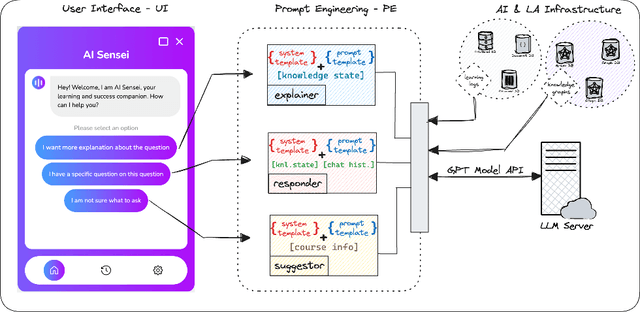
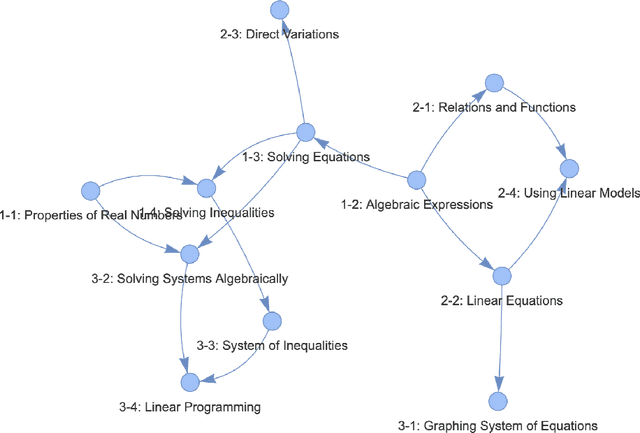
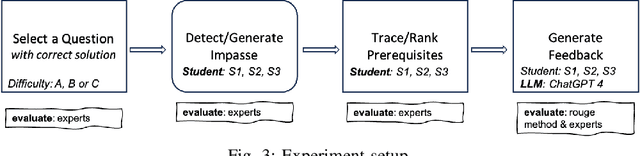
E-learning environments are increasingly harnessing large language models (LLMs) like GPT-3.5 and GPT-4 for tailored educational support. This study introduces an approach that integrates dynamic knowledge graphs with LLMs to offer nuanced student assistance. By evaluating past and ongoing student interactions, the system identifies and appends the most salient learning context to prompts directed at the LLM. Central to this method is the knowledge graph's role in assessing a student's comprehension of topic prerequisites. Depending on the categorized understanding (good, average, or poor), the LLM adjusts its guidance, offering advanced assistance, foundational reviews, or in-depth prerequisite explanations, respectively. Preliminary findings suggest students could benefit from this tiered support, achieving enhanced comprehension and improved task outcomes. However, several issues related to potential errors arising from LLMs were identified, which can potentially mislead students. This highlights the need for human intervention to mitigate these risks. This research aims to advance AI-driven personalized learning while acknowledging the limitations and potential pitfalls, thus guiding future research in technology and data-driven education.