 Add to Chrome
 Add to Firefox
 Add to Edge
Sigma-Branch: Hierarchical Single-Path Network Reconstruction for Dynamic Inference with Reduced Active Parameters
Jun 07, 2026
Deploying deep neural networks on memory-constrained edge accelerators is bottlenecked by per-inference off-chip weight transfer rather than computation: the dense network cannot be retained on-chip, and every parameter must be loaded for every input. Existing model compression reduces this transfer only at the cost of permanent capacity loss. We propose Sigma-Branch (SigmaB), a framework that restructures a pretrained dense network into a hierarchical binary tree composed of a shared backbone, hierarchical routers, and specialized leaves. Pretrained weights are distributed across the tree via activation-based spherical k-means clustering, which jointly initializes router weights and per-branch channel allocations; soft-routing fine-tuning then aligns each leaf with its routed input subset. At inference, the resulting network executes only a single root-to-leaf path, reducing the active-parameter footprint while storing the complete dense parameter set in memory. Across CIFAR-100 / ResNet-50, ImageNet-1K / ResNet-50, and ModelNet40 / PointNet++, SigmaB-Net reduces per-inference active parameters by 58-60% while remaining within 1.72 percentage points (pp) of the dense baseline Top-1. At comparable ImageNet-1K Top-1, the active-parameter reduction exceeds static structured pruning (FPGM, HRank) by 14-23 pp. The cross-modal evaluation, spanning 2D vision and 3D point-cloud backbones, substantiates a framework-level claim that decouples per-inference memory traffic from the total parameter count.

Hardware-accelerated graph neural networks: an alternative approach for neuromorphic event-based audio classification and keyword spotting on SoC FPGA
Feb 18, 2026As the volume of data recorded by embedded edge sensors increases, particularly from neuromorphic devices producing discrete event streams, there is a growing need for hardware-aware neural architectures that enable efficient, low-latency, and energy-conscious local processing. We present an FPGA implementation of event-graph neural networks for audio processing. We utilise an artificial cochlea that converts time-series signals into sparse event data, reducing memory and computation costs. Our architecture was implemented on a SoC FPGA and evaluated on two open-source datasets. For classification task, our baseline floating-point model achieves 92.7% accuracy on SHD dataset - only 2.4% below the state of the art - while requiring over 10x and 67x fewer parameters. On SSC, our models achieve 66.9-71.0% accuracy. Compared to FPGA-based spiking neural networks, our quantised model reaches 92.3% accuracy, outperforming them by up to 19.3% while reducing resource usage and latency. For SSC, we report the first hardware-accelerated evaluation. We further demonstrate the first end-to-end FPGA implementation of event-audio keyword spotting, combining graph convolutional layers with recurrent sequence modelling. The system achieves up to 95% word-end detection accuracy, with only 10.53 microsecond latency and 1.18 W power consumption, establishing a strong benchmark for energy-efficient event-driven KWS.
Hardware-Accelerated Event-Graph Neural Networks for Low-Latency Time-Series Classification on SoC FPGA
Mar 09, 2025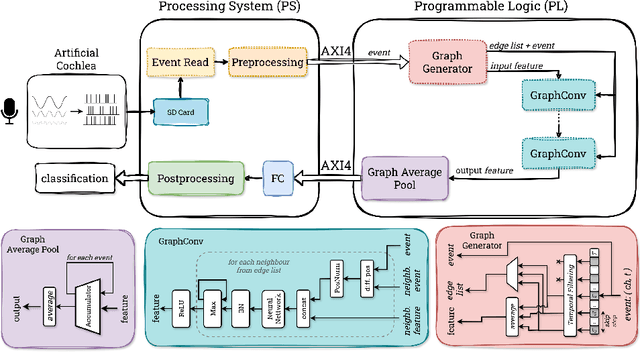
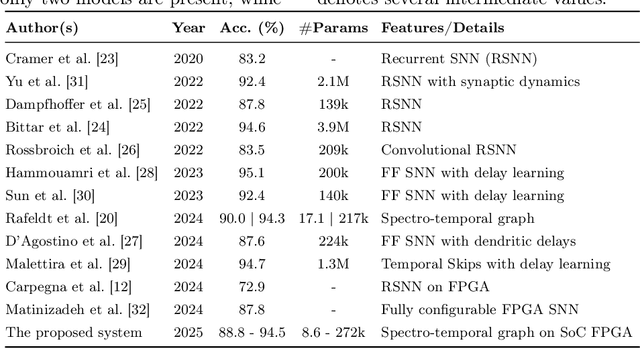
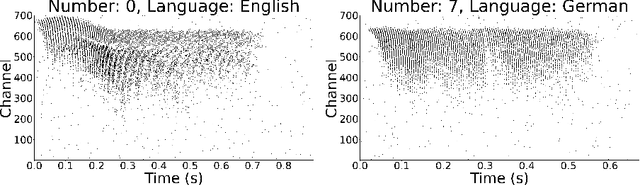
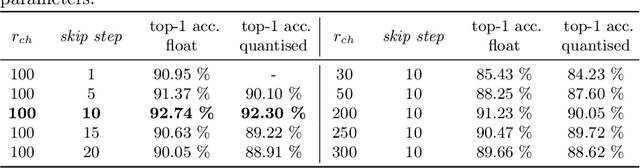
As the quantities of data recorded by embedded edge sensors grow, so too does the need for intelligent local processing. Such data often comes in the form of time-series signals, based on which real-time predictions can be made locally using an AI model. However, a hardware-software approach capable of making low-latency predictions with low power consumption is required. In this paper, we present a hardware implementation of an event-graph neural network for time-series classification. We leverage an artificial cochlea model to convert the input time-series signals into a sparse event-data format that allows the event-graph to drastically reduce the number of calculations relative to other AI methods. We implemented the design on a SoC FPGA and applied it to the real-time processing of the Spiking Heidelberg Digits (SHD) dataset to benchmark our approach against competitive solutions. Our method achieves a floating-point accuracy of 92.7% on the SHD dataset for the base model, which is only 2.4% and 2% less than the state-of-the-art models with over 10% and 67% fewer model parameters, respectively. It also outperforms FPGA-based spiking neural network implementations by 19.3% and 4.5%, achieving 92.3% accuracy for the quantised model while using fewer computational resources and reducing latency.
eagle: early approximated gradient based learning rate estimator
Feb 03, 2025We propose EAGLE update rule, a novel optimization method that accelerates loss convergence during the early stages of training by leveraging both current and previous step parameter and gradient values. The update algorithm estimates optimal parameters by computing the changes in parameters and gradients between consecutive training steps and leveraging the local curvature of the loss landscape derived from these changes. However, this update rule has potential instability, and to address that, we introduce an adaptive switching mechanism that dynamically selects between Adam and EAGLE update rules to enhance training stability. Experiments on standard benchmark datasets demonstrate that EAGLE optimizer, which combines this novel update rule with the switching mechanism achieves rapid training loss convergence with fewer epochs, compared to conventional optimization methods.