 Add to Chrome
 Add to Firefox
 Add to Edge
Radiomic Feature Selection Using Gradient Loss of Deep Neural Network for Lung Cancer Stage Detection
Jun 03, 2026
Radiomics enables extraction of quantitative imaging biomarkers from medical images and has become an important tool for computer-aided cancer diagnosis. However, radiomics datasets are typically high-dimensional with limited samples, making feature selection a critical step for building reliable predictive models. This study proposes a Gradient-Loss Recursive Feature Elimination (GL-RFE) framework that integrates gradient sensitivity analysis from a deep neural network to identify the most influential radiomic features for lung cancer stage detection. A total of 106 radiomic features were extracted from chest Computed Tomography (CT) scans using the PyRadiomics extension of the 3D Slicer platform. The proposed method evaluates feature importance by computing gradients of the network loss with respect to input features and recursively eliminates features with minimal contribution. The resulting top-15 radiomic features are used to train a deep neural network classifier for distinguishing early-stage and advanced-stage lung cancer. The proposed framework achieves strong classification performance, with accuracy of 90.22%, precision of 90.10%, recall of 90.24%, and F1-score of 90.16% on the test dataset. Visualization analyses, including correlation heat maps and distribution plots, further confirm reduced feature redundancy and improved class separability. Compared to conventional feature selection techniques, GL-RFE effectively captures nonlinear feature interactions and enhances model generalization. The presented protocol provides a reproducible and interpretable methodology for radiomics-based cancer stage detection and is particularly suitable for high-dimensional, small-sample biomedical datasets, with potential applications in other domains such as genomics and multimodal clinical analysis.

Optimisation of SOUP-GAN and CSR-GAN for High Resolution MR Images Reconstruction
Feb 27, 2026Magnetic Resonance (MR) imaging is a diagnostic tool used in modern medicine; however, its output can be affected by motion artefacts and may be limited by equipment. This research focuses on MRI image quality enhancement using two efficient Generative Adversarial Networks (GANs) models: SOUP-GAN and CSR-GAN. In both models, meaningful architectural modifications were introduced. The generator and discriminator of each were further deepened by adding convolutional layers and were enhanced in filter sizes as well. The LeakyReLU activation function was used to improve gradient flow, and hyperparameter tuning strategies were applied, including a reduced learning rate and an optimal batch size. Moreover, spectral normalisation was proposed to address mode collapse and improve training stability. The experiment shows that CSR-GAN has better performance in reconstructing the image with higher frequency details and reducing noise compared to other methods, with an optimised PSNR of 34.6 and SSIM of 0.89. However, SOUP-GAN performed the best in terms of delivering less noisy images with good structures, achieving a PSNR of 34.4 and SSIM of 0.83. The obtained results indicate that the proposed enhanced GAN model can be a useful tool for MR image quality improvement for subsequent better disease diagnostics.
Benchmarking Vanilla GAN, DCGAN, and WGAN Architectures for MRI Reconstruction: A Quantitative Analysis
Jan 30, 2026Magnetic Resonance Imaging (MRI) is a crucial imaging modality for viewing internal body structures. This research work analyses the performance of popular GAN models for accurate and precise MRI reconstruction by enhancing image quality and improving diagnostic accuracy. Three GAN architectures considered in this study are Vanilla GAN, Deep Convolutional GAN (DCGAN), and Wasserstein GAN (WGAN). They were trained and evaluated using knee, brain, and cardiac MRI datasets to assess their generalizability across body regions. While the Vanilla GAN operates on the fundamentals of the adversarial network setup, DCGAN advances image synthesis by securing the convolutional layers, giving a superior appearance to the prevalent spatial features. Training instability is resolved in WGAN through the Wasserstein distance to minimize an unstable regime, therefore, ensuring stable convergence and high-quality images. The GAN models were trained and tested using 1000 MR images of an anonymized knee, 805 images of Heart, 90 images of Brain MRI dataset. The Structural Similarity Index (SSIM) for Vanilla GAN is 0.84, DCGAN is 0.97, and WGAN is 0.99. The Peak Signal to Noise Ratio (PSNR) for Vanilla GAN is 26, DCGAN is 49.3, and WGAN is 43.5. The results were further statistically validated. This study shows that DCGAN and WGAN-based frameworks are promising in MR image reconstruction because of good image quality and superior accuracy. With the first cross-organ benchmark of baseline GANs under a common preprocessing pipeline, this work provides a reproducible benchmark for future hybrid GANs and clinical MRI applications.
* 20 pages
Detection and Forecasting of Parkinson Disease Progression from Speech Signal Features Using MultiLayer Perceptron and LSTM
Dec 24, 2024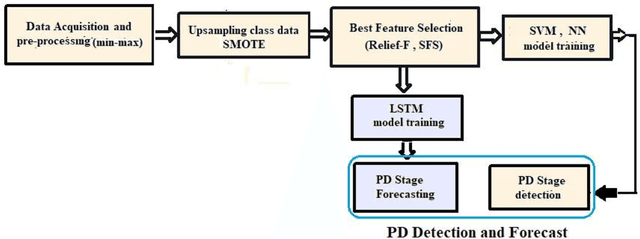
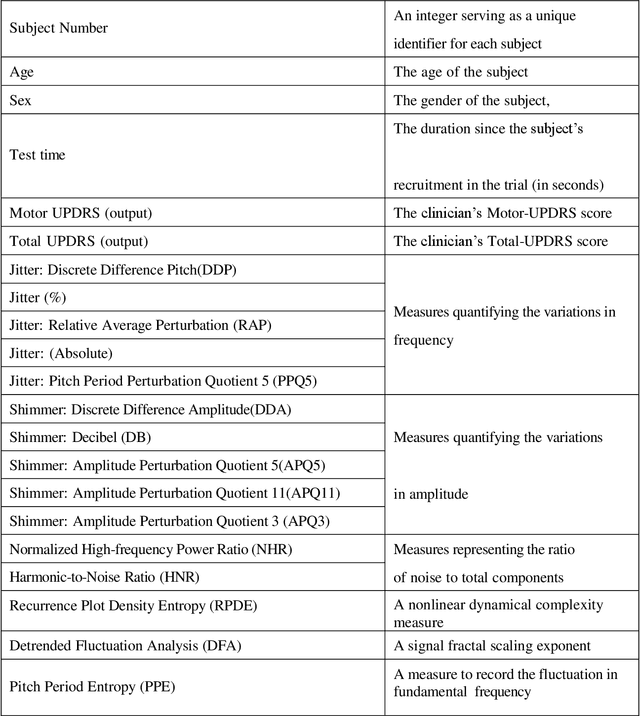
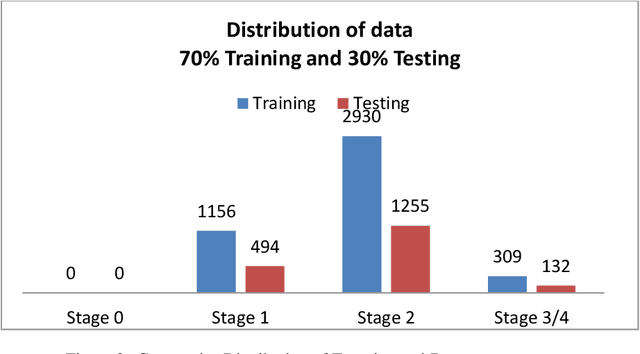
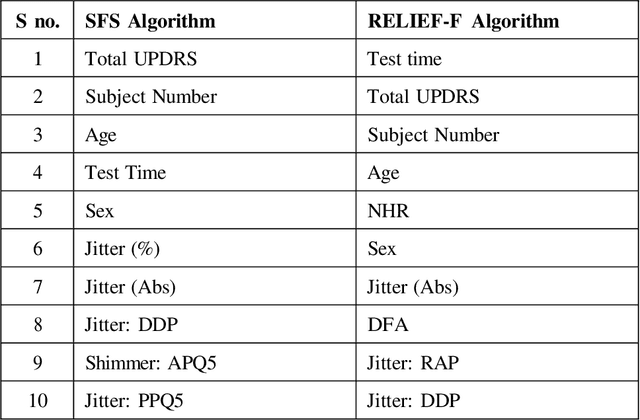
Accurate diagnosis of Parkinson disease, especially in its early stages, can be a challenging task. The application of machine learning techniques helps improve the diagnostic accuracy of Parkinson disease detection but only few studies have presented work towards the prediction of disease progression. In this research work, Long Short Term Memory LSTM was trained using the diagnostic features on Parkinson patients speech signals, to predict the disease progression while a Multilayer Perceptron MLP was trained on the same diagnostic features to detect the disease. Diagnostic features selected using two well-known feature selection methods named Relief-F and Sequential Forward Selection and applied on LSTM and MLP have shown to accurately predict the disease progression as stage 2 and 3 and its existence respectively.
Radiomic feature selection for lung cancer classifiers
Mar 16, 2020


Machine learning methods with quantitative imaging features integration have recently gained a lot of attention for lung nodule classification. However, there is a dearth of studies in the literature on effective features ranking methods for classification purpose. Moreover, optimal number of features required for the classification task also needs to be evaluated. In this study, we investigate the impact of supervised and unsupervised feature selection techniques on machine learning methods for nodule classification in Computed Tomography (CT) images. The research work explores the classification performance of Naive Bayes and Support Vector Machine(SVM) when trained with 2, 4, 8, 12, 16 and 20 highly ranked features from supervised and unsupervised ranking approaches. The best classification results were achieved using SVM trained with 8 radiomic features selected from supervised feature ranking methods and the accuracy was 100%. The study further revealed that very good nodule classification can be achieved by training any of the SVM or Naive Bayes with a fewer radiomic features. A periodic increment in the number of radiomic features from 2 to 20 did not improve the classification results whether the selection was made using supervised or unsupervised ranking approaches.