 Add to Chrome
 Add to Firefox
 Add to Edge
Improving Translation Quality by Selecting Better Data for LLM Fine-Tuning: A Comparative Analysis
Dec 12, 2025
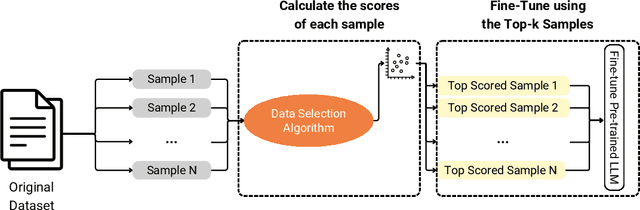
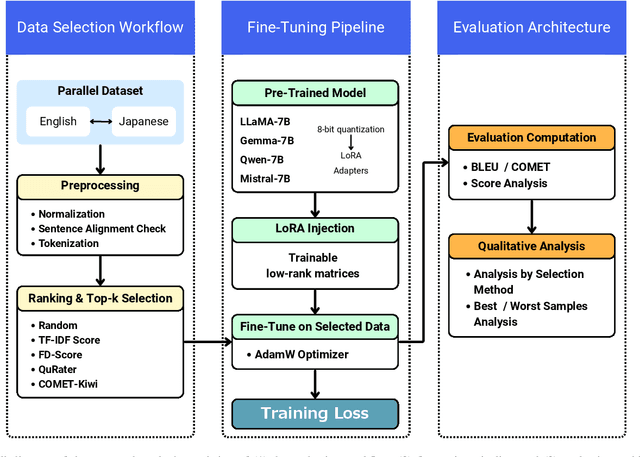
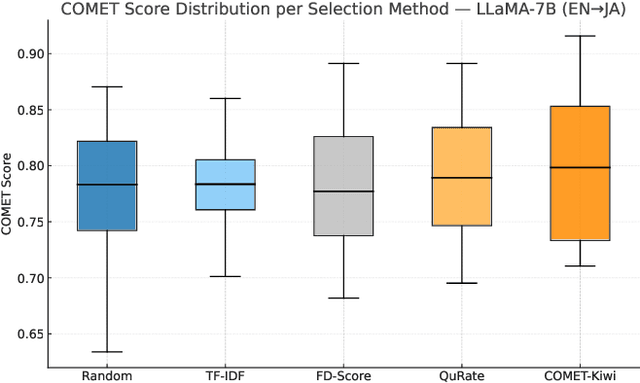
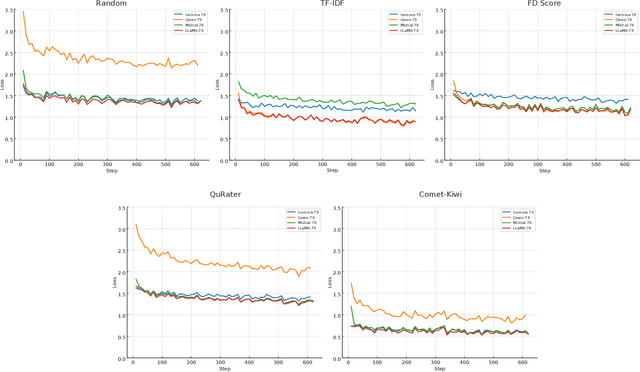
We investigated the impact of data selection on machine translation fine-tuning for open LLMs. Using Japanese-English corpora, we compare five selectors: TF-IDF, COMET Kiwi, QuRate, FD-Score, and random selection, under controlled training conditions. We observed that semantic selectors consistently outperform lexical and geometry-based heuristics, and that even when the selected data differ by less than 3%, the impact on model performance is substantial, underscoring the sensitivity of fine-tuning to data quality.

Exploring Parameter-Efficient Fine-Tuning and Backtranslation for the WMT 25 General Translation Task
Nov 15, 2025In this paper, we explore the effectiveness of combining fine-tuning and backtranslation on a small Japanese corpus for neural machine translation. Starting from a baseline English{\textrightarrow}Japanese model (COMET = 0.460), we first apply backtranslation (BT) using synthetic data generated from monolingual Japanese corpora, yielding a modest increase (COMET = 0.468). Next, we fine-tune (FT) the model on a genuine small parallel dataset drawn from diverse Japanese news and literary corpora, achieving a substantial jump to COMET = 0.589 when using Mistral 7B. Finally, we integrate both backtranslation and fine-tuning{ -- }first augmenting the small dataset with BT generated examples, then adapting via FT{ -- }which further boosts performance to COMET = 0.597. These results demonstrate that, even with limited training data, the synergistic use of backtranslation and targeted fine-tuning on Japanese corpora can significantly enhance translation quality, outperforming each technique in isolation. This approach offers a lightweight yet powerful strategy for improving low-resource language pairs.