 Add to Chrome
 Add to Firefox
 Add to Edge
Musical Attention Transformer: Music Generation Using a Music-Specific Attention Model
May 20, 2026
This study aims to enhance the quality of music generation using Transformers by incorporating meta-information. While Transformer-based approaches are effective at capturing long-term dependencies in musical compositions, the music they generate often suffers from issues such as excessive repetition or duplication of notes, leading to unnatural melodies. To address these limitations, we propose Musical Attention, a mechanism that incorporates meta-information such as bar numbers, key, signatures, and tempos into the attention process. Musical Attention explicitly leverages both the structural properties of music and its associated metadata, enabling the Transformer's attention mechanism to operate more effectively and thereby improving the quality of the generated output. In our framework, each musical note is represented as a combination of five events-pitch, bar number, onset, duration, and velocity in addition to the three metadata elements. The attention mechanism is then modified to reflect the correlations among these eight features, allowing the model to better capture the inherent characteristics of musical composition. Experimental results demonstrate that the model incorporating Musical Attention outperforms prior methods, such as Full Attention and Strided Attention, in terms of musical coherence, variation, and overall quality. Notably, it significantly reduces repetition and enhances the model's ability to generate diverse, harmonically consistent melodies. Musical Attention thus represents a meaningful advancement in AI-driven music generation, facilitating the creation of more natural and expressive compositions.

USDs: A universal stabilizer decoder framework using symmetry
Jan 21, 2026Quantum error correction is indispensable to achieving reliable quantum computation. When quantum information is encoded redundantly, a larger Hilbert space is constructed using multiple physical qubits, and the computation is performed within a designated subspace. When applying deep learning to the decoding of quantum error-correcting codes, a key challenge arises from the non-uniqueness between the syndrome measurements provided to the decoder and the corresponding error patterns that constitute the ground-truth labels. Building upon prior work that addressed this issue for the toric code by re-optimizing the decoder with respect to the symmetry inherent in the parity-check structure, we generalize this approach to arbitrary stabilizer codes. In our experiments, we employed multilayer perceptrons to approximate continuous functions that complement the syndrome measurements of the Color code and the Golay code. Using these models, we performed decoder re-optimization for each code. For the Color code, we achieved an improvement of approximately 0.8% in decoding accuracy at a physical error rate of 5%, while for the Golay code the accuracy increased by about 0.1%. Furthermore, from the evaluation of the geometric and algebraic structures in the continuous function approximation for each code, we showed that the design of generalized continuous functions is advantageous for learning the geometric structure inherent in the code. Our results also indicate that approximations that faithfully reproduce the code structure can have a significant impact on the effectiveness of reoptimization. This study demonstrates that the re-optimization technique previously shown to be effective for the Toric code can be generalized to address the challenge of label degeneracy that arises when applying deep learning to the decoding of stabilizer codes.
QGEC : Quantum Golay Code Error Correction
Dec 12, 2025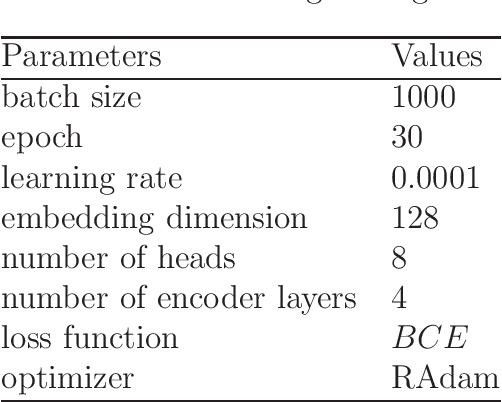
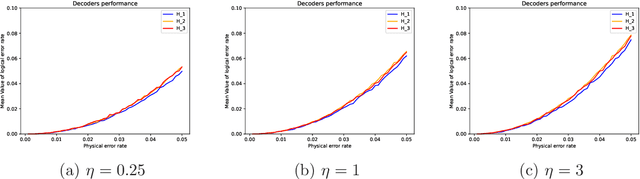
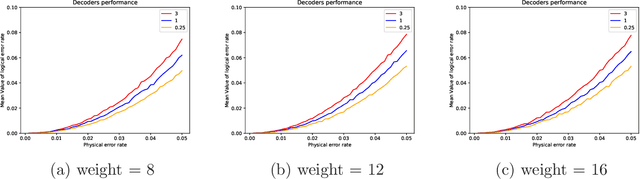
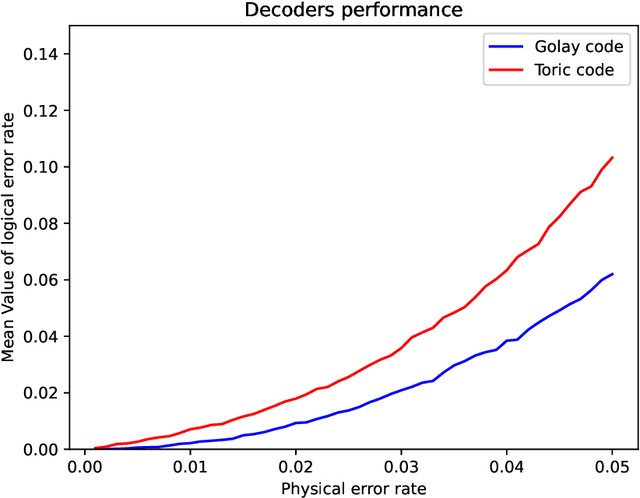
Quantum computers have the possibility of a much reduced calculation load compared with classical computers in specific problems. Quantum error correction (QEC) is vital for handling qubits, which are vulnerable to external noise. In QEC, actual errors are predicted from the results of syndrome measurements by stabilizer generators, in place of making direct measurements of the data qubits. Here, we propose Quantum Golay code Error Correction (QGEC), a QEC method using Golay code, which is an efficient coding method in classical information theory. We investigated our method's ability in decoding calculations with the Transformer. We evaluated the accuracy of the decoder in a code space defined by the generative polynomials with three different weights sets and three noise models with different correlations of bit-flip error and phase-flip error. Furthermore, under a noise model following a discrete uniform distribution, we compared the decoding performance of Transformer decoders with identical architectures trained respectively on Golay and toric codes. The results showed that the noise model with the smaller correlation gave better accuracy, while the weights of the generative polynomials had little effect on the accuracy of the decoder. In addition, they showed that Golay code requiring 23 data qubits and having a code distance of 7 achieved higher decoding accuracy than toric code which requiring 50 data qubits and having a code distance of 5. This suggests that implementing quantum error correction using a Transformer may enable the Golay code to realize fault-tolerant quantum computation more efficiently.