 Add to Chrome
 Add to Firefox
 Add to Edge
Determining Energy Efficiency Sweet Spots in Production LLM Inference
Feb 05, 2026
Large Language Models (LLMs) inference is central in modern AI applications, making it critical to understand their energy footprint. Existing approaches typically estimate energy consumption through simple linear functions of input and output sequence lengths, yet our observations reveal clear Energy Efficiency regimes: peak efficiency occurs with short-to-moderate inputs and medium-length outputs, while efficiency drops sharply for long inputs or very short outputs, indicating a non-linear dependency. In this work, we propose an analytical model derived from the computational and memory-access complexity of the Transformer architecture, capable of accurately characterizing the efficiency curve as a function of input and output lengths. To assess its accuracy, we evaluate energy consumption using TensorRT-LLM on NVIDIA H100 GPUs across a diverse set of LLMs ranging from 1B to 9B parameters, including OPT, LLaMA, Gemma, Falcon, Qwen2, and Granite, tested over input and output lengths from 64 to 4096 tokens, achieving a mean MAPE of 1.79%. Our results show that aligning sequence lengths with these efficiency "Sweet Spots" can substantially reduce energy usage, supporting informed truncation, summarization, and adaptive generation strategies in production systems.

Assessing Tenstorrent's RISC-V MatMul Acceleration Capabilities
May 09, 2025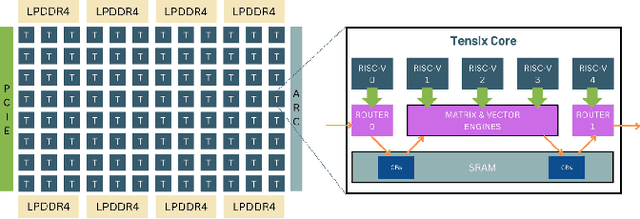
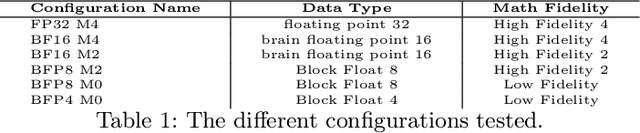
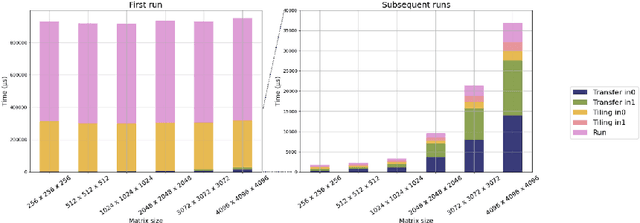
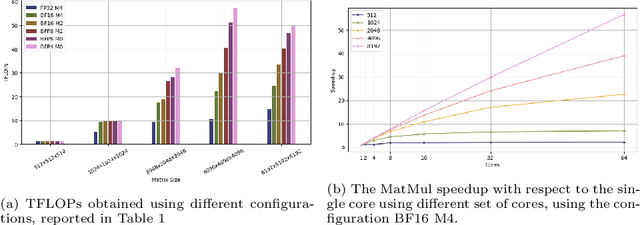
The increasing demand for generative AI as Large Language Models (LLMs) services has driven the need for specialized hardware architectures that optimize computational efficiency and energy consumption. This paper evaluates the performance of the Tenstorrent Grayskull e75 RISC-V accelerator for basic linear algebra kernels at reduced numerical precision, a fundamental operation in LLM computations. We present a detailed characterization of Grayskull's execution model, gridsize, matrix dimensions, data formats, and numerical precision impact computational efficiency. Furthermore, we compare Grayskull's performance against state-of-the-art architectures with tensor acceleration, including Intel Sapphire Rapids processors and two NVIDIA GPUs (V100 and A100). Whilst NVIDIA GPUs dominate raw performance, Grayskull demonstrates a competitive trade-off between power consumption and computational throughput, reaching a peak of 1.55 TFLOPs/Watt with BF16.