 Add to Chrome
 Add to Firefox
 Add to Edge
Attention in Motion: Secure Platooning via Transformer-based Misbehavior Detection
Dec 22, 2025
Vehicular platooning promises transformative improvements in transportation efficiency and safety through the coordination of multi-vehicle formations enabled by Vehicle-to-Everything (V2X) communication. However, the distributed nature of platoon coordination creates security vulnerabilities, allowing authenticated vehicles to inject falsified kinematic data, compromise operational stability, and pose a threat to passenger safety. Traditional misbehaviour detection approaches, which rely on plausibility checks and statistical methods, suffer from high False Positive (FP) rates and cannot capture the complex temporal dependencies inherent in multi-vehicle coordination dynamics. We present Attention In Motion (AIMformer), a transformer-based framework specifically tailored for real-time misbehaviour detection in vehicular platoons with edge deployment capabilities. AIMformer leverages multi-head self-attention mechanisms to simultaneously capture intra-vehicle temporal dynamics and inter-vehicle spatial correlations. It incorporates global positional encoding with vehicle-specific temporal offsets to handle join/exit maneuvers. We propose a Precision-Focused Binary Cross-Entropy (PFBCE) loss function that penalizes FPs to meet the requirements of safety-critical vehicular systems. Extensive evaluation across 4 platoon controllers, multiple attack vectors, and diverse mobility scenarios demonstrates superior performance ($\geq$ 0.93) compared to state-of-the-art baseline architectures. A comprehensive deployment analysis utilizing TensorFlow Lite (TFLite), Open Neural Network Exchange (ONNX), and TensorRT achieves sub-millisecond inference latency, making it suitable for real-time operation on resource-constrained edge platforms. Hence, validating AIMformer is viable for both in-vehicle and roadside infrastructure deployment.

AttentionGuard: Transformer-based Misbehavior Detection for Secure Vehicular Platoons
May 15, 2025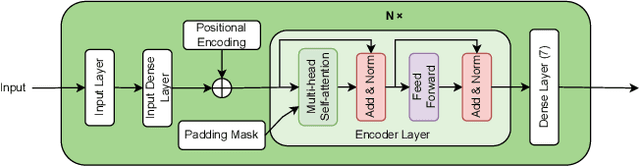
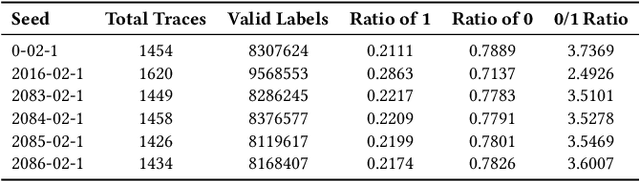
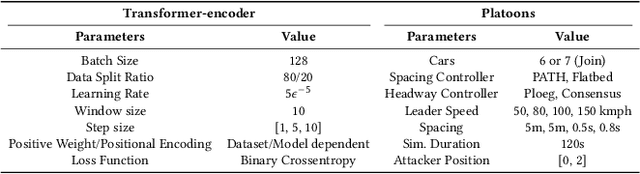
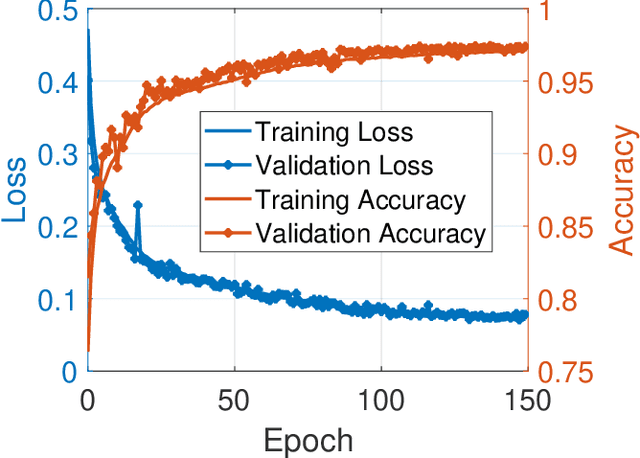
Vehicle platooning, with vehicles traveling in close formation coordinated through Vehicle-to-Everything (V2X) communications, offers significant benefits in fuel efficiency and road utilization. However, it is vulnerable to sophisticated falsification attacks by authenticated insiders that can destabilize the formation and potentially cause catastrophic collisions. This paper addresses this challenge: misbehavior detection in vehicle platooning systems. We present AttentionGuard, a transformer-based framework for misbehavior detection that leverages the self-attention mechanism to identify anomalous patterns in mobility data. Our proposal employs a multi-head transformer-encoder to process sequential kinematic information, enabling effective differentiation between normal mobility patterns and falsification attacks across diverse platooning scenarios, including steady-state (no-maneuver) operation, join, and exit maneuvers. Our evaluation uses an extensive simulation dataset featuring various attack vectors (constant, gradual, and combined falsifications) and operational parameters (controller types, vehicle speeds, and attacker positions). Experimental results demonstrate that AttentionGuard achieves up to 0.95 F1-score in attack detection, with robust performance maintained during complex maneuvers. Notably, our system performs effectively with minimal latency (100ms decision intervals), making it suitable for real-time transportation safety applications. Comparative analysis reveals superior detection capabilities and establishes the transformer-encoder as a promising approach for securing Cooperative Intelligent Transport Systems (C-ITS) against sophisticated insider threats.