 Add to Chrome
 Add to Firefox
 Add to Edge
Sequencing to Mitigate Catastrophic Forgetting in Continual Learning
Dec 18, 2025
To cope with real-world dynamics, an intelligent system needs to incrementally acquire, update, and exploit knowledge throughout its lifetime. This ability, known as Continual learning, provides a foundation for AI systems to develop themselves adaptively. Catastrophic forgetting is a major challenge to the progress of Continual Learning approaches, where learning a new task usually results in a dramatic performance drop on previously learned ones. Many approaches have emerged to counteract the impact of CF. Most of the proposed approaches can be categorized into five classes: replay-based, regularization-based, optimization-based, representation-based, and architecture-based. In this work, we approach the problem from a different angle, specifically by considering the optimal sequencing of tasks as they are presented to the model. We investigate the role of task sequencing in mitigating CF and propose a method for determining the optimal task order. The proposed method leverages zero-shot scoring algorithms inspired by neural architecture search (NAS). Results demonstrate that intelligent task sequencing can substantially reduce CF. Moreover, when combined with traditional continual learning strategies, sequencing offers enhanced performance and robustness against forgetting. Additionally, the presented approaches can find applications in other fields, such as curriculum learning.

Distributed Learning and Inference Systems: A Networking Perspective
Jan 09, 2025

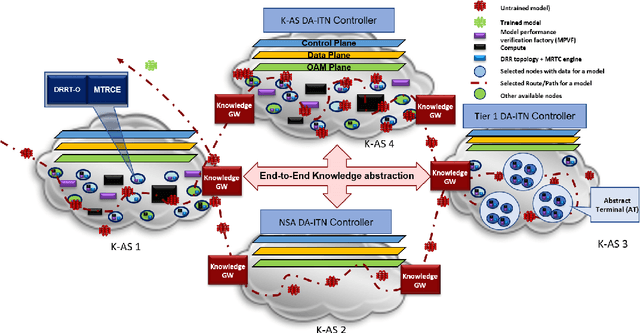

Machine learning models have achieved, and in some cases surpassed, human-level performance in various tasks, mainly through centralized training of static models and the use of large models stored in centralized clouds for inference. However, this centralized approach has several drawbacks, including privacy concerns, high storage demands, a single point of failure, and significant computing requirements. These challenges have driven interest in developing alternative decentralized and distributed methods for AI training and inference. Distribution introduces additional complexity, as it requires managing multiple moving parts. To address these complexities and fill a gap in the development of distributed AI systems, this work proposes a novel framework, Data and Dynamics-Aware Inference and Training Networks (DA-ITN). The different components of DA-ITN and their functions are explored, and the associated challenges and research areas are highlighted.