 Add to Chrome
 Add to Firefox
 Add to Edge
Static in Frames, Dynamic in Events: Rethinking Features in Event Cameras as Motion Cues
Aug 11, 2026
Event cameras capture intensity changes asynchronously with high temporal resolution, requiring novel preprocessing methods for downstream tasks. Unlike static intensity snapshots, event data inherently encode information about scene dynamics and object motion, meaning that features derived from events can exhibit behaviors with no direct analogue in frame-based vision. In this paper, we analyze two features used in event-based corner detection---the eigenvalues of the structure tensor and the spatiotemporal density values---and show that they are \emph{motion cues}. We hypothesize that these features, combined with local geometric information, can enhance motion estimation tasks. To validate this, we first theoretically analyze how the eigenvalues of the structure tensor at moving corner points relate to the direction of motion. We then design controlled experiments on a synthetic dataset, confirming that extending local geometric features with eigenvalues and density values provides complementary motion information and is robust to texture and shot noise. Finally, we integrate the proposed features into a state-of-the-art event-based optical flow network and evaluate on the real-world DSEC benchmark, where the added features consistently improve accuracy, with the largest gains in data-scarce scenarios and for lower-capacity models. The code for this paper can be found at: \href{https://github.com/hesamaraghi/static-in-frames-dynamic-in-events}{https://github.com/hesamaraghi/static-in-frames-dynamic-in-events}.

Cooking beyond Frames: A Stereo Event Camera Dataset in the Kitchen
Aug 05, 2026Event cameras, also known as neuromorphic cameras, have gained significant attention in recent years due to their high temporal resolution, high dynamic range, and low power consumption. While many studies and datasets in neuromorphic vision have focused on automotive and drone applications, human-centric daily-life scenarios remain largely underrepresented, despite their importance for developing and benchmarking event-based perception systems. Moreover, the few existing event-based human activity datasets are typically recorded with scripted human actions, limiting their ability to capture natural human behaviors. In this paper, we introduce EventKitchen, a large-scale stereo event camera benchmark dataset of human cooking activities in the kitchen. EventKitchen is egocentrically collected from 10 participants in 13 diverse kitchens, where the participants wear a helmet with multiple sensors and naturally perform cooking activities, without any scripted actions. EventKitchen comprises 5.5 hours of stereo event recordings with synchronized RGB, depth, and IMU data. We provide human annotations for 10,762 action segments and 13,482 bounding boxes. We train baseline models on EventKitchen to perform multiple event-based tasks, including action recognition, object detection, and stereo depth estimation. By capturing natural, real-world human activities, EventKitchen establishes a challenging benchmark for neuromorphic vision beyond autonomous driving.
Making Every Event Count: Balancing Data Efficiency and Accuracy in Event Camera Subsampling
May 27, 2025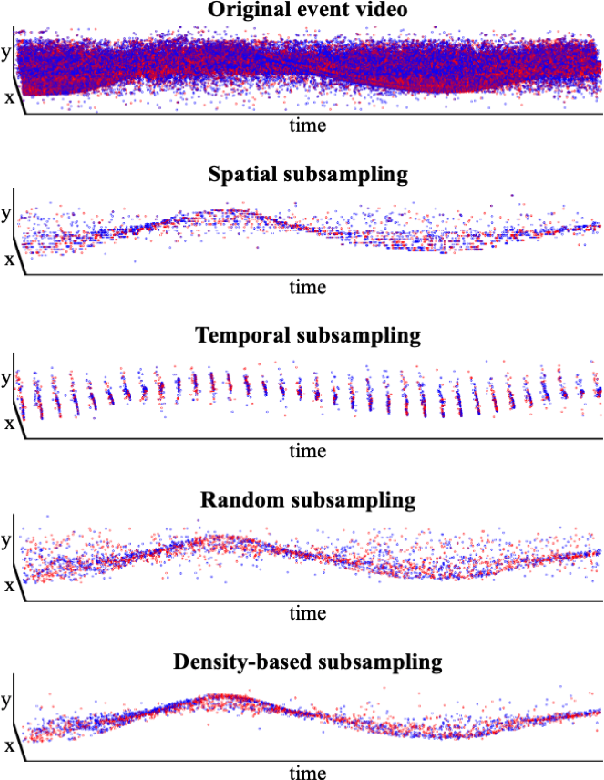
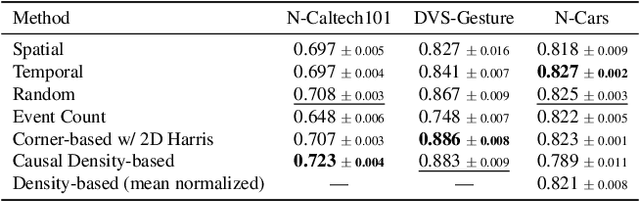
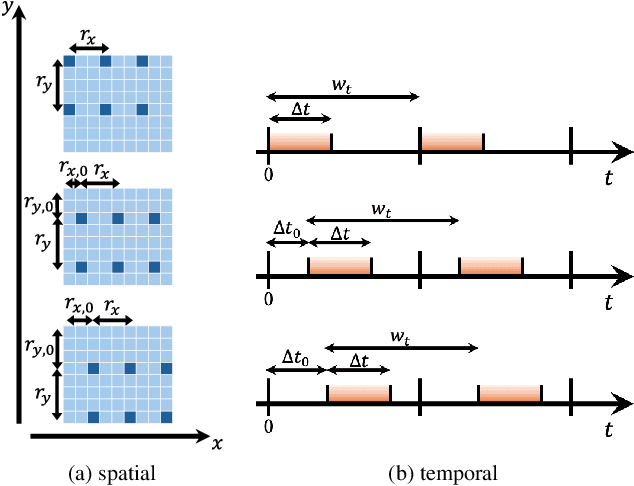
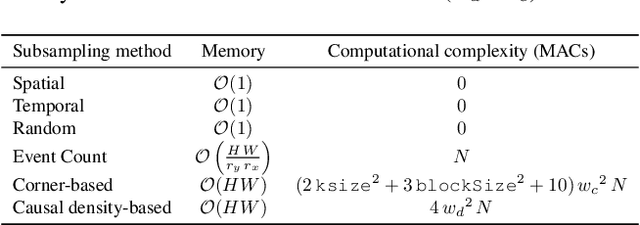
Event cameras offer high temporal resolution and power efficiency, making them well-suited for edge AI applications. However, their high event rates present challenges for data transmission and processing. Subsampling methods provide a practical solution, but their effect on downstream visual tasks remains underexplored. In this work, we systematically evaluate six hardware-friendly subsampling methods using convolutional neural networks for event video classification on various benchmark datasets. We hypothesize that events from high-density regions carry more task-relevant information and are therefore better suited for subsampling. To test this, we introduce a simple causal density-based subsampling method, demonstrating improved classification accuracy in sparse regimes. Our analysis further highlights key factors affecting subsampling performance, including sensitivity to hyperparameters and failure cases in scenarios with large event count variance. These findings provide insights for utilization of hardware-efficient subsampling strategies that balance data efficiency and task accuracy. The code for this paper will be released at: https://github.com/hesamaraghi/event-camera-subsampling-methods.
Pushing the boundaries of event subsampling in event-based video classification using CNNs
Sep 13, 2024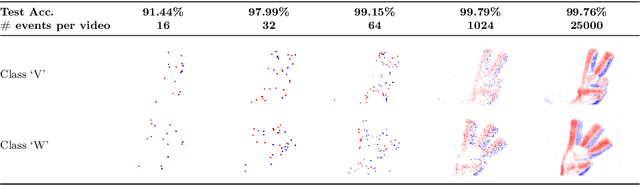

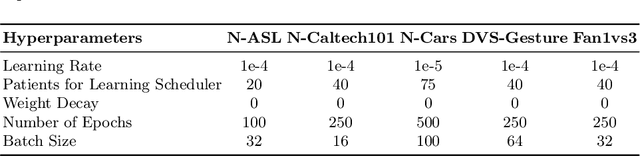
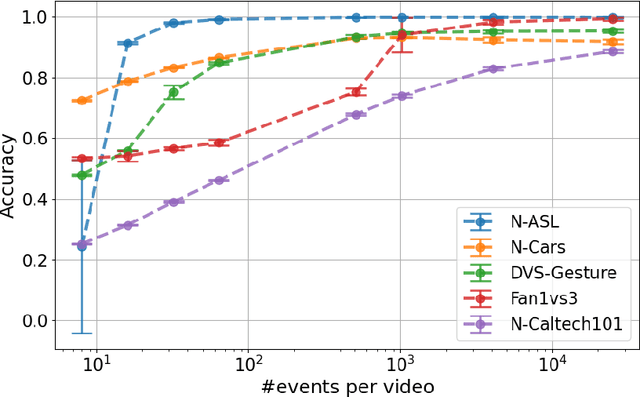
Event cameras offer low-power visual sensing capabilities ideal for edge-device applications. However, their high event rate, driven by high temporal details, can be restrictive in terms of bandwidth and computational resources. In edge AI applications, determining the minimum amount of events for specific tasks can allow reducing the event rate to improve bandwidth, memory, and processing efficiency. In this paper, we study the effect of event subsampling on the accuracy of event data classification using convolutional neural network (CNN) models. Surprisingly, across various datasets, the number of events per video can be reduced by an order of magnitude with little drop in accuracy, revealing the extent to which we can push the boundaries in accuracy vs. event rate trade-off. Additionally, we also find that lower classification accuracy in high subsampling rates is not solely attributable to information loss due to the subsampling of the events, but that the training of CNNs can be challenging in highly subsampled scenarios, where the sensitivity to hyperparameters increases. We quantify training instability across multiple event-based classification datasets using a novel metric for evaluating the hyperparameter sensitivity of CNNs in different subsampling settings. Finally, we analyze the weight gradients of the network to gain insight into this instability.