 Add to Chrome
 Add to Firefox
 Add to Edge
Flexible Kernels for Protein Property Prediction
Jun 09, 2026
Despite its importance to applications in protein design, predicting protein properties like binding affinity and thermostability from sparse experimental data remains a significant challenge. Accordingly, we introduce a class of sequence kernels that exploit evolutionary substitution matrices as well as local linearity and demonstrate that the resulting Gaussian processes provide data-efficient models of protein property landscapes, frequently outperforming alternatives that rely on foundation model embeddings. Furthermore--by learning what are in effect structure-aware substitution matrices--we show that our kernels can readily incorporate structural information from foundation models. We demonstrate that these structure-conditioned kernels are well suited to multi-task learning across multiple protein property landscapes and can decisively outperform local supervised learning methods.

AI solutions for drafting in Magic: the Gathering
Sep 03, 2020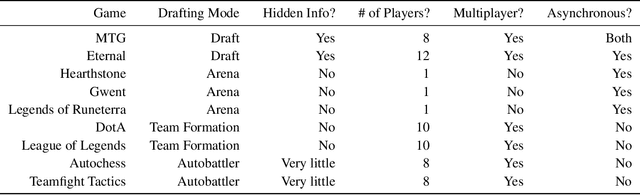
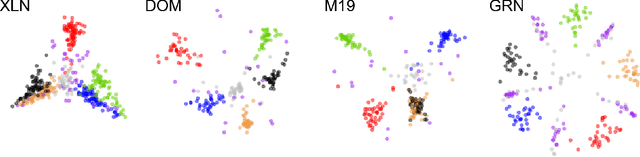
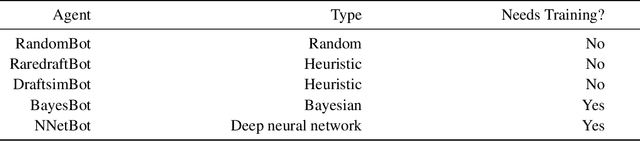
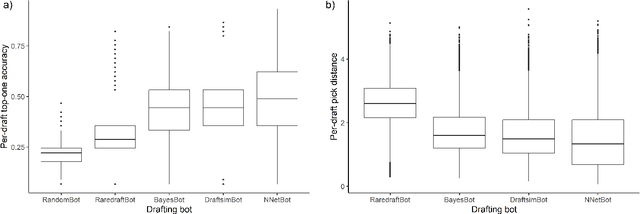
Drafting in Magic: the Gathering is a sub-game of a larger trading card game, where several players progressively build decks by picking cards from a common pool. Drafting poses an interesting problem for game-playing and AI research due to its large search space, mechanical complexity, multiplayer nature, and hidden information. Despite this, drafting remains understudied in part due to a lack of high-quality, public datasets. To rectify this problem, we present a dataset of over 100,000 simulated, anonymized human drafts collected from Draftsim.com. Additionally, we propose four diverse strategies for drafting agents, including a primitive heuristic agent, an expert-tuned complex heuristic agent, a Naive Bayes agent, and a deep neural network agent. We benchmark their ability to emulate human drafting, and show that the deep neural network agent outperforms all other agents, while Naive Bayes and expert-tuned agents outperform simple heuristics. We analyze the accuracy of AI agents across the timeline of a draft, for different cards, and in terms of approximating subtle inconsistencies of human behavior, and describe unique strengths and weaknesses for each agent. This work helps to identify next steps in the creation of humanlike drafting agents, and can serve as a set of useful benchmarks for the next generation of drafting bots.