 Add to Chrome
 Add to Firefox
 Add to Edge
Sparsity, Regularization and Causality in Agricultural Yield: The Case of Paddy Rice in Peru
Sep 25, 2024
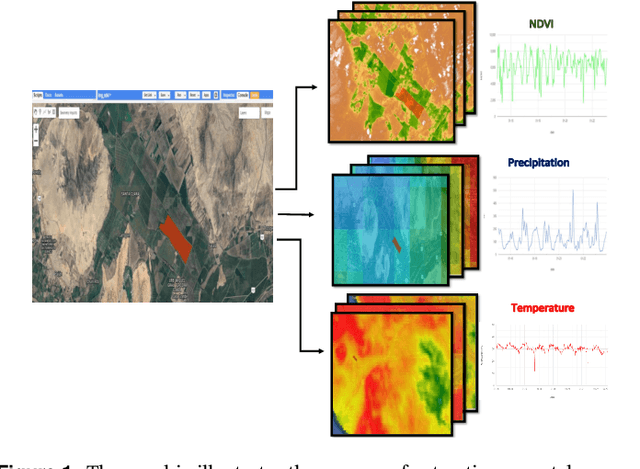
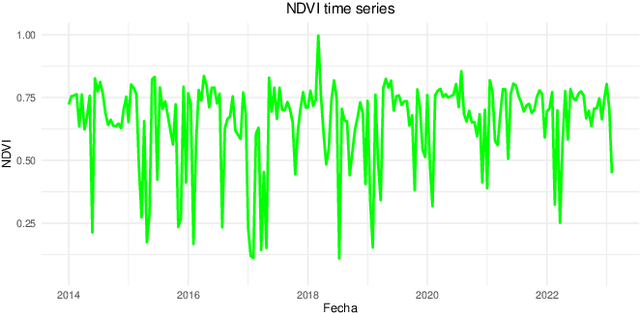
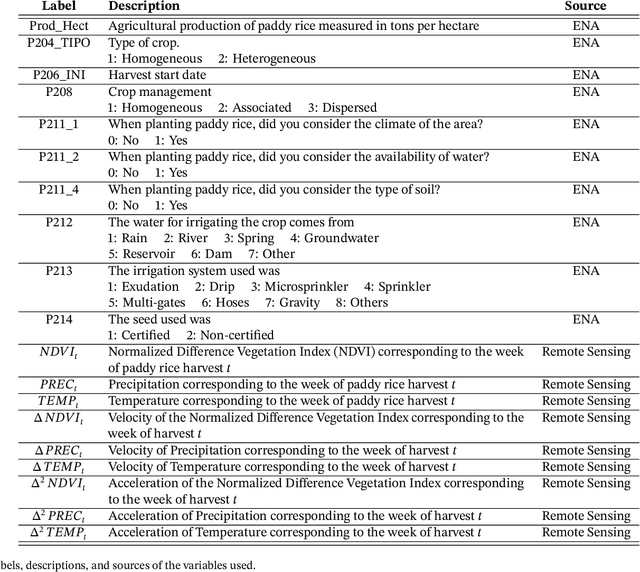
This study introduces a novel approach that integrates agricultural census data with remotely sensed time series to develop precise predictive models for paddy rice yield across various regions of Peru. By utilizing sparse regression and Elastic-Net regularization techniques, the study identifies causal relationships between key remotely sensed variables-such as NDVI, precipitation, and temperature-and agricultural yield. To further enhance prediction accuracy, the first- and second-order dynamic transformations (velocity and acceleration) of these variables are applied, capturing non-linear patterns and delayed effects on yield. The findings highlight the improved predictive performance when combining regularization techniques with climatic and geospatial variables, enabling more precise forecasts of yield variability. The results confirm the existence of causal relationships in the Granger sense, emphasizing the value of this methodology for strategic agricultural management. This contributes to more efficient and sustainable production in paddy rice cultivation.

Statistical Hypothesis Testing for Information Value (IV)
Sep 30, 2023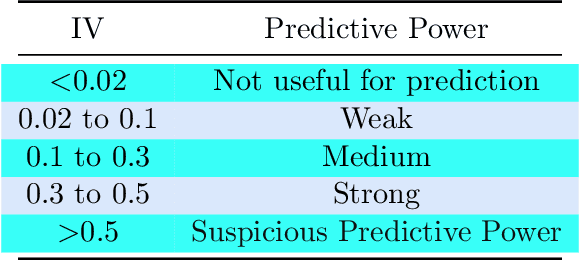
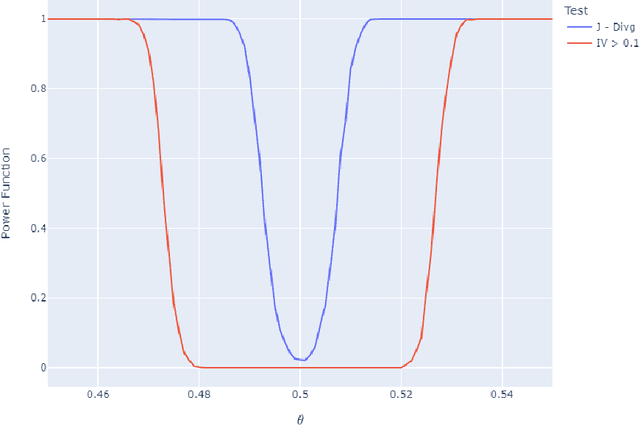

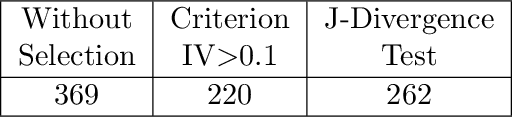
Information value (IV) is a quite popular technique for features selection before the modeling phase. There are practical criteria, based on fixed thresholds for IV, but at the same time mysterious and lacking theoretical arguments, to decide if a predictor has sufficient predictive power to be considered in the modeling phase. However, the mathematical development and statistical inference methods for this technique are almost nonexistent in the literature. In this paper we present a theoretical framework for IV, and at the same time, we propose a non-parametric hypothesis test to evaluate the predictive power of features contemplated in a data set. Due to its relationship with divergence measures developed in the Information Theory, we call our proposal the J - Divergence test. We show how to efficiently compute our test statistic and we study its performance on simulated data. In various scenarios, particularly in unbalanced data sets, we show its superiority over conventional criteria based on fixed thresholds. Furthermore, we apply our test on fraud identification data and provide an open-source Python library, called "statistical-iv"(https://pypi.org/project/statistical-iv/), where we implement our main results.