 Add to Chrome
 Add to Firefox
 Add to Edge
SLeDGe: Semi-Supervised Learning on Data Streams with Graph Structure Learning
Jun 19, 2026
Semi-supervised learning (SSL) on data streams is challenging due to the continuous evolution of high-volume data and the scarcity of labels. Existing methods are limited in leveraging the intrinsic relationships among samples because they typically rely on fixed similarity measures or static graph structures, which cannot capture how relationships evolve over time. We propose SLeDGe, an SSL method for data streams that jointly learns a predictive model and an adaptive graph structure under strict memory and label constraints. SLeDGe maintains compact labeled and unlabeled memories using distinct update strategies, balancing rapid adaptation to novel features with the retention of historical consistency. In addition, by encouraging sparsity in the relational graph, SLeDGe filters out spurious connections and enables effective propagation of label supervision. Across 12 datasets, SLeDGe outperforms state-of-the-art competitors, achieving average relative accuracy gains of 31.7% with 0.1% labels and 14.8% with 1% labels.

Simple yet Effective Node Property Prediction on Edge Streams under Distribution Shifts
Apr 01, 2025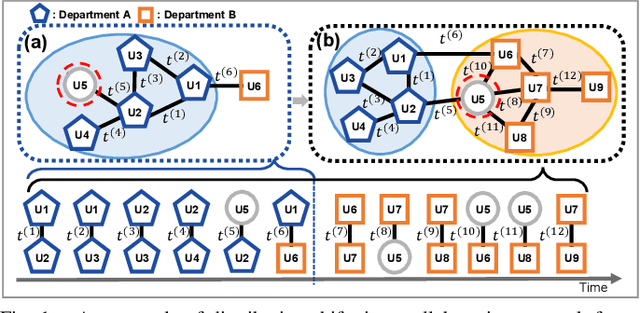
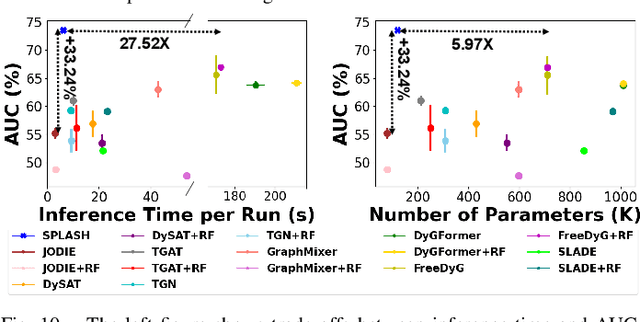

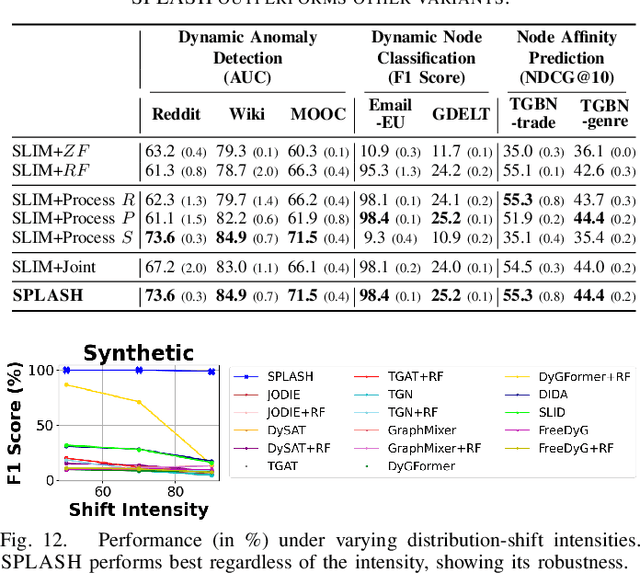
The problem of predicting node properties (e.g., node classes) in graphs has received significant attention due to its broad range of applications. Graphs from real-world datasets often evolve over time, with newly emerging edges and dynamically changing node properties, posing a significant challenge for this problem. In response, temporal graph neural networks (TGNNs) have been developed to predict dynamic node properties from a stream of emerging edges. However, our analysis reveals that most TGNN-based methods are (a) far less effective without proper node features and, due to their complex model architectures, (b) vulnerable to distribution shifts. In this paper, we propose SPLASH, a simple yet powerful method for predicting node properties on edge streams under distribution shifts. Our key contributions are as follows: (1) we propose feature augmentation methods and an automatic feature selection method for edge streams, which improve the effectiveness of TGNNs, (2) we propose a lightweight MLP-based TGNN architecture that is highly efficient and robust under distribution shifts, and (3) we conduct extensive experiments to evaluate the accuracy, efficiency, generalization, and qualitative performance of the proposed method and its competitors on dynamic node classification, dynamic anomaly detection, and node affinity prediction tasks across seven real-world datasets.