 Add to Chrome
 Add to Firefox
 Add to Edge
Score-Based One-step MeanFlow Policy Optimization
May 22, 2026
Diffusion and flow matching have emerged as expressive policy classes in reinforcement learning, but their reliance on multi-step denoising imposes substantial computational overhead at inference time, which is particularly problematic in online RL. MeanFlow offers a promising alternative by learning an average velocity field that maps noise to data in a single network evaluation. However, MeanFlow typically requires samples from the target distribution to construct its target velocity field, which are unavailable in online RL. We propose Score-Based One-step MeanFlow Policy Optimization (SOM), an actor-critic algorithm that resolves this by constructing the target velocity field directly from the Q-function via score estimation and a probability flow ODE, thereby concentrating probability mass on high-value modes. In the fully online RL setting, SOM achieves state-of-the-art performance on locomotion tasks with a single generation step, while substantially reducing both training and inference time compared to prior diffusion- and flow-matching-based policies.

Direct Soft-Policy Sampling via Langevin Dynamics
Feb 08, 2026Soft policies in reinforcement learning define policies as Boltzmann distributions over state-action value functions, providing a principled mechanism for balancing exploration and exploitation. However, realizing such soft policies in practice remains challenging. Existing approaches either depend on parametric policies with limited expressivity or employ diffusion-based policies whose intractable likelihoods hinder reliable entropy estimation in soft policy objectives. We address this challenge by directly realizing soft-policy sampling via Langevin dynamics driven by the action gradient of the Q-function. This perspective leads to Langevin Q-Learning (LQL), which samples actions from the target Boltzmann distribution without explicitly parameterizing the policy. However, directly applying Langevin dynamics suffers from slow mixing in high-dimensional and non-convex Q-landscapes, limiting its practical effectiveness. To overcome this, we propose Noise-Conditioned Langevin Q-Learning (NC-LQL), which integrates multi-scale noise perturbations into the value function. NC-LQL learns a noise-conditioned Q-function that induces a sequence of progressively smoothed value landscapes, enabling sampling to transition from global exploration to precise mode refinement. On OpenAI Gym MuJoCo benchmarks, NC-LQL achieves competitive performance compared to state-of-the-art diffusion-based methods, providing a simple yet powerful solution for online RL.
Offline Imitation Learning by Controlling the Effective Planning Horizon
Jan 18, 2024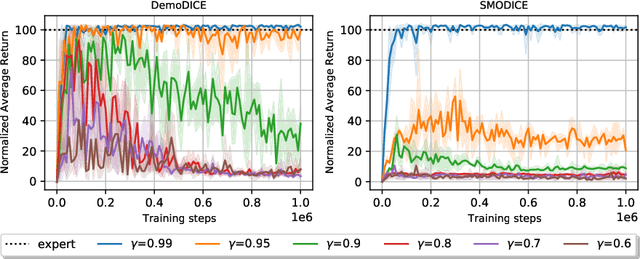
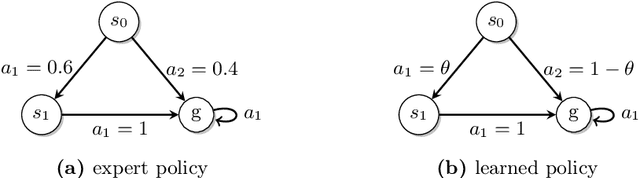
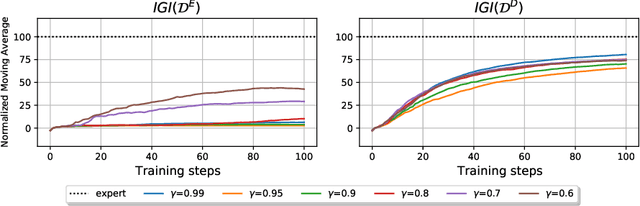
In offline imitation learning (IL), we generally assume only a handful of expert trajectories and a supplementary offline dataset from suboptimal behaviors to learn the expert policy. While it is now common to minimize the divergence between state-action visitation distributions so that the agent also considers the future consequences of an action, a sampling error in an offline dataset may lead to erroneous estimates of state-action visitations in the offline case. In this paper, we investigate the effect of controlling the effective planning horizon (i.e., reducing the discount factor) as opposed to imposing an explicit regularizer, as previously studied. Unfortunately, it turns out that the existing algorithms suffer from magnified approximation errors when the effective planning horizon is shortened, which results in a significant degradation in performance. We analyze the main cause of the problem and provide the right remedies to correct the algorithm. We show that the corrected algorithm improves on popular imitation learning benchmarks by controlling the effective planning horizon rather than an explicit regularization.