 Add to Chrome
 Add to Firefox
 Add to Edge
Learning to Search and Searching to Learn for Generalization in Planning
May 25, 2026
Combinatorial generalization remains a central challenge in Deep Reinforcement Learning (DRL). Classical planning provides a simple yet challenging setting to study this problem through explicit relational descriptions, without requiring learning from perception. In sparse-reward domains, standard RL exploration via real-time search is ineffective, and learning-based planning methods often rely on expert demonstrations, hindsight relabeling, or random walks from the goal state. In contrast, planners rely on best-first search methods such as $\mathrm{A}^\star$ to solve problems from scratch. We propose a self-improving $\mathrm{WA}^\star$ learning framework in combination with a value heuristic represented by a Relational Graph Neural Network: the heuristic guides search, and the resulting search data updates the heuristic via $Q$-learning. This loop yields heuristics that can function as general policies and solve new instances even without search, where DRL otherwise fails, as we show on puzzles such as Sokoban, PushWorld, The Witness, and the 2023 International Planning Competition benchmarks. Notably, we demonstrate strong zero-shot generalization: For example, heuristics trained on Blocksworld instances with fewer than 30 blocks successfully solve instances with 488 blocks without search.

Learning Lifted Action Models from Traces with Minimal Information About Actions and States
May 18, 2026It has been recently shown that lifted STRIPS models can be learned correctly and efficiently from action traces alone; i.e., applicable action sequences from a hidden STRIPS model. The result is remarkable because the states are not assumed to be observable at all, and yet it is not practical enough as STRIPS actions include arguments that are not needed for selecting the actions. This shortcoming has been addressed by assuming that the action traces come instead from a hidden STRIPS+ model where some action arguments are implicit in the hidden action preconditions. A limitation of this approach, however, is that it assumes that the states are fully observable. In this work, we relax these restrictions and consider the problem of learning STRIPS+ action domains from traces in a more general context where the traces carry partial information about both actions and states. In particular, we formulate algorithms and completeness results for three general cases, all of which assume full observability of selected action arguments. In the first case, no observability of the state is assumed; in the second case, full observability of some state predicates is assumed, and in the third case, local observability of some state predicates is assumed instead. Given a STRIPS+ domain, these results characterize the conditions under which an equivalent domain can be learned from traces. Experimental results are reported.
Efficient Lookahead Encoding and Abstracted Width for Learning General Policies in Classical Planning
May 18, 2026Generalized planning aims to learn policies that generalize across collections of instances within a classical planning domain. Recent Graph Neural Network (GNN) approaches have learned nearly perfect policies for several domains. This work improves on the recently published idea of Iterated Width (IW) policies. Therein, the policy broadens its successor scope through an IW-lookahead search that can "jump" over multiple transitions, simplifying the problem structure. Yet, each transition is evaluated individually, leading to unscalable compute costs and expressivity limitations. Furthermore, although IW(1) is attractive because it scales linearly with the number of atoms, it becomes inefficient once thousands of objects are considered, as in the International Planning Competition (IPC) 2023 benchmark. We address both limitations. First, we introduce a vastly more efficient holistic encoding of the entire search tree. It jointly represents IW(1)-reachable states only by their relational differences to the current state, enabling Relational GNNs (R-GNNs) to score all transitions in a single forward pass. Second, we define Abstracted IW(1) to improve scaling through relational abstraction during novelty checks. Rather than testing fully instantiated atoms, it abstracts each atom by replacing all but one argument with its type. The original atom is novel if any of its abstracted forms is novel. This structural compression shifts novelty search scaling from atoms to objects, while preserving meaningful subgoal structure. We evaluate our contributions on the hyperscaling IPC 2023 benchmark and across diverse domains, including domains requiring features beyond the $C_2$ logic fragment. Our policies achieve new state-of-the-art performance, significantly surpassing prior work, including the classical planner LAMA.
Differentiable Learning of Lifted Action Schemas for Classical Planning
May 13, 2026Classical planners can effectively solve very large deterministic MDPs represented in STRIPS or PDDL where states are sets of atoms over objects and relations, and lifted action schemas add or delete these atoms. This compact representation yields strong search heuristics and provides an ideal setting for structural generalization, since lifted relations and action schemas give rise to infinitely many domain instances. A central challenge is to learn these relations and action schemas from data, and recent approaches have addressed this problem using different types of observations. In this work, we develop a novel neural network architecture for learning action schemas from traces where states are fully observed but action arguments are unobserved. The problem is a simplification but an important step towards learning planning domains from sequences of images and action labels, and we aim to solve this simplification in a nearly perfect manner. The challenge lies in learning the action schemas while simultaneously identifying the action arguments from observed state changes. Our approach yields a robust differentiable component that can then be integrated into larger neuro-symbolic models. We evaluate the architecture on various planning domains, where the learned lifted action schemas must recover the ground-truth structure. Additionally, we report experiments on robustness to observation noise and on a variation related to slot-based dynamics models.
First-Order Representation Languages for Goal-Conditioned RL
Dec 22, 2025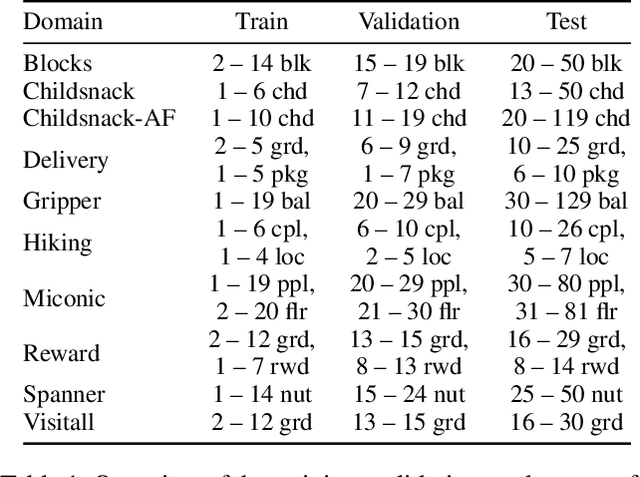
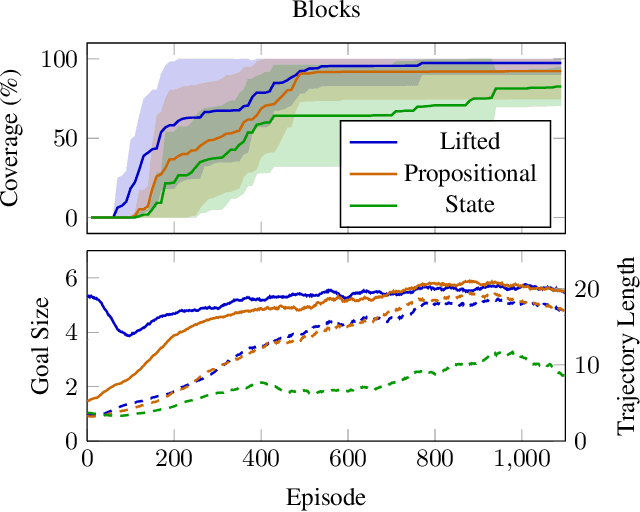
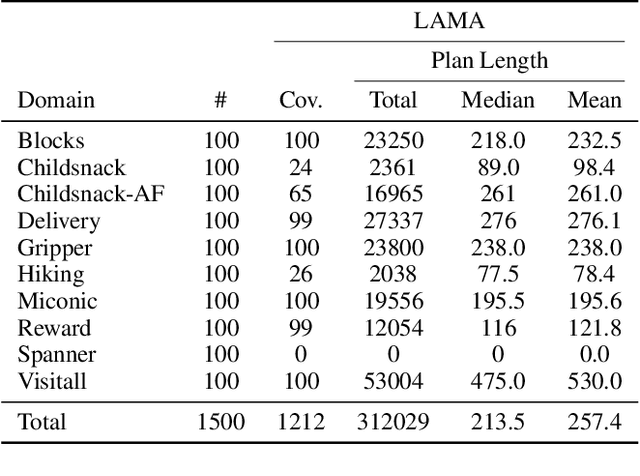
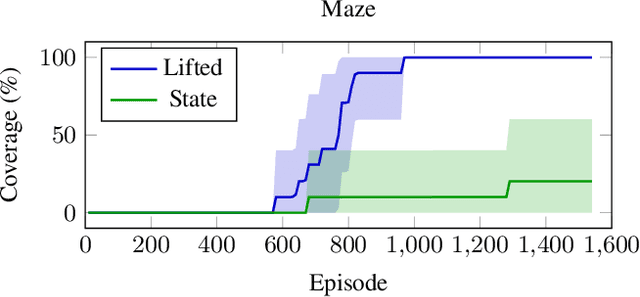
First-order relational languages have been used in MDP planning and reinforcement learning (RL) for two main purposes: specifying MDPs in compact form, and representing and learning policies that are general and not tied to specific instances or state spaces. In this work, we instead consider the use of first-order languages in goal-conditioned RL and generalized planning. The question is how to learn goal-conditioned and general policies when the training instances are large and the goal cannot be reached by random exploration alone. The technique of Hindsight Experience Replay (HER) provides an answer to this question: it relabels unsuccessful trajectories as successful ones by replacing the original goal with one that was actually achieved. If the target policy must generalize across states and goals, trajectories that do not reach the original goal states can enable more data- and time-efficient learning. In this work, we show that further performance gains can be achieved when states and goals are represented by sets of atoms. We consider three versions: goals as full states, goals as subsets of the original goals, and goals as lifted versions of these subgoals. The result is that the latter two successfully learn general policies on large planning instances with sparse rewards by automatically creating a curriculum of easier goals of increasing complexity. The experiments illustrate the computational gains of these versions, their limitations, and opportunities for addressing them.
Learning General Policies with Policy Gradient Methods
Dec 22, 2025While reinforcement learning methods have delivered remarkable results in a number of settings, generalization, i.e., the ability to produce policies that generalize in a reliable and systematic way, has remained a challenge. The problem of generalization has been addressed formally in classical planning where provable correct policies that generalize over all instances of a given domain have been learned using combinatorial methods. The aim of this work is to bring these two research threads together to illuminate the conditions under which (deep) reinforcement learning approaches, and in particular, policy optimization methods, can be used to learn policies that generalize like combinatorial methods do. We draw on lessons learned from previous combinatorial and deep learning approaches, and extend them in a convenient way. From the former, we model policies as state transition classifiers, as (ground) actions are not general and change from instance to instance. From the latter, we use graph neural networks (GNNs) adapted to deal with relational structures for representing value functions over planning states, and in our case, policies. With these ingredients in place, we find that actor-critic methods can be used to learn policies that generalize almost as well as those obtained using combinatorial approaches while avoiding the scalability bottleneck and the use of feature pools. Moreover, the limitations of the DRL methods on the benchmarks considered have little to do with deep learning or reinforcement learning algorithms, and result from the well-understood expressive limitations of GNNs, and the tradeoff between optimality and generalization (general policies cannot be optimal in some domains). Both of these limitations are addressed without changing the basic DRL methods by adding derived predicates and an alternative cost structure to optimize.
Learning Sketch Decompositions in Planning via Deep Reinforcement Learning
Dec 11, 2024In planning and reinforcement learning, the identification of common subgoal structures across problems is important when goals are to be achieved over long horizons. Recently, it has been shown that such structures can be expressed as feature-based rules, called sketches, over a number of classical planning domains. These sketches split problems into subproblems which then become solvable in low polynomial time by a greedy sequence of IW$(k)$ searches. Methods for learning sketches using feature pools and min-SAT solvers have been developed, yet they face two key limitations: scalability and expressivity. In this work, we address these limitations by formulating the problem of learning sketch decompositions as a deep reinforcement learning (DRL) task, where general policies are sought in a modified planning problem where the successor states of a state s are defined as those reachable from s through an IW$(k)$ search. The sketch decompositions obtained through this method are experimentally evaluated across various domains, and problems are regarded as solved by the decomposition when the goal is reached through a greedy sequence of IW$(k)$ searches. While our DRL approach for learning sketch decompositions does not yield interpretable sketches in the form of rules, we demonstrate that the resulting decompositions can often be understood in a crisp manner.
Learning Lifted STRIPS Models from Action Traces Alone: A Simple, General, and Scalable Solution
Nov 22, 2024Learning STRIPS action models from action traces alone is a challenging problem as it involves learning the domain predicates as well. In this work, a novel approach is introduced which, like the well-known LOCM systems, is scalable, but like SAT approaches, is sound and complete. Furthermore, the approach is general and imposes no restrictions on the hidden domain or the number or arity of the predicates. The new learning method is based on an \emph{efficient, novel test} that checks whether the assumption that a predicate is affected by a set of action patterns, namely, actions with specific argument positions, is consistent with the traces. The predicates and action patterns that pass the test provide the basis for the learned domain that is then easily completed with preconditions and static predicates. The new method is studied theoretically and experimentally. For the latter, the method is evaluated on traces and graphs obtained from standard classical domains like the 8-puzzle, which involve hundreds of thousands of states and transitions. The learned representations are then verified on larger instances.
Learning to Ground Existentially Quantified Goals
Sep 30, 2024Goal instructions for autonomous AI agents cannot assume that objects have unique names. Instead, objects in goals must be referred to by providing suitable descriptions. However, this raises problems in both classical planning and generalized planning. The standard approach to handling existentially quantified goals in classical planning involves compiling them into a DNF formula that encodes all possible variable bindings and adding dummy actions to map each DNF term into the new, dummy goal. This preprocessing is exponential in the number of variables. In generalized planning, the problem is different: even if general policies can deal with any initial situation and goal, executing a general policy requires the goal to be grounded to define a value for the policy features. The problem of grounding goals, namely finding the objects to bind the goal variables, is subtle: it is a generalization of classical planning, which is a special case when there are no goal variables to bind, and constraint reasoning, which is a special case when there are no actions. In this work, we address the goal grounding problem with a novel supervised learning approach. A GNN architecture, trained to predict the cost of partially quantified goals over small domain instances is tested on larger instances involving more objects and different quantified goals. The proposed architecture is evaluated experimentally over several planning domains where generalization is tested along several dimensions including the number of goal variables and objects that can bind such variables. The scope of the approach is also discussed in light of the known relationship between GNNs and C2 logics.
Symmetries and Expressive Requirements for Learning General Policies
Sep 24, 2024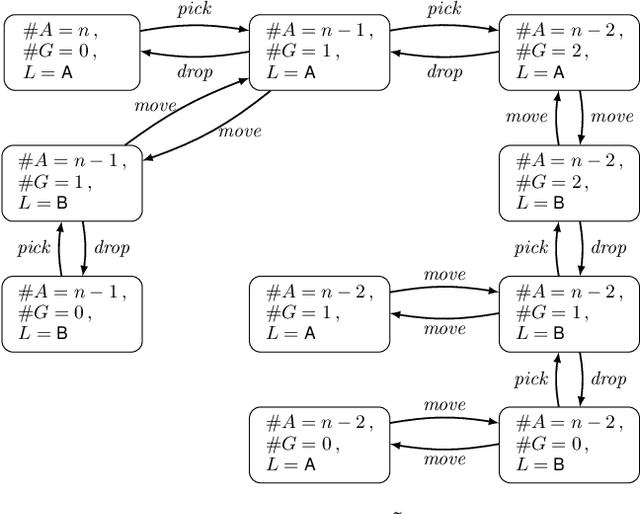
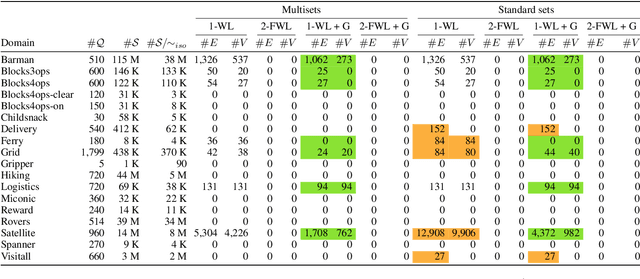
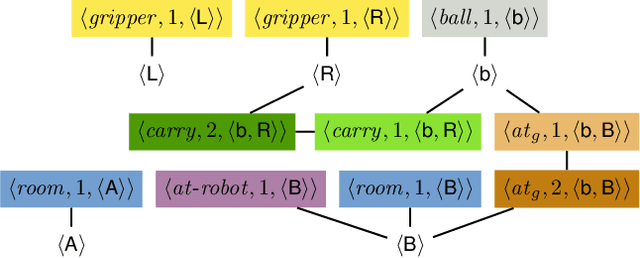
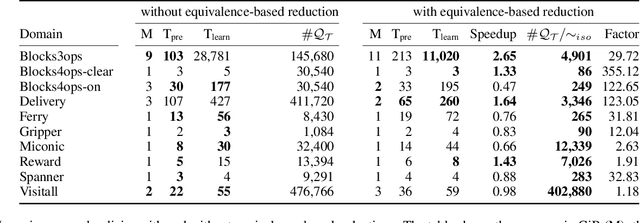
State symmetries play an important role in planning and generalized planning. In the first case, state symmetries can be used to reduce the size of the search; in the second, to reduce the size of the training set. In the case of general planning, however, it is also critical to distinguish non-symmetric states, i.e., states that represent non-isomorphic relational structures. However, while the language of first-order logic distinguishes non-symmetric states, the languages and architectures used to represent and learn general policies do not. In particular, recent approaches for learning general policies use state features derived from description logics or learned via graph neural networks (GNNs) that are known to be limited by the expressive power of C_2, first-order logic with two variables and counting. In this work, we address the problem of detecting symmetries in planning and generalized planning and use the results to assess the expressive requirements for learning general policies over various planning domains. For this, we map planning states to plain graphs, run off-the-shelf algorithms to determine whether two states are isomorphic with respect to the goal, and run coloring algorithms to determine if C_2 features computed logically or via GNNs distinguish non-isomorphic states. Symmetry detection results in more effective learning, while the failure to detect non-symmetries prevents general policies from being learned at all in certain domains.