 Add to Chrome
 Add to Firefox
 Add to Edge
Joint Flow Matching for Generator-Consistent Classification
Jul 27, 2026
We introduce Joint Flow Matching (JFM), a training framework for continuous normalising flows over multiple variables. Standard flow matching transports variables from noise to data simultaneously, offering no natural mechanism for forward and reverse conditional inference from a shared joint model. JFM resolves this by assigning opposite roles to each variable at the temporal endpoints. We prove that JFM produces a consistent joint distribution where that forward or reverse integration are conditionals of the same joint. We explore this consistency in the context of joint classification and generation as the basis for interpretability in discriminative-generative models. We validate JFM on conditional datasets producing competitive accuracy with inherently well-calibrated confidence scores without post-hoc calibration, and classifier-consistent image generation.

Classifying States of the Hopfield Network with Improved Accuracy, Generalization, and Interpretability
Mar 04, 2025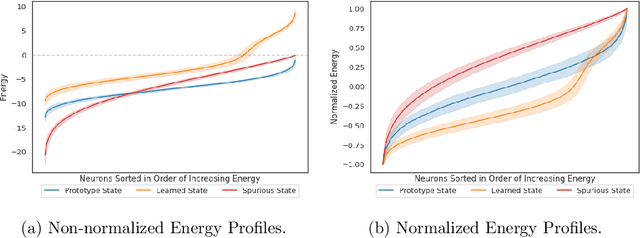
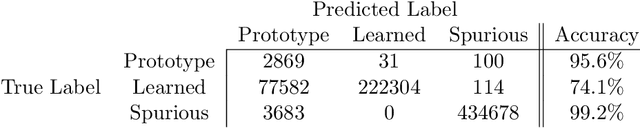
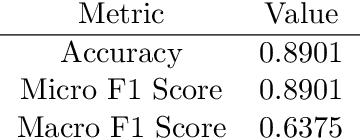
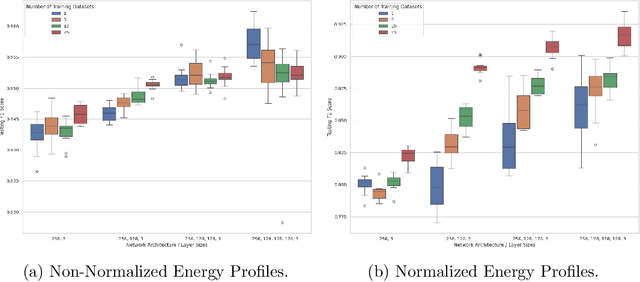
We extend the existing work on Hopfield network state classification, employing more complex models that remain interpretable, such as densely-connected feed-forward deep neural networks and support vector machines. The states of the Hopfield network can be grouped into several classes, including learned (those presented during training), spurious (stable states that were not learned), and prototype (stable states that were not learned but are representative for a subset of learned states). It is often useful to determine to what class a given state belongs to; for example to ignore spurious states when retrieving from the network. Previous research has approached the state classification task with simple linear methods, most notably the stability ratio. We deepen the research on classifying states from prototype-regime Hopfield networks, investigating how varying the factors strengthening prototypes influences the state classification task. We study the generalizability of different classification models when trained on states derived from different prototype tasks -- for example, can a network trained on a Hopfield network with 10 prototypes classify states from a network with 20 prototypes? We find that simple models often outperform the stability ratio while remaining interpretable. These models require surprisingly little training data and generalize exceptionally well to states generated by a range of Hopfield networks, even those that were trained on exceedingly different datasets.