 Add to Chrome
 Add to Firefox
 Add to Edge
Zamba2-VL Technical Report
May 29, 2026
We present Zamba2-VL, a suite of vision-language models built on Zamba2, a hybrid language-model architecture combining Mamba2 state-space layers with a small number of shared transformer blocks. Across a broad range of image understanding, reasoning, OCR, grounding, and counting benchmarks, Zamba2-VL is competitive with leading Transformer-based open-weight VLMs of comparable scale, including the Molmo2, Qwen3-VL, and InternVL3.5 families, and substantially outperforms prior SSM-based and hybrid VLMs such as VL-Mamba, Cobra, and mmMamba. Inheriting the near-linear prefill compute and small, near-constant recurrent state of its Zamba2 backbone, Zamba2-VL delivers roughly an order of magnitude lower time-to-first-token (TTFT) than these Transformer baselines at matched parameter scale, with the efficiency gap most pronounced at the smaller 1.2B and 2.7B scales most relevant to on-device and edge deployment. We release three models -- 1.2B, 2.7B, and 7B -- together with inference code at https://huggingface.co/collections/Zyphra/zamba2-vl.

The Unreasonable Ineffectiveness of the Deeper Layers
Mar 26, 2024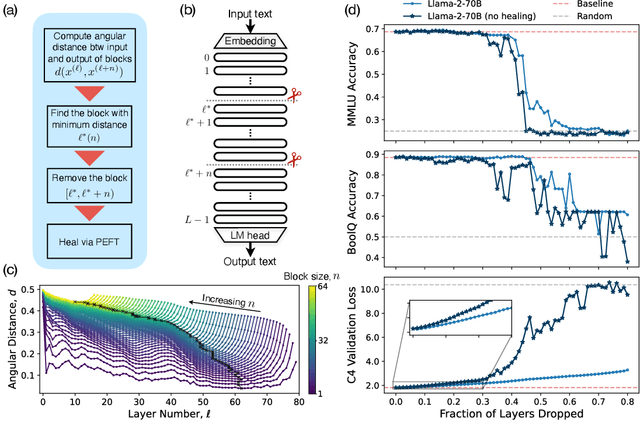
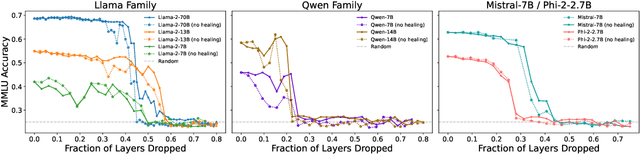
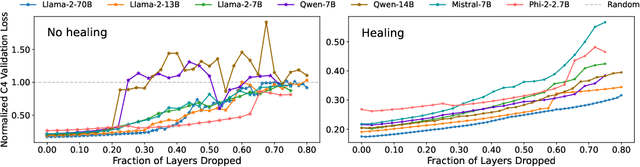
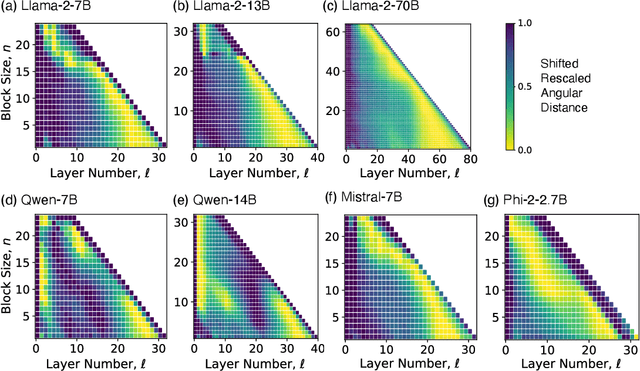
We empirically study a simple layer-pruning strategy for popular families of open-weight pretrained LLMs, finding minimal degradation of performance on different question-answering benchmarks until after a large fraction (up to half) of the layers are removed. To prune these models, we identify the optimal block of layers to prune by considering similarity across layers; then, to "heal" the damage, we perform a small amount of finetuning. In particular, we use parameter-efficient finetuning (PEFT) methods, specifically quantization and Low Rank Adapters (QLoRA), such that each of our experiments can be performed on a single A100 GPU. From a practical perspective, these results suggest that layer pruning methods can complement other PEFT strategies to further reduce computational resources of finetuning on the one hand, and can improve the memory and latency of inference on the other hand. From a scientific perspective, the robustness of these LLMs to the deletion of layers implies either that current pretraining methods are not properly leveraging the parameters in the deeper layers of the network or that the shallow layers play a critical role in storing knowledge.