 Add to Chrome
 Add to Firefox
 Add to Edge
A Human-Inspired Decoupled Architecture for Efficient Audio Representation Learning
Mar 27, 2026
While self-supervised learning (SSL) has revolutionized audio representation, the excessive parameterization and quadratic computational cost of standard Transformers limit their deployment on resource-constrained devices. To address this bottleneck, we propose HEAR (Human-inspired Efficient Audio Representation), a novel decoupled architecture. Inspired by the human cognitive ability to isolate local acoustic features from global context, HEAR splits the processing pipeline into two dedicated modules: an Acoustic Model for local feature extraction and a Task Model for global semantic integration. Coupled with an Acoustic Tokenizer trained via knowledge distillation, our approach enables robust Masked Audio Modeling (MAM). Extensive experiments demonstrate that HEAR requires only 15M parameters and 9.47 GFLOPs for inference, operating at a fraction of the computational cost of conventional foundation models (which typically require 85M-94M parameters). Despite this high efficiency, HEAR achieves highly competitive performance across diverse audio classification benchmarks. The code and pre-trained models are available at https://github.com/HarunoriKawano/HEAR

An Effective Transformer-based Contextual Model and Temporal Gate Pooling for Speaker Identification
Sep 10, 2023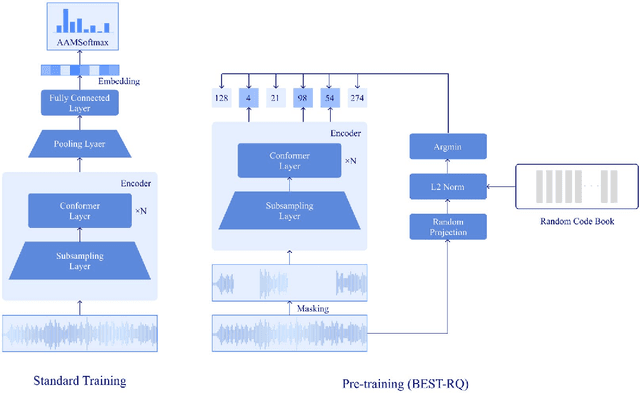
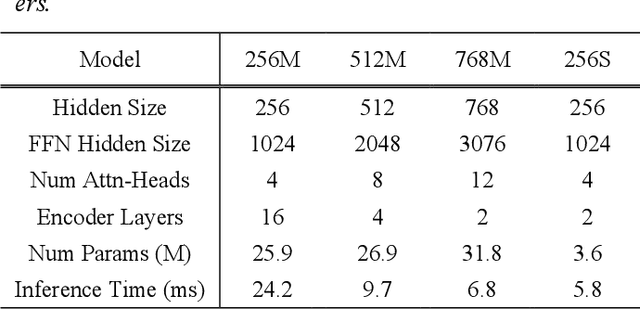
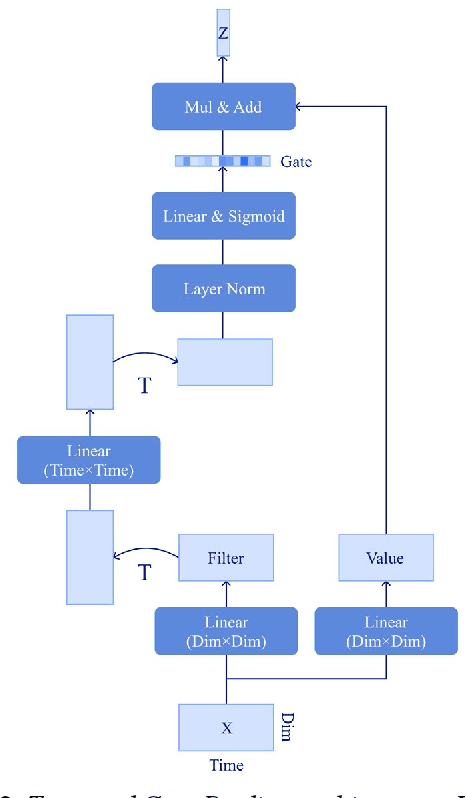
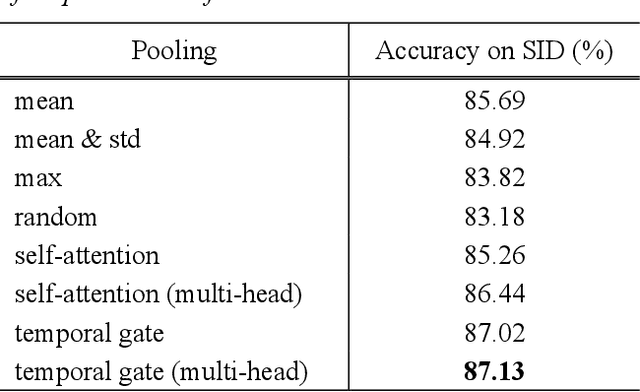
Wav2vec2 has achieved success in applying Transformer architecture and self-supervised learning to speech recognition. Recently, these have come to be used not only for speech recognition but also for the entire speech processing. This paper introduces an effective end-to-end speaker identification model applied Transformer-based contextual model. We explored the relationship between the hyper-parameters and the performance in order to discern the structure of an effective model. Furthermore, we propose a pooling method, Temporal Gate Pooling, with powerful learning ability for speaker identification. We applied Conformer as encoder and BEST-RQ for pre-training and conducted an evaluation utilizing the speaker identification of VoxCeleb1. The proposed method has achieved an accuracy of 87.1% with 28.5M parameters, demonstrating comparable precision to wav2vec2 with 317.7M parameters. Code is available at https://github.com/HarunoriKawano/speaker-identification-with-tgp.