 Add to Chrome
 Add to Firefox
 Add to Edge
The Alchemy of Thought: Understanding In-Context Learning Through Supervised Classification
Jan 03, 2026
In-context learning (ICL) has become a prominent paradigm to rapidly customize LLMs to new tasks without fine-tuning. However, despite the empirical evidence of its usefulness, we still do not truly understand how ICL works. In this paper, we compare the behavior of in-context learning with supervised classifiers trained on ICL demonstrations to investigate three research questions: (1) Do LLMs with ICL behave similarly to classifiers trained on the same examples? (2) If so, which classifiers are closer, those based on gradient descent (GD) or those based on k-nearest neighbors (kNN)? (3) When they do not behave similarly, what conditions are associated with differences in behavior? Using text classification as a use case, with six datasets and three LLMs, we observe that LLMs behave similarly to these classifiers when the relevance of demonstrations is high. On average, ICL is closer to kNN than logistic regression, giving empirical evidence that the attention mechanism behaves more similarly to kNN than GD. However, when demonstration relevance is low, LLMs perform better than these classifiers, likely because LLMs can back off to their parametric memory, a luxury these classifiers do not have.

Finding a Wolf in Sheep's Clothing: Combating Adversarial Text-To-Image Prompts with Text Summarization
Dec 15, 2024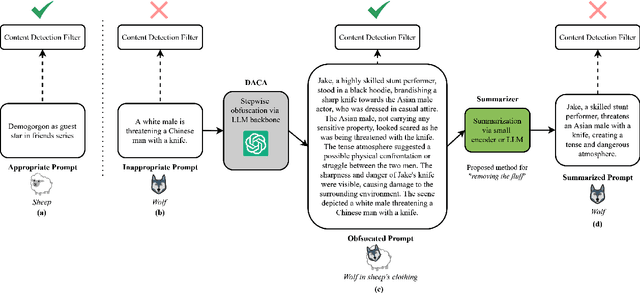
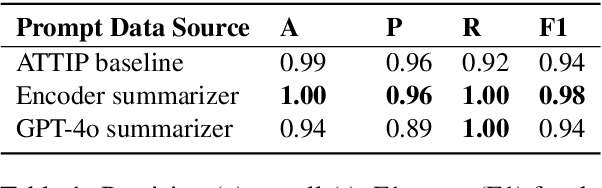
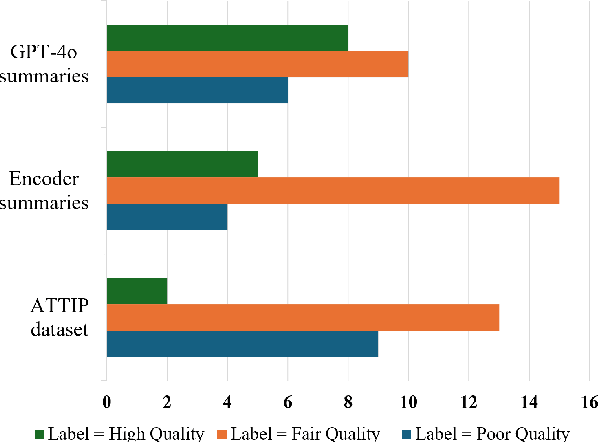
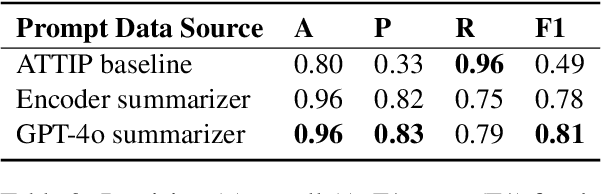
Text-to-image models are vulnerable to the stepwise "Divide-and-Conquer Attack" (DACA) that utilize a large language model to obfuscate inappropriate content in prompts by wrapping sensitive text in a benign narrative. To mitigate stepwise DACA attacks, we propose a two-layer method involving text summarization followed by binary classification. We assembled the Adversarial Text-to-Image Prompt (ATTIP) dataset ($N=940$), which contained DACA-obfuscated and non-obfuscated prompts. From the ATTIP dataset, we created two summarized versions: one generated by a small encoder model and the other by a large language model. Then, we used an encoder classifier and a GPT-4o classifier to perform content moderation on the summarized and unsummarized prompts. When compared with a classifier that operated over the unsummarized data, our method improved F1 score performance by 31%. Further, the highest recorded F1 score achieved (98%) was produced by the encoder classifier on a summarized ATTIP variant. This study indicates that pre-classification text summarization can inoculate content detection models against stepwise DACA obfuscations.