 Add to Chrome
 Add to Firefox
 Add to Edge
LIBAD: A Multimodal Anomaly Detection Benchmark for Li-Ion Battery Electrode Manufacturing
Aug 08, 2026
Multimodal industrial anomaly detection has largely focused on discrete products using strongly correlated RGB and 3D observations, leaving continuous process manufacturing and weakly correlated sensing modalities underexplored. We introduce LIBAD, the first multimodal anomaly detection benchmark for Li-ion battery electrode manufacturing. Collected from real roll-to-roll production lines, LIBAD provides aligned double-sided visible-light imaging, high-resolution X-ray radiography, and inline-compatible low-resolution X-ray radiography. Electrode patches in LIBAD exhibit highly homogeneous material appearance, while defect evidence can be strong in one modality but weak or absent in another, resulting in pronounced cross-modal anomaly inconsistency. Benchmarks of representative methods under the inline-compatible visible-light and low-resolution X-ray setting exhibit limited transferability and consistently high false-positive rates. We therefore propose DA-Core, a memory-based method that jointly considers feature-space coverage and local density of normal features during coreset selection, allowing compact memory banks to better preserve fine-grained normal variations. With a coreset ratio of 0.05, DA-Core reduces FPR95 from 60.4% to 54.3% compared with standard farthest point sampling. At this ratio, DA-Core also outperforms the best standard coreset result (obtained at 0.20) while reducing inference time by 43.9%. These results suggest that both the data distribution of normal features and the modality relationship itself require explicit consideration when designing anomaly detection methods for process manufacturing.

Tensorial template matching for fast cross-correlation with rotations and its application for tomography
Aug 05, 2024Object detection is a main task in computer vision. Template matching is the reference method for detecting objects with arbitrary templates. However, template matching computational complexity depends on the rotation accuracy, being a limiting factor for large 3D images (tomograms). Here, we implement a new algorithm called tensorial template matching, based on a mathematical framework that represents all rotations of a template with a tensor field. Contrary to standard template matching, the computational complexity of the presented algorithm is independent of the rotation accuracy. Using both, synthetic and real data from tomography, we demonstrate that tensorial template matching is much faster than template matching and has the potential to improve its accuracy
Cross-Modal Distillation in Industrial Anomaly Detection: Exploring Efficient Multi-Modal IAD
May 22, 2024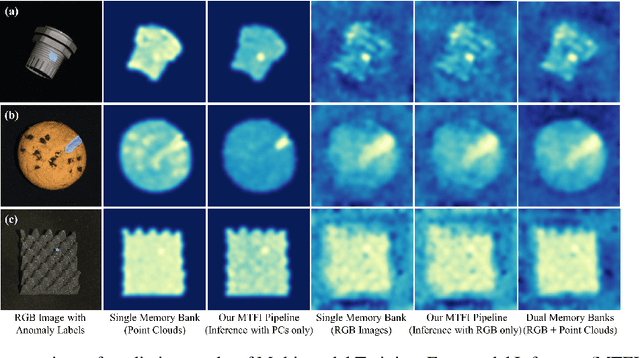
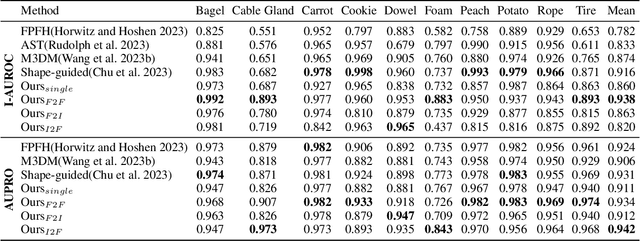
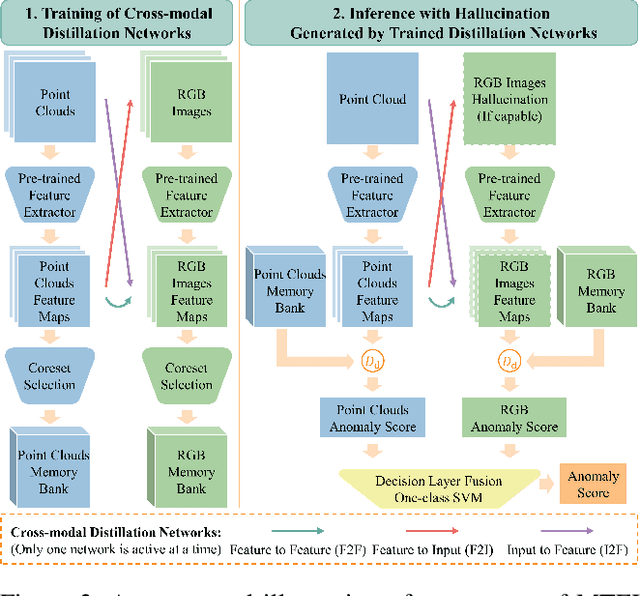
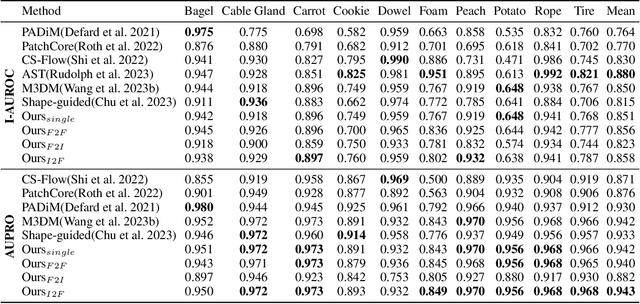
Recent studies of multi-modal Industrial Anomaly Detection (IAD) based on point clouds and RGB images indicated the importance of exploiting redundancy and complementarity among modalities for accurate classification and segmentation. However, achieving multi-modal IAD in practical production lines remains a work in progress that requires consideration of the trade-offs between costs and benefits associated with introducing new modalities, while ensuring compatibility with current processes. Combining fast in-line inspections with high-resolution, time-consuming, near-line characterization techniques to enhance detection accuracy fits well into the existing quality control process, but only part of the samples can be tested with expensive near-line methods. Thus, the model must have the ability to leverage multi-modal training and handle incomplete modalities during inference. One solution is generating cross-modal hallucination to transfer knowledge among modalities for missing modality issues. In this paper, we propose CMDIAD, a Cross-Modal Distillation framework for IAD to demonstrate the feasibility of Multi-modal Training, Few-modal Inference pipeline. Moreover, we investigate reasons behind the asymmetric performance improvement using point clouds or RGB images as main modality of inference. This lays the foundation of our future multi-modal dataset construction for efficient IAD from manufacturing scenarios.
Fast Normalized Cross-Correlation for Template Matching with Rotations
Nov 13, 2023Normalized cross-correlation is the reference approach to carry out template matching on images. When it is computed in Fourier space, it can handle efficiently template translations but it cannot do so with template rotations. Including rotations requires sampling the whole space of rotations, repeating the computation of the correlation each time. This article develops an alternative mathematical theory to handle efficiently, at the same time, rotations and translations. Our proposal has a reduced computational complexity because it does not require to repeatedly sample the space of rotations. To do so, we integrate the information relative to all rotated versions of the template into a unique symmetric tensor template -which is computed only once per template-. Afterward, we demonstrate that the correlation between the image to be processed with the independent tensor components of the tensorial template contains enough information to recover template instance positions and rotations. Our proposed method has the potential to speed up conventional template matching computations by a factor of several magnitude orders for the case of 3D images.
Join, select, and insert: efficient out-of-core algorithms for hierarchical segmentation trees
Oct 05, 2022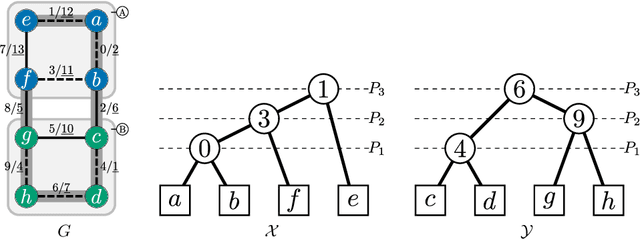
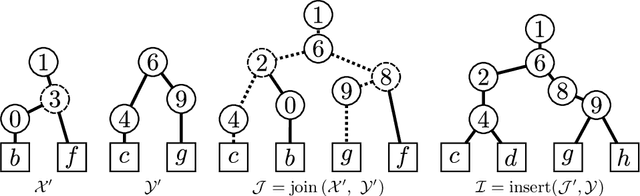
Binary Partition Hierarchies (BPH) and minimum spanning trees are fundamental data structures involved in hierarchical analysis such as quasi-flat zones or watershed. However, classical BPH construction algorithms require to have the whole data in memory, which prevent the processing of large images that cannot fit entirely in the main memory of the computer. To cope with this problem, an algebraic framework leading to a high level calculus was introduced allowing an out-of-core computation of BPHs. This calculus relies on three operations: select, join, and insert. In this article, we introduce three efficient algorithms to perform these operations providing pseudo-code and complexity analysis.