 Add to Chrome
 Add to Firefox
 Add to Edge
TAPAS: Efficient Two-Server Asymmetric Private Aggregation Beyond Prio(+)
Mar 20, 2026
Privacy-preserving aggregation is a cornerstone for AI systems that learn from distributed data without exposing individual records, especially in federated learning and telemetry. Existing two-server protocols (e.g., Prio and successors) set a practical baseline by validating inputs while preventing any single party from learning users' values, but they impose symmetric costs on both servers and communication that scales with the per-client input dimension $L$. Modern learning tasks routinely involve dimensionalities $L$ in the tens to hundreds of millions of model parameters. We present TAPAS, a two-server asymmetric private aggregation scheme that addresses these limitations along four dimensions: (i) no trusted setup or preprocessing, (ii) server-side communication that is independent of $L$ (iii) post-quantum security based solely on standard lattice assumptions (LWE, SIS), and (iv) stronger robustness with identifiable abort and full malicious security for the servers. A key design choice is intentional asymmetry: one server bears the $O(L)$ aggregation and verification work, while the other operates as a lightweight facilitator with computation independent of $L$. This reduces total cost, enables the secondary server to run on commodity hardware, and strengthens the non-collusion assumption of the servers. One of our main contributions is a suite of new and efficient lattice-based zero-knowledge proofs; to our knowledge, we are the first to establish privacy and correctness with identifiable abort in the two-server setting.

$\mathsf{OPA}$: One-shot Private Aggregation with Single Client Interaction and its Applications to Federated Learning
Oct 29, 2024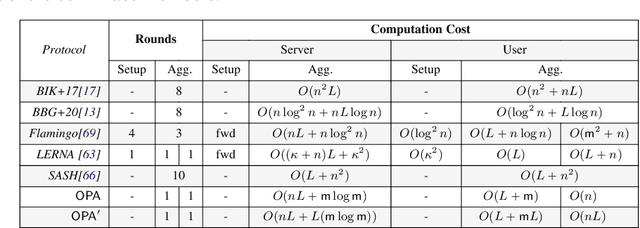
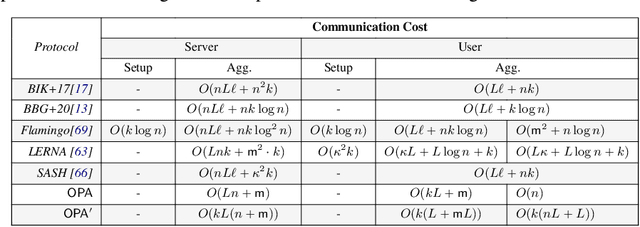

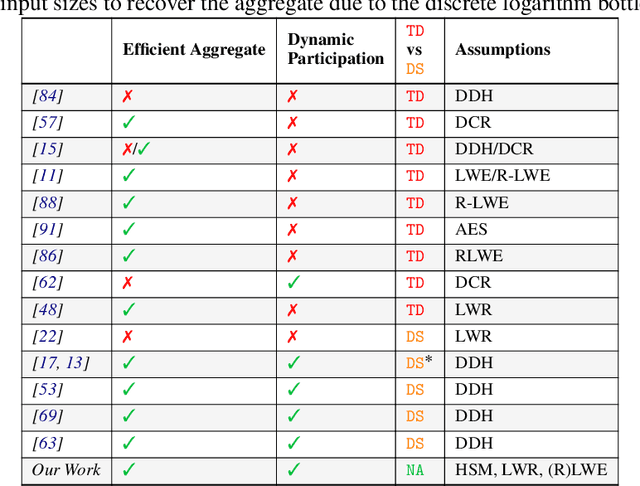
Our work aims to minimize interaction in secure computation due to the high cost and challenges associated with communication rounds, particularly in scenarios with many clients. In this work, we revisit the problem of secure aggregation in the single-server setting where a single evaluation server can securely aggregate client-held individual inputs. Our key contribution is the introduction of One-shot Private Aggregation ($\mathsf{OPA}$) where clients speak only once (or even choose not to speak) per aggregation evaluation. Since each client communicates only once per aggregation, this simplifies managing dropouts and dynamic participation, contrasting with multi-round protocols and aligning with plaintext secure aggregation, where clients interact only once. We construct $\mathsf{OPA}$ based on LWR, LWE, class groups, DCR and demonstrate applications to privacy-preserving Federated Learning (FL) where clients \emph{speak once}. This is a sharp departure from prior multi-round FL protocols whose study was initiated by Bonawitz et al. (CCS, 2017). Moreover, unlike the YOSO (You Only Speak Once) model for general secure computation, $\mathsf{OPA}$ eliminates complex committee selection protocols to achieve adaptive security. Beyond asymptotic improvements, $\mathsf{OPA}$ is practical, outperforming state-of-the-art solutions. We benchmark logistic regression classifiers for two datasets, while also building an MLP classifier to train on MNIST, CIFAR-10, and CIFAR-100 datasets. We build two flavors of $\caps$ (1) from (threshold) key homomorphic PRF and (2) from seed homomorphic PRG and secret sharing.