 Add to Chrome
 Add to Firefox
 Add to Edge
When Rolling Gets Weird: A Curved-Link Tensegrity Robot for Non-Intuitive Behavior
Mar 17, 2026
Conventional mobile tensegrity robots constructed with straight links offer mobility at the cost of locomotion speed. While spherical robots provide highly effective rolling behavior, they often lack the stability required for navigating unstructured terrain common in many space exploration environments. This research presents a solution with a semi-circular, curved-link tensegrity robot that strikes a balance between efficient rolling locomotion and controlled stability, enabled by discontinuities present at the arc endpoints. Building upon an existing geometric static modeling framework [1], this work presents the system design of an improved Tensegrity eXploratory Robot 2 (TeXploR2). Internal shifting masses instantaneously roll along each curved-link, dynamically altering the two points of contact with the ground plane. Simulations of quasistatic, piecewise continuous locomotion sequences reveal new insights into the positional displacement between inertial and body frames. Non-intuitive rolling behaviors are identified and experimentally validated using a tetherless prototype, demonstrating successful dynamic locomotion. A preliminary impact test highlights the tensegrity structure's inherent shock absorption capabilities and conformability. Future work will focus on finalizing a dynamic model that is experimentally validated with extended testing in real-world environments as well as further refinement of the prototype to incorporate additional curved-links and subsequent ground contact points for increased controllability.

Improving Grip Stability Using Passive Compliant Microspine Arrays for Soft Robots in Unstructured Terrain
Feb 17, 2025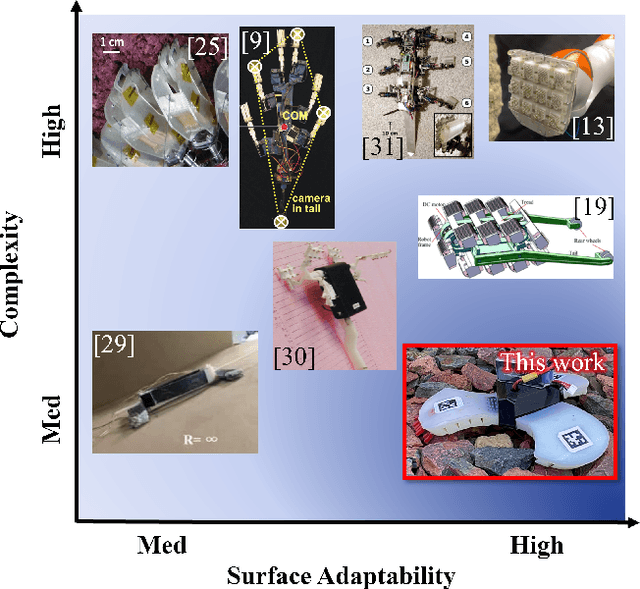
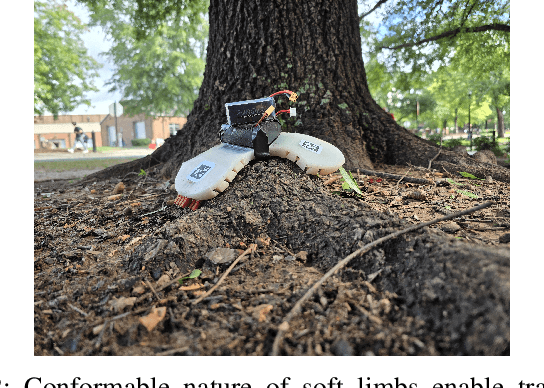

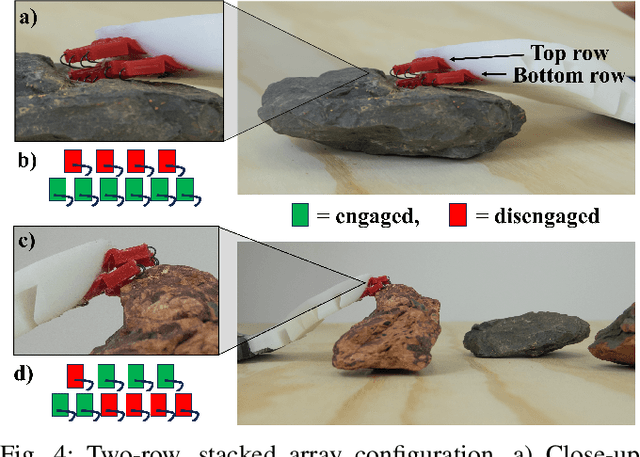
Microspine grippers are small spines commonly found on insect legs that reinforce surface interaction by engaging with asperities to increase shear force and traction. An array of such microspines, when integrated into the limbs or undercarriage of a robot, can provide the ability to maneuver uneven terrains, traverse inclines, and even climb walls. Conformability and adaptability of soft robots makes them ideal candidates for these applications involving traversal of complex, unstructured terrains. However, there remains a real-life realization gap for soft locomotors pertaining to their transition from controlled lab environment to the field by improving grip stability through effective integration of microspines. We propose a passive, compliant microspine stacked array design to enhance the locomotion capabilities of mobile soft robots, in our case, ones that are motor tendon actuated. We offer a standardized microspine array integration method with effective soft-compliant stiffness integration, and reduced complexity resulting from a single actuator passively controlling them. The presented design utilizes a two-row, stacked microspine array configuration that offers additional gripping capabilities on extremely steep/irregular surfaces from the top row while not hindering the effectiveness of the more frequently active bottom row. We explore different configurations of the microspine array to account for changing surface topologies and enable independent, adaptable gripping of asperities per microspine. Field test experiments are conducted on various rough surfaces including concrete, brick, compact sand, and tree roots with three robots consisting of a baseline without microspines compared against two robots with different combinations of microspine arrays. Tracking results indicate that the inclusion of microspine arrays increases planar displacement on average by 15 and 8 times.