 Add to Chrome
 Add to Firefox
 Add to Edge
Detecting overfitting in Neural Networks during long-horizon grokking using Random Matrix Theory
May 14, 2026
Training Neural Networks (NNs) without overfitting is difficult; detecting that overfitting is difficult as well. We present a novel Random Matrix Theory method that detects the onset of overfitting in deep learning models without access to train or test data. For each model layer, we randomize each weight matrix element-wise, $\mathbf{W} \to \mathbf{W}^{\mathrm{rand}}$, fit the randomized empirical spectral distribution with a Marchenko-Pastur distribution, and identify large outliers that violate self-averaging. We call these outliers Correlation Traps. During the onset of overfitting, which we call the "anti-grokking" phase in long-horizon grokking, Correlation Traps form and grow in number and scale as test accuracy decreases while train accuracy remains high. Traps may be benign or may harm generalization; we provide an empirical approach to distinguish between them by passing random data through the trained model and evaluating the JS divergence of output logits. Our findings show that anti-grokking is an additional grokking phase with high train accuracy and decreasing test accuracy, structurally distinct from pre-grokking through its Correlation Traps. More broadly, we find that some foundation-scale LLMs exhibit the same Correlation Traps, indicating potentially harmful overfitting.

Grokking and Generalization Collapse: Insights from \texttt{HTSR} theory
Jun 04, 2025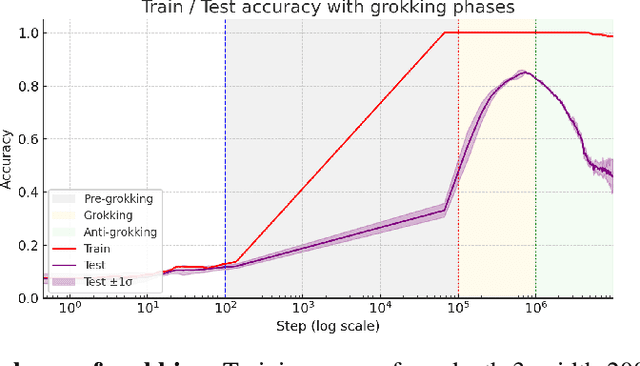

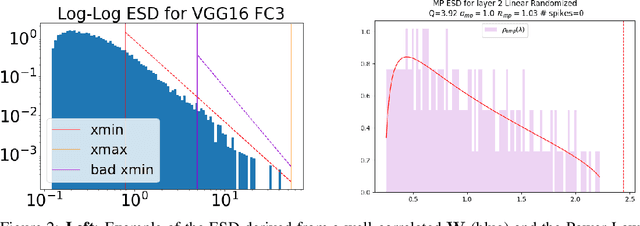
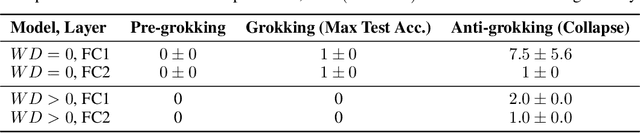
We study the well-known grokking phenomena in neural networks (NNs) using a 3-layer MLP trained on 1 k-sample subset of MNIST, with and without weight decay, and discover a novel third phase -- \emph{anti-grokking} -- that occurs very late in training and resembles but is distinct from the familiar \emph{pre-grokking} phases: test accuracy collapses while training accuracy stays perfect. This late-stage collapse is distinct, from the known pre-grokking and grokking phases, and is not detected by other proposed grokking progress measures. Leveraging Heavy-Tailed Self-Regularization HTSR through the open-source WeightWatcher tool, we show that the HTSR layer quality metric $\alpha$ alone delineates all three phases, whereas the best competing metrics detect only the first two. The \emph{anti-grokking} is revealed by training for $10^7$ and is invariably heralded by $\alpha < 2$ and the appearance of \emph{Correlation Traps} -- outlier singular values in the randomized layer weight matrices that make the layer weight matrix atypical and signal overfitting of the training set. Such traps are verified by visual inspection of the layer-wise empirical spectral densities, and by using Kolmogorov--Smirnov tests on randomized spectra. Comparative metrics, including activation sparsity, absolute weight entropy, circuit complexity, and $l^2$ weight norms track pre-grokking and grokking but fail to distinguish grokking from anti-grokking. This discovery provides a way to measure overfitting and generalization collapse without direct access to the test data. These results strengthen the claim that the \emph{HTSR} $\alpha$ provides universal layer-convergence target at $\alpha \approx 2$ and underscore the value of using the HTSR alpha $(\alpha)$ metric as a measure of generalization.