 Add to Chrome
 Add to Firefox
 Add to Edge
Make it SING: Analyzing Semantic Invariants in Classifiers
Mar 17, 2026
All classifiers, including state-of-the-art vision models, possess invariants, partially rooted in the geometry of their linear mappings. These invariants, which reside in the null-space of the classifier, induce equivalent sets of inputs that map to identical outputs. The semantic content of these invariants remains vague, as existing approaches struggle to provide human-interpretable information. To address this gap, we present Semantic Interpretation of the Null-space Geometry (SING), a method that constructs equivalent images, with respect to the network, and assigns semantic interpretations to the available variations. We use a mapping from network features to multi-modal vision language models. This allows us to obtain natural language descriptions and visual examples of the induced semantic shifts. SING can be applied to a single image, uncovering local invariants, or to sets of images, allowing a breadth of statistical analysis at the class and model levels. For example, our method reveals that ResNet50 leaks relevant semantic attributes to the null space, whereas DinoViT, a ViT pretrained with self-supervised DINO, is superior in maintaining class semantics across the invariant space.

A2D: Anywhere Anytime Drumming
Apr 04, 2023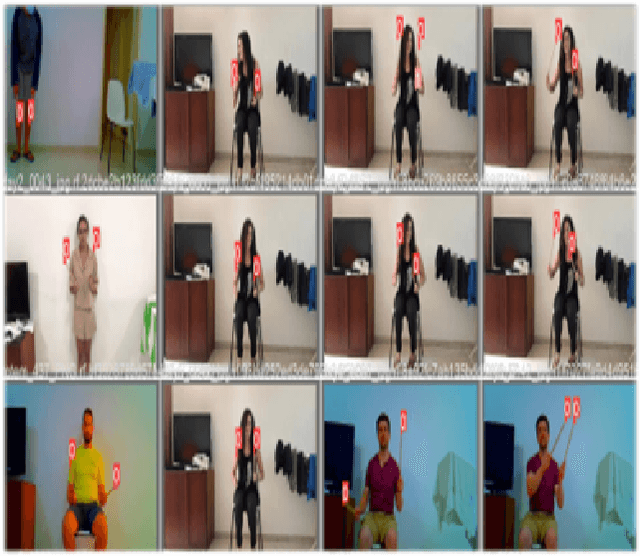
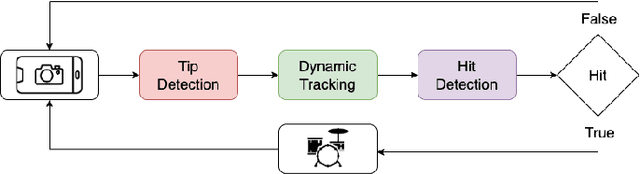

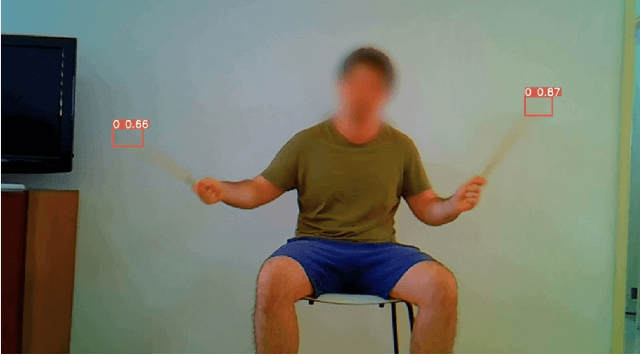
The drum kit, which has only been around for around 100 years, is a popular instrument in many music genres such as pop, rock, and jazz. However, the road to owning a kit is expensive, both financially and space-wise. Also, drums are more difficult to move around compared to other instruments, as they do not fit into a single bag. We propose a no-drums approach that uses only two sticks and a smartphone or a webcam to provide an air-drumming experience. The detection algorithm combines deep learning tools with tracking methods for an enhanced user experience. Based on both quantitative and qualitative testing with humans-in-the-loop, we show that our system has zero misses for beginner level play and negligible misses for advanced level play. Additionally, our limited human trials suggest potential directions for future research.