 Add to Chrome
 Add to Firefox
 Add to Edge
Toward Continuous Assurance for the Democratization of AI Agent Creation in Industry
Jul 23, 2026
AI agents are increasingly created inside organizations by non-engineering users through low-code, no-code, and conversational development environments. This democratization enables rapid local innovation, but it also creates a reliability gap: agents that appear to users as simple productivity artifacts may depend on changing models, tools, retrieval sources, permissions, prompts, schedules, and external services. These dependencies can cause silent degradation long after deployment, even when no user directly modifies the agent. This paper identifies the reliability challenge created by democratized AI agent creation and proposes a lightweight continuous-assurance framework for citizen-created organizational agents. The framework combines dependency mapping, readiness contracts, scheduled checks, diagnostics, and lifecycle governance to assess whether an agent remains operationally ready under expected conditions. We also present an initial prototype auditor and scenario-based assessment showing how the proposed taxonomy can be translated into practical checks and actionable remediation guidance.

MaMaDroid2.0 -- The Holes of Control Flow Graphs
Feb 28, 2022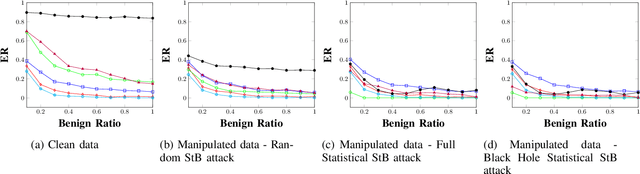
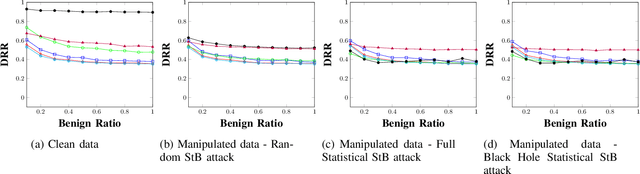
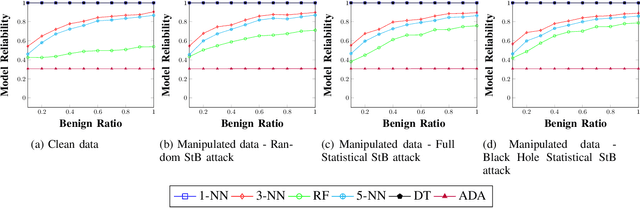
Android malware is a continuously expanding threat to billions of mobile users around the globe. Detection systems are updated constantly to address these threats. However, a backlash takes the form of evasion attacks, in which an adversary changes malicious samples such that those samples will be misclassified as benign. This paper fully inspects a well-known Android malware detection system, MaMaDroid, which analyzes the control flow graph of the application. Changes to the portion of benign samples in the train set and models are considered to see their effect on the classifier. The changes in the ratio between benign and malicious samples have a clear effect on each one of the models, resulting in a decrease of more than 40% in their detection rate. Moreover, adopted ML models are implemented as well, including 5-NN, Decision Tree, and Adaboost. Exploration of the six models reveals a typical behavior in different cases, of tree-based models and distance-based models. Moreover, three novel attacks that manipulate the CFG and their detection rates are described for each one of the targeted models. The attacks decrease the detection rate of most of the models to 0%, with regards to different ratios of benign to malicious apps. As a result, a new version of MaMaDroid is engineered. This model fuses the CFG of the app and static analysis of features of the app. This improved model is proved to be robust against evasion attacks targeting both CFG-based models and static analysis models, achieving a detection rate of more than 90% against each one of the attacks.