 Add to Chrome
 Add to Firefox
 Add to Edge
Jetson-ORB-SLAM3: Accuracy-Preserving GPU Implementation for Edge Computing Devices
Aug 18, 2026
Visual-inertial SLAM on low-power edge platforms is constrained by the cost of dense feature extraction and loop closure. Prior GPU ports of ORB-SLAM trade accuracy for speed by approximating the ORB detector, altering the feature set and therefore the estimated trajectory. We present an accuracy-preserving GPU implementation of ORB-SLAM3 for the NVIDIA Jetson Orin Nano, whose GPU ORB front end reproduces the reference CPU detector algorithmically to 94.7% exact keypoint agreement and 99.9% descriptor bit agreement. This work also makes CNN-based loop closure edge-viable through native TensorRT. The visual front end (feature extraction) is offloaded to the GPU while the mapping and optimization back end is kept on the CPU, matching each computation to the hardware it suits. The accuracy is verified by comparing four configurations: the GPU pipeline and the unmodified CPU reference, each run on both the Jetson Orin Nano and a desktop. On EuRoC dataset, all four agree to within 0.10cm in mean absolute trajectory error (SE(3)), so neither the GPU port nor the change of hardware shifts the estimated trajectory. The GPU-versus-CPU comparison is reproducible on TUM-VI and KITTI datasets, so the acceleration is accuracy-preserving rather than approximate. The proposed implementation is competitive with published ORB-SLAM3 on EuRoC, attains sub-centimeter accuracy on five of the six TUM-VI room sequences, and reaches sub-1% relative translation error on nine of eleven KITTI sequences. For loop closure, the generic ONNX-Runtime CUDA/TensorRT execution providers are unusable with our CosPlace ResNet-50 on the embedded platform, whereas a native libnvinfer FP16 engine reduces per-query inference to 2.2ms, a 180x speedup. Learned place recognition therefore runs concurrently with tracking on a 7W device. In monocular-inertial mode the system sustains 32FPS mean over the eleven EuRoC sequences.

Passive Classification of Source Printer using Text-line-level Geometric Distortion Signatures from Scanned Images of Printed Documents
Jun 20, 2017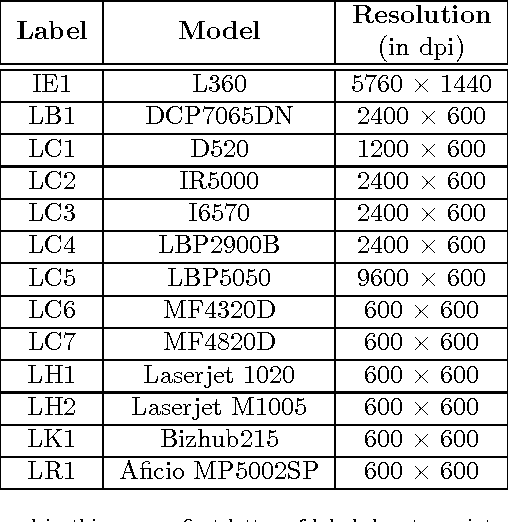
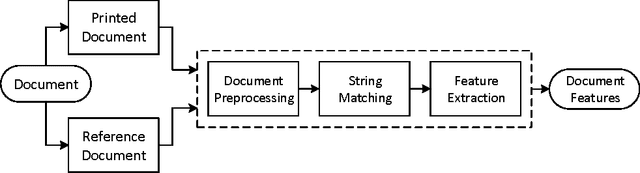
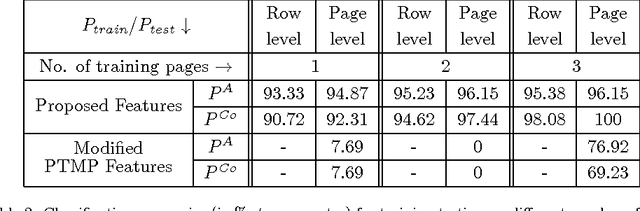

In this digital era, one thing that still holds the convention is a printed archive. Printed documents find their use in many critical domains such as contract papers, legal tenders and proof of identity documents. As more advanced printing, scanning and image editing techniques are becoming available, forgeries on these legal tenders pose a serious threat. Ability to easily and reliably identify source printer of a printed document can help a lot in reducing this menace. During printing procedure, printer hardware introduces certain distortions in printed characters' locations and shapes which are invisible to naked eyes. These distortions are referred as geometric distortions, their profile (or signature) is generally unique for each printer and can be used for printer classification purpose. This paper proposes a set of features for characterizing text-line-level geometric distortions, referred as geometric distortion signatures and presents a novel system to use them for identification of the origin of a printed document. Detailed experiments performed on a set of thirteen printers demonstrate that the proposed system achieves state of the art performance and gives much higher accuracy under small training size constraint. For four training and six test pages of three different fonts, the proposed method gives 99\% classification accuracy.