 Add to Chrome
 Add to Firefox
 Add to Edge
Spectro-Temporal Interference Confounds Phase Encoding in Spatial Audio Foundation Models
Jun 12, 2026
Recent spatial self supervised audio models achieve high performance on localization tasks, raising questions about their encoding of microsecond interaural phase fine structures. We propose a psychoacoustic benchmark based on the binaural masking level difference to evaluate this. Using an equalization cancellation baseline and a GCC PHAT positive control we evaluate nine frozen audio models spanning binaural SSL, monaural SSL, and neural audio codecs. Four monaural negative controls yield zero BMLD confirming binaural specificity. Two general purpose binaural SSL models exhibit minimal phase sensitivity while dedicated binaural spatial SSL models achieve BMLD comparable to the analytical baseline. Progressive physical ablations show that general purpose binaural SSL models rely on spectro temporal interference textures rather than cross channel phase computation. High detection rates in speech reflect a confounding reliance on broadband envelopes rather than genuine phase encoding.

BadSKP: Backdoor Attacks on Knowledge Graph-Enhanced LLMs with Soft Prompts
May 12, 2026Recent knowledge graph (KG)-enhanced large language models (LLMs) move beyond purely textual knowledge augmentation by encoding retrieved subgraphs into continuous soft prompts via graph neural networks, introducing a graph-conditioned channel that operates alongside the standard text interface. However, existing backdoor attacks are largely designed for the textual channel, and their effectiveness against this dual-channel architecture remains unclear. We show that this architecture creates a robustness gap: text-channel backdoor attacks that readily compromise textual KG prompting systems become largely ineffective against soft-prompt-based counterparts. We interpret this gap through semantic anchoring, whereby graph-derived soft prompts bias the generation-driving hidden state toward query-consistent semantics and suppress surface-level malicious instructions. Because this anchoring effect is itself induced by the graph channel, an attacker who manipulates graph-level representations can in turn redirect it toward adversarial semantics. To demonstrate this risk, we propose BadSKP, a backdoor attack that targets the graph-to-prompt interface through a multi-stage optimization strategy: it constructs adversarial target embeddings, optimizes poisoned node embeddings to steer the induced soft prompt, and approximates the optimized representations with fluent adversarial node attributes. Experiments on two soft-prompt KG-enhanced LLMs across four datasets show that BadSKP achieves high attack success under both frozen and trojaned settings, while text-only attacks remain unreliable even under perplexity-based defenses.
Unit-Based Agent for Semi-Cascaded Full-Duplex Dialogue Systems
Jan 29, 2026Full-duplex voice interaction is crucial for natural human computer interaction. We present a framework that decomposes complex dialogue into minimal conversational units, enabling the system to process each unit independently and predict when to transit to the next. This framework is instantiated as a semi-cascaded full-duplex dialogue system built around a multimodal large language model, supported by auxiliary modules such as voice activity detection (VAD) and text-to-speech (TTS) synthesis. The resulting system operates in a train-free, plug-and-play manner. Experiments on the HumDial dataset demonstrate the effectiveness of our framework, which ranks second among all teams on the test set of the Human-like Spoken Dialogue Systems Challenge (Track 2: Full-Duplex Interaction). Code is available at the GitHub repository https://github.com/yu-haoyuan/fd-badcat.
From Turn-Taking to Synchronous Dialogue: A Survey of Full-Duplex Spoken Language Models
Sep 18, 2025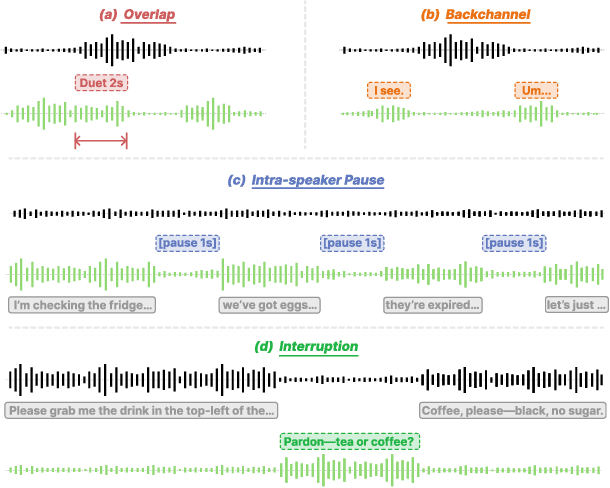

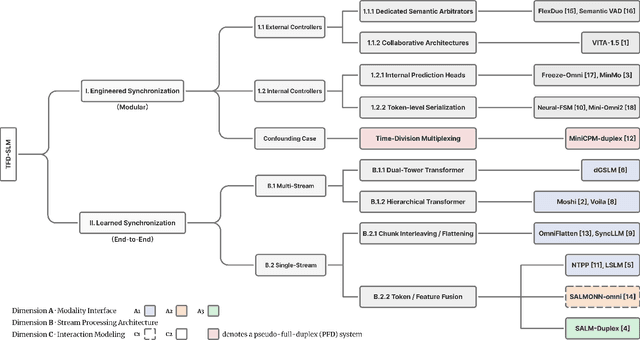
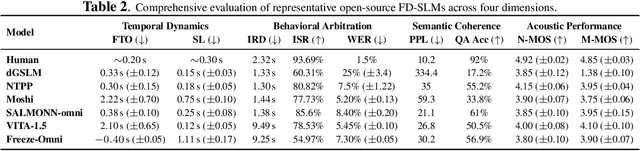
True Full-Duplex (TFD) voice communication--enabling simultaneous listening and speaking with natural turn-taking, overlapping speech, and interruptions--represents a critical milestone toward human-like AI interaction. This survey comprehensively reviews Full-Duplex Spoken Language Models (FD-SLMs) in the LLM era. We establish a taxonomy distinguishing Engineered Synchronization (modular architectures) from Learned Synchronization (end-to-end architectures), and unify fragmented evaluation approaches into a framework encompassing Temporal Dynamics, Behavioral Arbitration, Semantic Coherence, and Acoustic Performance. Through comparative analysis of mainstream FD-SLMs, we identify fundamental challenges: synchronous data scarcity, architectural divergence, and evaluation gaps, providing a roadmap for advancing human-AI communication.