 Add to Chrome
 Add to Firefox
 Add to Edge
Traceable by Design: An LLM Pipeline and Dashboard for EU Regulatory Consultation Analysis
May 29, 2026
Public consultations generate large volumes of data in the form of stakeholder submissions that are practically unfeasible to analyse manually. We present an end-to-end LLM-based pipeline and interactive dashboard for structured topic extraction from regulatory consultation submissions, demonstrated on the European Commission's Digital Fairness Act (DFA) public call for evidence as a case study. The system processes raw PDF attachments and web-form responses, extracts topic annotations, and grounds every extraction in a verbatim quote from the source text. Applied to 4,322 DFA submissions, the pipeline produced 15,368 topic annotations supported by 20,951 verbatim evidence quotes. Three principles govern the proposed design: verbatim grounding, full traceability, and transparency by design. The dashboard exposes the full extraction dataset through five analytical views, from dataset-level topic overviews to individual paragraph drill-downs, with every result traceable to its source. Beyond the predefined DFA topic categories, the pipeline generated certain stakeholder concerns, such as Age Verification, Payment Processor Censorship, and Digital Ownership, that a fixed-taxonomy approach would have missed. The pipeline is domain-generic; adapting it to a new consultation requires only a prompt update and a new dataset. A live demo is available at https://dfa-dashboard.thalesbertaglia.com/. The code and processed data are publicly available at https://github.com/thalesbertaglia/dfa-dashboard.

Computational Studies in Influencer Marketing: A Systematic Literature Review
Jun 17, 2025Influencer marketing has become a crucial feature of digital marketing strategies. Despite its rapid growth and algorithmic relevance, the field of computational studies in influencer marketing remains fragmented, especially with limited systematic reviews covering the computational methodologies employed. This makes overarching scientific measurements in the influencer economy very scarce, to the detriment of interested stakeholders outside of platforms themselves, such as regulators, but also researchers from other fields. This paper aims to provide an overview of the state of the art of computational studies in influencer marketing by conducting a systematic literature review (SLR) based on the PRISMA model. The paper analyses 69 studies to identify key research themes, methodologies, and future directions in this research field. The review identifies four major research themes: Influencer identification and characterisation, Advertising strategies and engagement, Sponsored content analysis and discovery, and Fairness. Methodologically, the studies are categorised into machine learning-based techniques (e.g., classification, clustering) and non-machine-learning-based techniques (e.g., statistical analysis, network analysis). Key findings reveal a strong focus on optimising commercial outcomes, with limited attention to regulatory compliance and ethical considerations. The review highlights the need for more nuanced computational research that incorporates contextual factors such as language, platform, and industry type, as well as improved model explainability and dataset reproducibility. The paper concludes by proposing a multidisciplinary research agenda that emphasises the need for further links to regulation and compliance technology, finer granularity in analysis, and the development of standardised datasets.
Across Platforms and Languages: Dutch Influencers and Legal Disclosures on Instagram, YouTube and TikTok
Jul 17, 2024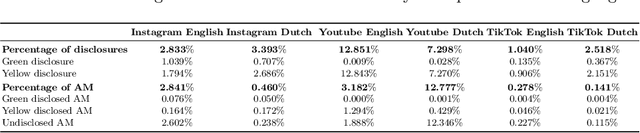
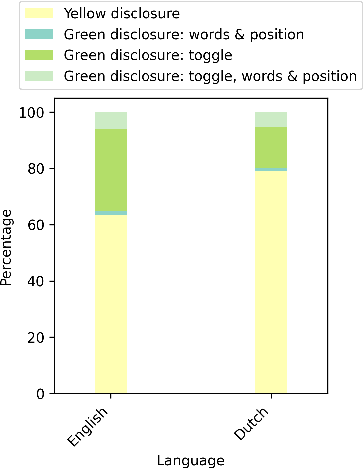
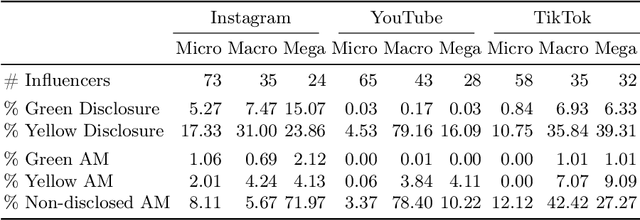
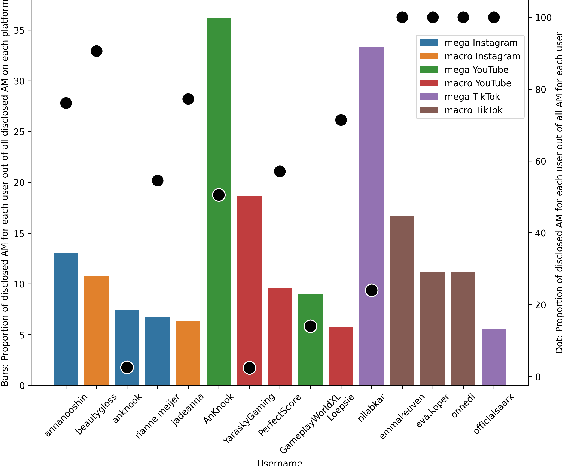
Content monetization on social media fuels a growing influencer economy. Influencer marketing remains largely undisclosed or inappropriately disclosed on social media. Non-disclosure issues have become a priority for national and supranational authorities worldwide, who are starting to impose increasingly harsher sanctions on them. This paper proposes a transparent methodology for measuring whether and how influencers comply with disclosures based on legal standards. We introduce a novel distinction between disclosures that are legally sufficient (green) and legally insufficient (yellow). We apply this methodology to an original dataset reflecting the content of 150 Dutch influencers publicly registered with the Dutch Media Authority based on recently introduced registration obligations. The dataset consists of 292,315 posts and is multi-language (English and Dutch) and cross-platform (Instagram, YouTube and TikTok). We find that influencer marketing remains generally underdisclosed on social media, and that bigger influencers are not necessarily more compliant with disclosure standards.