 Add to Chrome
 Add to Firefox
 Add to Edge
What does a Bayes-filtered transformer believe? A predictive Monte Carlo approach
Jul 19, 2026
A Bayes-filtered transformer (BFT) is a transformer trained on sequences that are generated in two steps: first a latent task is drawn from a prior, then observations are drawn conditional on that task. Trained under autoregressive log loss, the BFT's next-token prediction, in the idealized limit, is the Bayesian posterior predictive distribution (PPD) induced by that prior and that conditional law. In practice the trained BFT is only an approximation of this ideal PPD, raising an interpretive question: what prior and posterior over the latent task has the trained BFT actually internalized? Existing work answers this question by comparing the trained BFT's predictions against the predictions of various "reference" posteriors, each standing in for a different candidate algorithm or computation the BFT might be implementing. This prediction-space comparison is fragile: different posteriors can share the same posterior-mean predictions. We use predictive Monte Carlo (PMC) as a general interpretability tool for any BFT: using only next-token generation, PMC returns an approximation to the implicit prior and posterior over the latent task, answering the interpretive question directly in latent space. We apply PMC to three stylized task families spanning 0-Markov and 1-Markov exchangeability. The phenomena previously reported in these settings remain visible in latent space. Code is available at https://github.com/afiq-aswadi/bft-pmc

Piston sensing for sparse aperture systems via all-optical diffractive neural network
Dec 14, 2022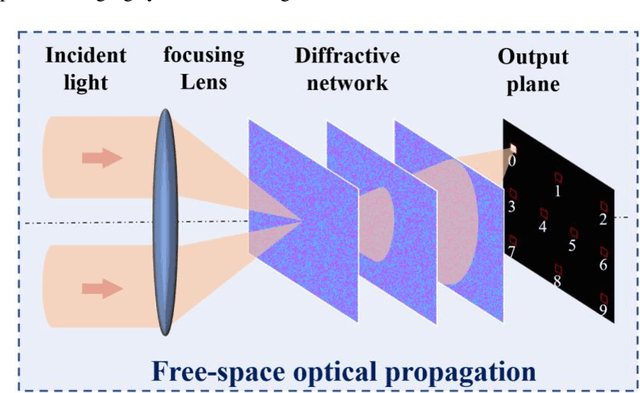
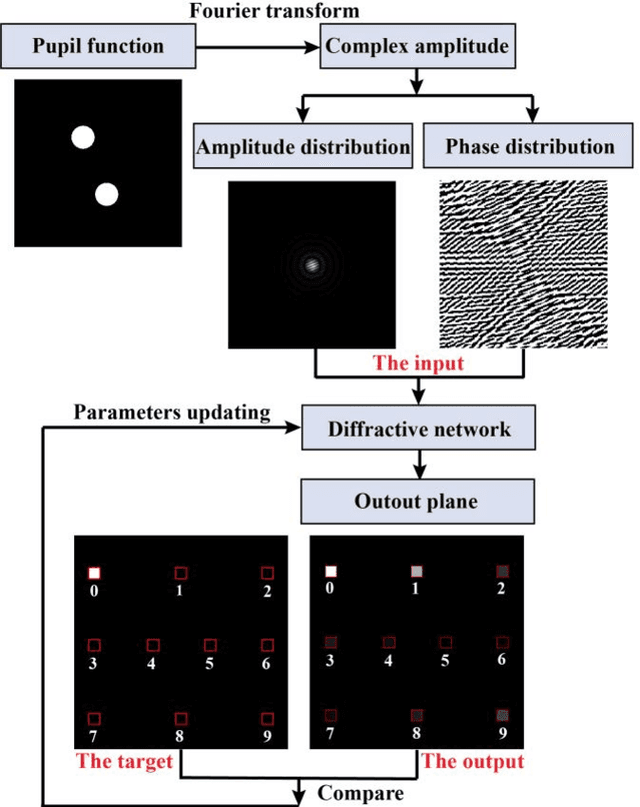
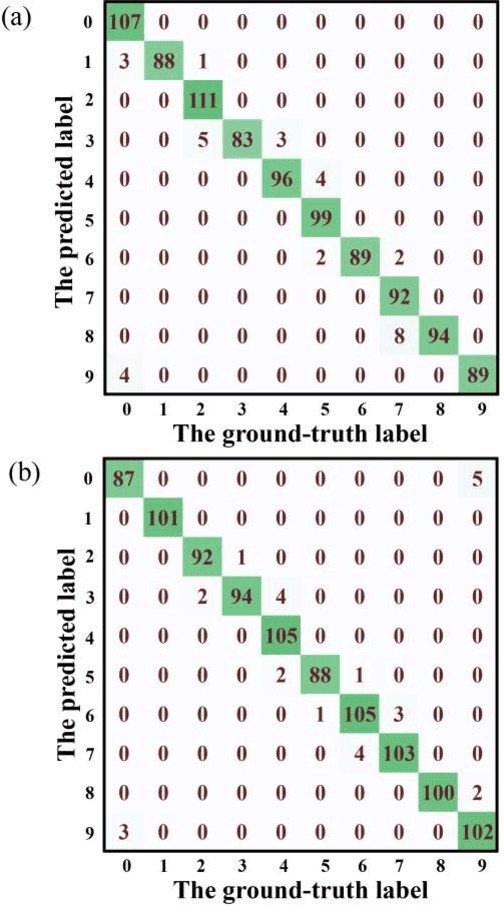
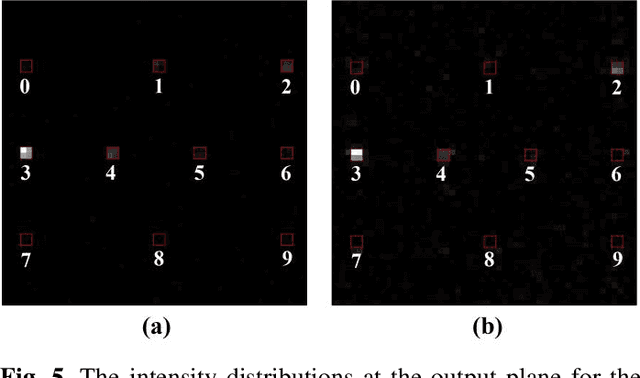
It is a crucial issue to realize real-time piston correction in the area of sparse aperture imaging. This paper introduces an optical diffractive neural network-based piston sensing method, which can achieve light-speed sensing. By using detectable intensity to represent pistons, the proposed method is capable of converting complex amplitude distribution of the imaging optical field into piston values directly. Differing from the electrical neural network, the way of intensity representation enables the method to obtain the predicted pistons without imaging acquisition and electrical processing process. The simulations demonstrate the feasibility of the method for point source, and high accuracies are achieved for both monochromatic light and broadband light. This method can greatly improve the real-time performance of piston sensing and contribute to the development of the sparse aperture system.