 Add to Chrome
 Add to Firefox
 Add to Edge
RxnCLF: Contrastive Transformation-Aware Reaction Foundation Model for Improved Reactivity Prediction
Aug 06, 2026
Reaction yield prediction remains challenging because labeled data are scarce and reaction space is both combinatorially large and sparsely populated, limiting the generalization of existing reaction representations. String-, fingerprint-, and graph-based reaction encodings only partially capture chemical transformations, making accurate prediction difficult for reactions with complex substrates. We propose reaction contrastive learning foundation (RxnCLF), a self-supervised contrastive framework for reaction representation learning. RxnCLF is built on a condensed reaction graph (CRG) that unifies reactant and product information into a single graph, enabling the model to learn explicit and enriched transformation structure rather than disconnected graphs. Pretrained on 1.7 million Pistachio reactions, RxnCLF learns a compact and continuous latent space that captures both reaction-center features and broader side chain contexts, making it transformation-aware and chemically interpretable. Fine-tuned on multiple yield prediction benchmarks, including Buchwald-Hartwig, Pd-catalyzed BH coupling, and proprietary HTE C-N coupling and amide formation datasets, RxnCLF consistently outperforms graph and sequence-based baselines, improving R2 and achieving the best performance overall. Our results highlight the promise of CRG-based RxnCLF as a scalable reaction foundation model, with the potential to generalize across broader reaction spaces and support diverse downstream reaction informatics tasks, including regioselectivity prediction, enantioselectivity prediction, and reaction condition optimization.

DirectMultiStep: Direct Route Generation for Multi-Step Retrosynthesis
May 22, 2024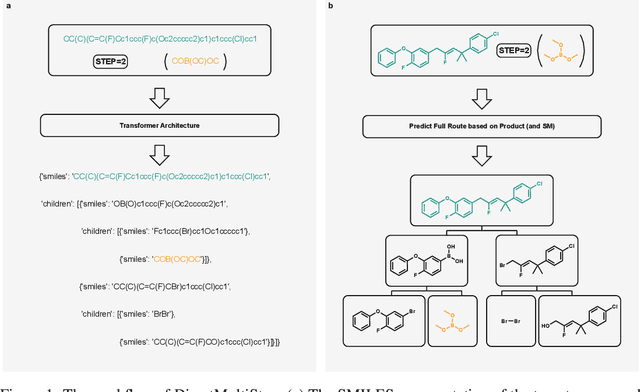
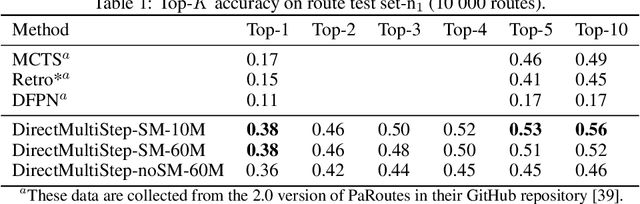
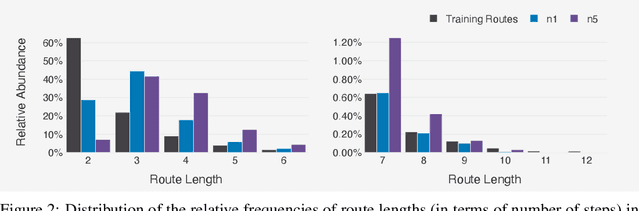
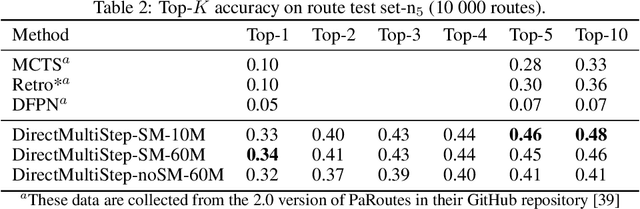
Traditional computer-aided synthesis planning (CASP) methods rely on iterative single-step predictions, leading to exponential search space growth that limits efficiency and scalability. We introduce a transformer-based model that directly generates multi-step synthetic routes as a single string by conditionally predicting each molecule based on all preceding ones. The model accommodates specific conditions such as the desired number of steps and starting materials, outperforming state-of-the-art methods on the PaRoutes dataset with a 2.2x improvement in Top-1 accuracy on the n$_1$ test set and a 3.3x improvement on the n$_5$ test set. It also successfully predicts routes for FDA-approved drugs not included in the training data, showcasing its generalization capabilities. While the current suboptimal diversity of the training set may impact performance on less common reaction types, our approach presents a promising direction towards fully automated retrosynthetic planning.
Kernel-Elastic Autoencoder for Molecular Design
Oct 12, 2023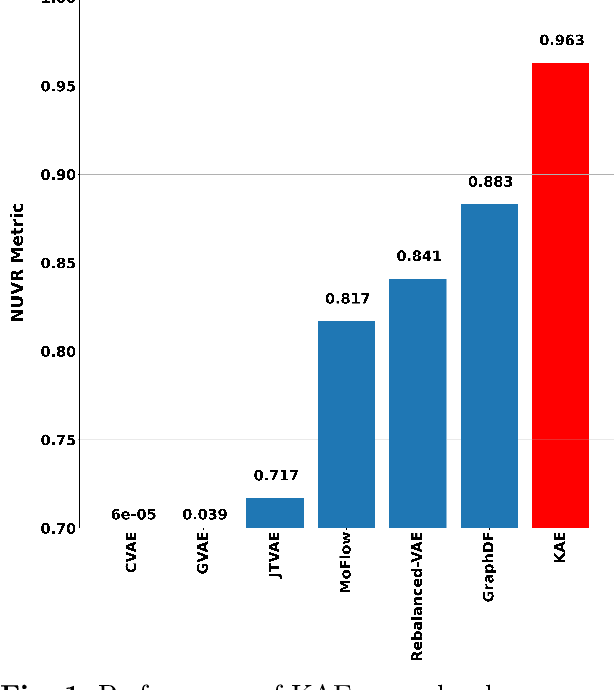
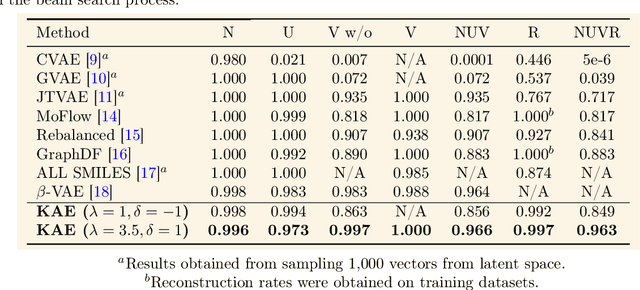
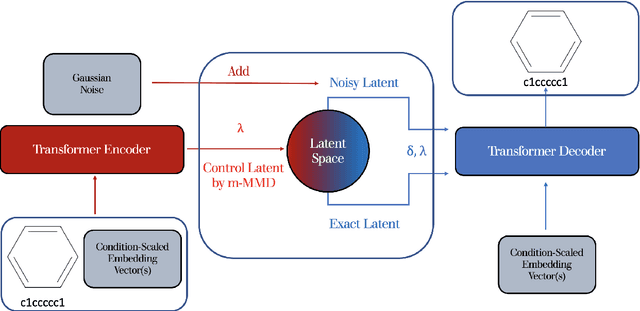
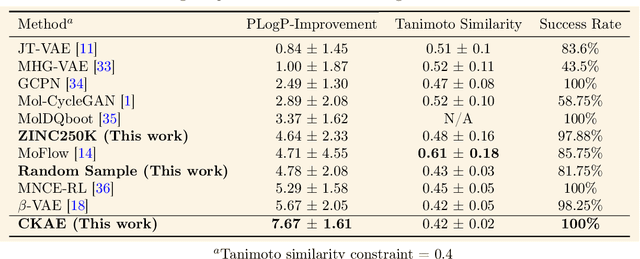
We introduce the Kernel-Elastic Autoencoder (KAE), a self-supervised generative model based on the transformer architecture with enhanced performance for molecular design. KAE is formulated based on two novel loss functions: modified maximum mean discrepancy and weighted reconstruction. KAE addresses the long-standing challenge of achieving valid generation and accurate reconstruction at the same time. KAE achieves remarkable diversity in molecule generation while maintaining near-perfect reconstructions on the independent testing dataset, surpassing previous molecule-generating models. KAE enables conditional generation and allows for decoding based on beam search resulting in state-of-the-art performance in constrained optimizations. Furthermore, KAE can generate molecules conditional to favorable binding affinities in docking applications as confirmed by AutoDock Vina and Glide scores, outperforming all existing candidates from the training dataset. Beyond molecular design, we anticipate KAE could be applied to solve problems by generation in a wide range of applications.