 Add to Chrome
 Add to Firefox
 Add to Edge
Reinforcing Human Behavior Simulation via Verbal Feedback
May 19, 2026
Humans learn social norms and behaviors from verbal feedback (e.g., a parent saying "that was rude" or a friend explaining "here's why that hurt"). Yet, learning from feedback for LLMs has largely focused on domains like code and math, where RL rewards are directly verifiable and condensed into scalar values. As LLMs are increasingly used to simulate human behavior, e.g., standing in for users, patients, students, and other personas, there is a pressing need to make them more human-like, which requires embracing a fundamentally different kind of signal: feedback that is verbal, subjective, and multi-faceted. We present DITTO, a model trained by treating verbal feedback as a first-class signal in reinforcement learning. After each rollout, DITTO receives verbal feedback and generates a feedback-conditioned improved rollout; both outputs are jointly optimized with GRPO, distilling verbal guidance into the base policy without requiring feedback at test time. We also introduce SOUL (Simulation gym Of hUman-Like behavior), a unified benchmark and training data suite spanning 10 tasks across six categories: Theory of Mind, character role play, social skill, learner simulation, user simulation, and persona simulation. DITTO achieves an average 36% improvement over the base model and exceeds GPT-5.4 on 6 of 10 SOUL benchmarks, demonstrating that RL with verbal feedback is a promising direction for training LLMs to simulate human behavior.

DSCom: A Data-Driven Self-Adaptive Community-Based Framework for Influence Maximization in Social Networks
Nov 18, 2023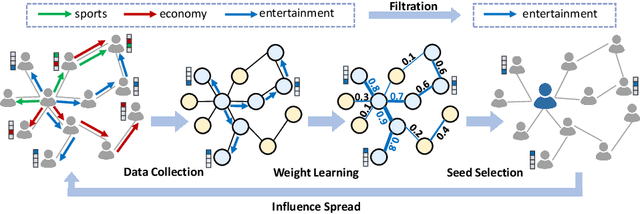
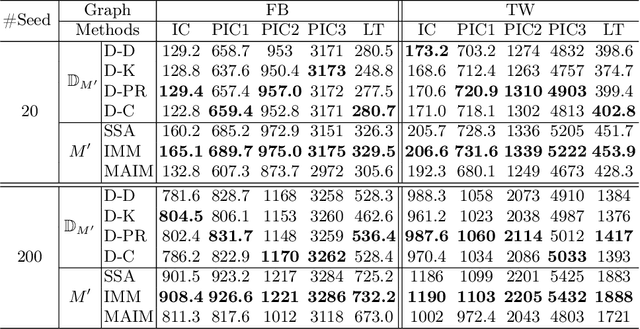
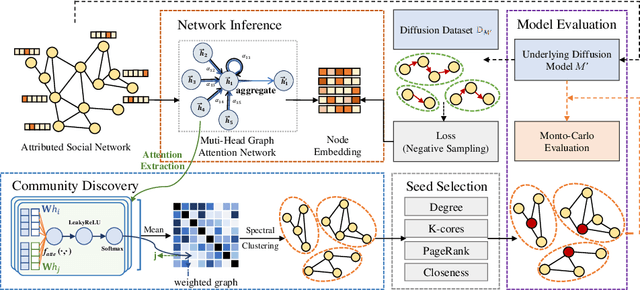

Influence maximization aims to find a subset of seeds that maximize the influence spread under a given budget. In this paper, we mainly address the data-driven version of this problem, where the diffusion model is not given but needs to be inferred from the history cascades. Several previous works have addressed this topic in a statistical way and provided efficient algorithms with theoretical guarantee. However, in their settings, though the diffusion parameters are inferred, they still need users to preset the diffusion model, which can be an intractable problem in real-world practices. In this paper, we reformulate the problem on the attributed network and leverage the node attributes to estimate the closeness between the connected nodes. Specifically, we propose a machine learning-based framework, named DSCom, to address this problem in a heuristic way. Under this framework, we first infer the users' relationship from the diffusion dataset through attention mechanism and then leverage spectral clustering to overcome the influence overlap problem in the lack of exact diffusion formula. Compared to the previous theoretical works, we carefully designed empirical experiments with parameterized diffusion models based on real-world social networks, which prove the efficiency and effectiveness of our algorithm.