 Add to Chrome
 Add to Firefox
 Add to Edge
Region-Point Joint Representation for Effective Trajectory Similarity Learning
Nov 17, 2025
Recent learning-based methods have reduced the computational complexity of traditional trajectory similarity computation, but state-of-the-art (SOTA) methods still fail to leverage the comprehensive spectrum of trajectory information for similarity modeling. To tackle this problem, we propose \textbf{RePo}, a novel method that jointly encodes \textbf{Re}gion-wise and \textbf{Po}int-wise features to capture both spatial context and fine-grained moving patterns. For region-wise representation, the GPS trajectories are first mapped to grid sequences, and spatial context are captured by structural features and semantic context enriched by visual features. For point-wise representation, three lightweight expert networks extract local, correlation, and continuous movement patterns from dense GPS sequences. Then, a router network adaptively fuses the learned point-wise features, which are subsequently combined with region-wise features using cross-attention to produce the final trajectory embedding. To train RePo, we adopt a contrastive loss with hard negative samples to provide similarity ranking supervision. Experiment results show that RePo achieves an average accuracy improvement of 22.2\% over SOTA baselines across all evaluation metrics.

CGGM: A conditional graph generation model with adaptive sparsity for node anomaly detection in IoT networks
Feb 27, 2024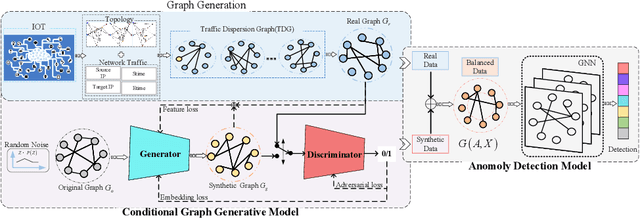
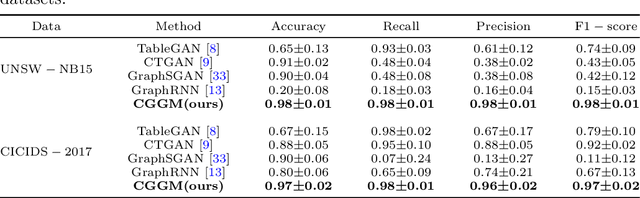
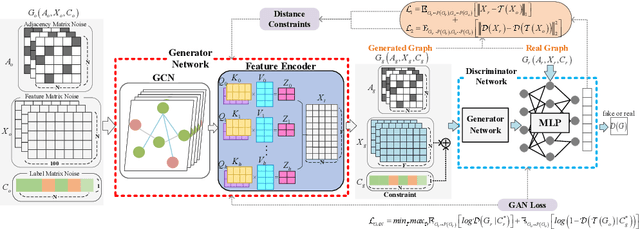
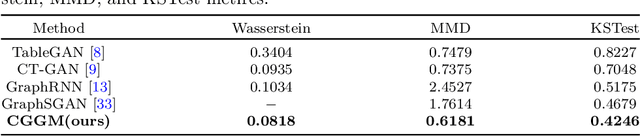
Dynamic graphs are extensively employed for detecting anomalous behavior in nodes within the Internet of Things (IoT). Generative models are often used to address the issue of imbalanced node categories in dynamic graphs. Nevertheless, the constraints it faces include the monotonicity of adjacency relationships, the difficulty in constructing multi-dimensional features for nodes, and the lack of a method for end-to-end generation of multiple categories of nodes. This paper presents a novel graph generation model, called CGGM, designed specifically to generate a larger number of nodes belonging to the minority class. The mechanism for generating an adjacency matrix, through adaptive sparsity, enhances flexibility in its structure. The feature generation module, called multidimensional features generator (MFG) to generate node features along with topological information. Labels are transformed into embedding vectors, serving as conditional constraints to control the generation of synthetic data across multiple categories. Using a multi-stage loss, the distribution of synthetic data is adjusted to closely resemble that of real data. In extensive experiments, we show that CGGM's synthetic data outperforms state-of-the-art methods across various metrics. Our results demonstrate efficient generation of diverse data categories, robustly enhancing multi-category classification model performance.